Begin of page section:
Page sections:

  • Go to contents (Accesskey 1)
  • Go to position marker (Accesskey 2)
  • Go to main navigation (Accesskey 3)
  • Go to sub navigation (Accesskey 4)
  • Go to additional information (Accesskey 5)
  • Go to page settings (user/language) (Accesskey 8)
  • Go to search (Accesskey 9)

End of this page section. Go to overview of page sections

Begin of page section:
Page settings:

English en
Deutsch de
Search
Login

End of this page section. Go to overview of page sections

Begin of page section:
Search:

Search for details about Uni Graz
Close

End of this page section. Go to overview of page sections


Search

Begin of page section:
Main navigation:

Page navigation:

  • University

    University
    • About the University
    • Organisation
    • Faculties
    • Library
    • Working at University of Graz
    • Campus
    Developing solutions for the world of tomorrow - that is our mission. Our students and our researchers take on the great challenges of society and carry the knowledge out.
  • Research Profile

    Research Profile
    • Our Expertise
    • Research Questions
    • Research Portal
    • Promoting Research
    • Research Transfer
    • Ethics in Research
    Scientific excellence and the courage to break new ground. Research at the University of Graz creates the foundations for making the future worth living.
  • Studies

    Studies
    • Prospective Students
    • Students
  • Community

    Community
    • International
    • Location
    • Research and Business
    • Alumni
    The University of Graz is a hub for international research and brings together scientists and business experts. Moreover, it fosters the exchange and cooperation in study and teaching.
  • Spotlight
Topics
  • Our digital Advent calendar
  • Sustainable University
  • Researchers answer
  • Work for us
Close menu

End of this page section. Go to overview of page sections

Begin of page section:
You are here:

University of Graz News Berechnende Kunst

End of this page section. Go to overview of page sections

Wednesday, 23 July 2014

Berechnende Kunst
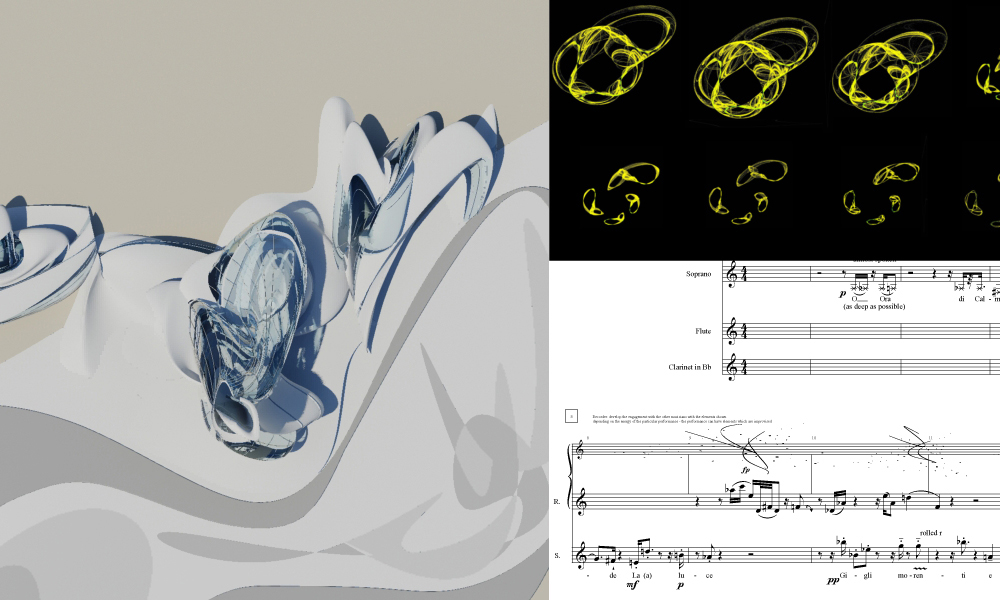
Architektur (l.) und Komposition (r. unten) bedienen sich mathematischer Strukturen (r. oben). Ein Team der Uni Graz arbeitet nun an Systemen, die für die KünstlerInnen besser zu handhaben sind.

Architektur (l.) und Komposition (r. unten) bedienen sich mathematischer Strukturen (r. oben). Ein Team der Uni Graz arbeitet nun an Systemen, die für die KünstlerInnen besser zu handhaben sind.

MathematikerInnen der Uni Graz entwickeln Inspirationsquellen für Musik und Architektur

„Die Kunst bedient sich schon seit Jahrzehnten mathematischer Strukturen, um neue Formen zu finden“, erklärt Univ.-Prof. Dr. Klemens Fellner vom Institut für Mathematik und Wissenschaftliches Rechnen der Karl-Franzens-Universität Graz. Größen wie Zaha Hadid benützen algorithmische Design Software, um ihre spektakulären Gebäude zu entwerfen. Komponisten wie Jannis Xenakis oder György Ligeti bedienten sich der Mathematik, um ihre Klänge zu kreieren. „Manche der verwendeten Modelle sind allerdings so unkontrollierbar komplex, dass sie die Gestaltungsfähigkeit schon wieder einschränken“, schildert Fellner. Im Team mit seiner Kollegin Univ.-Prof. Dr. Karin Baur und Univ.-Prof. Dr. Gerhard Eckel vom Institut für Elektronische Musik und Akustik der Kunstuni Graz werden nun verschiedene Systeme mit hoher künstlerischer Inspirationskraft analysiert, die sich gezielt regulieren lassen. „Wir orientieren uns beispielsweise an Gleichungen, die beschreiben, wie sich Fischschwärme arrangieren“, so Fellner. „Manipuliert man das Verhalten einzelner Individuen, ergibt sich immer noch eine große Bandbreite an verschiedenen Ausdrucksformen, sie wird aber kontrollierbarer“, ergänzt Karin Baur. Trotz eingebauter Kontrollgrößen bleibt also die Palette an kreativen Möglichkeiten breit.

Das innovative Projekt soll nicht nur die Kunst fördern, sondern auch der Mathematik weiterhelfen. „Wir erwarten uns durch den Dialog mit MusikerInnen und ArchitektInnen neue Perspektiven und Erkenntnisse, die auch das Verständnis komplexer mathematischer Strukturen erleichtern“, erhofft sich Baur einen Mehrwert.
Das Vorhaben wird als unkonventionelle Forschung von der Karl-Franzens-Universität Graz für drei Jahre mit rund 180.000 Euro gefördert.

created by Dagmar Eklaude

Related news

Chemical Christmas show at the University of Graz: An explosive evening at the Schauspielh

At the beginning of December, the University of Graz transformed the theater into a laboratory: as part of “Chemical Life,” teacher training students staged a chemical Christmas show for Styrian school classes—complete with ethanol rockets, nitrogen snow, and glowing effects. An evening designed to inspire interest in studying chemistry.

Train by train: Koralm railway accelerates exchange between the Universities

Lectures at the University of Klagenfurt in the morning, seminars at the University of Graz in the afternoon: Austria's longest tunnel and a journey time of around 45 minutes make it easy. The Koralm railway increases the speed of networking between the two university locations. The collaboration builds on existing cooperation - for example in the areas of teacher training, Slavic studies and as employers, the universities are well coordinated.

On the trail of the Big Bang: University of Graz receives 1.5 million euros for doctoral programmes

The Austrian Science Fund FWF has selected the Doctoral Programme in Theoretical Particle Physics at the University of Graz for funding from the Doc.funds. Six young scientists will be funded for 3.5 years. They will gain fundamentally new insights into the origins of the world.

From trans women and knee prostheses: sports science prizes awarded

Walking better with a prosthesis, successfully getting rid of excess weight, training more effectively, more fairness for trans people in sport: these were the topics addressed by the students at the University of Graz who were awarded the sports science prizes for their Master's theses on 3 December 2025.

Begin of page section:
Additional information:

University of Graz
Universitaetsplatz 3
8010 Graz
Austria
  • Contact
  • Web Editors
  • Moodle
  • UNIGRAZonline
  • Imprint
  • Data Protection Declaration
  • Accessibility Declaration
Weatherstation
Uni Graz

End of this page section. Go to overview of page sections

End of this page section. Go to overview of page sections

Begin of page section:

End of this page section. Go to overview of page sections