Begin of page section:
Page sections:

  • Go to contents (Accesskey 1)
  • Go to position marker (Accesskey 2)
  • Go to main navigation (Accesskey 3)
  • Go to sub navigation (Accesskey 4)
  • Go to additional information (Accesskey 5)
  • Go to page settings (user/language) (Accesskey 8)
  • Go to search (Accesskey 9)

End of this page section. Go to overview of page sections

Begin of page section:
Page settings:

English en
Deutsch de
Search
Login

End of this page section. Go to overview of page sections

Begin of page section:
Search:

Search for details about Uni Graz
Close

End of this page section. Go to overview of page sections


Search

Begin of page section:
Main navigation:

Page navigation:

  • University

    University
    • About the University
    • Organisation
    • Faculties
    • Library
    • Working at University of Graz
    • Campus
    Developing solutions for the world of tomorrow - that is our mission. Our students and our researchers take on the great challenges of society and carry the knowledge out.
  • Research Profile

    Research Profile
    • Our Expertise
    • Research Questions
    • Research Portal
    • Promoting Research
    • Research Transfer
    • Ethics in Research
    Scientific excellence and the courage to break new ground. Research at the University of Graz creates the foundations for making the future worth living.
  • Studies

    Studies
    • Prospective Students
    • Students
  • Community

    Community
    • International
    • Location
    • Research and Business
    • Alumni
    The University of Graz is a hub for international research and brings together scientists and business experts. Moreover, it fosters the exchange and cooperation in study and teaching.
  • Spotlight
Topics
  • Our digital Advent calendar
  • Sustainable University
  • Researchers answer
  • Work for us
Close menu

End of this page section. Go to overview of page sections

Begin of page section:
You are here:

University of Graz News Beistand

End of this page section. Go to overview of page sections

Monday, 18 February 2019

Beistand

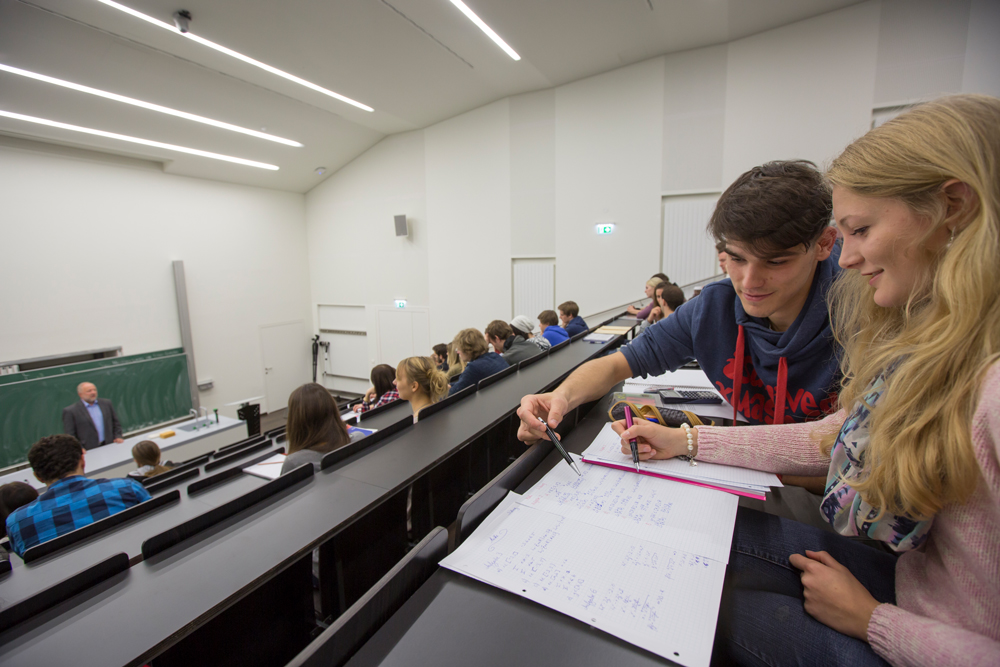
Aktive Unterstützung bei Vorwissenschaftlichen Arbeiten: Studierende geben Tipps an SchülerInnen weiter. Foto: Uni Graz/Lunghammer ©Uni Graz/Lunghammer

Aktive Unterstützung bei Vorwissenschaftlichen Arbeiten: Studierende geben Tipps an SchülerInnen weiter. Foto: Uni Graz/Lunghammer

Vorwissenschaftliche Arbeiten: MentorInnen unterstützen SchülerInnen

Zum fünften Mal öffnete die Universität Graz am 15. Februar 2019 ihre Pforten für Schüler/innen, die im Rahmen der Matura Neu ihre Vorwissenschaftlichen Arbeiten (VWA) verfassen. Sie nehmen an einem speziellen VWA-Mentoring Programm teil, einer Initiative der Geisteswissenschaftlichen Fakultät, bei der Studierende zu MentorInnen ausgebildet werden, die SchülerInnen in einer herausfordernden Zeit zur Seite stehen. 44 Studierende aus vier Fakultäten nehmen in diesem Jahr am Programm teil. Sie sind MentorInnen für 47 SchülerInnen von zehn steirischen Schulen und helfen diesen dabei Schulstress im Abschlussjahr, Matura und VWA unter einen Hut zu bekommen. Um ihren Mentees so gut wie möglich zur Seite stehen zu können, absolvieren die Studierenden im Zuge des Programms Weiterbildungen, die sie auf diese Tätigkeit vorbereiten sollen.

Die diesjährige Auftaktveranstaltung des Programms wurde von Studiendekanin Margit Reitbauer sowie von Birgit Schwarz, Schulqualitätsmanagement (Schulaufsicht in der Bildungsdirektion für Steiermark) eröffnet. Reitbauer betonte dabei die Chancen, die sich hier für Studierende wie Schüler/innen auftun und riet den knapp 50 „Paaren“ des diesjährigen Programms, diese entsprechend zu nutzen. Birgit Schwarz, die das Programm bereits von Beginn an unterstützt, fand lobende Worte für das Engagement aller Beteiligten und hob die Einzigartigkeit dieses Programms in der Steiermark hervor. Im Anschluss an die Eröffnung, die im Rahmen der ÖH MaturantInnen-Beratung stattfand, bot sich MentorInnen und Mentees die Gelegenheit, sich über das kommende gemeinsame Jahr und seine Herausforderungen auszutauschen


created by Ulrike Freitag & Konstantin Tzivanopoulos

Related news

Fair distribution: Researchers determine just greenhouse gas budgets for all EU regions

Ten years ago, on 12 December 2015, the Paris Climate Agreement was signed at the UN Climate Conference. In order to limit global warming to well below two degrees, only a certain amount of CO2 may be emitted worldwide. While the focus was originally on national emission targets, more than 200 subnational regions and almost 300 cities have now adopted their own targets. But how many emissions are they fairly entitled to? Researchers at the University of Graz have now developed transparent criteria for fair distribution at the subnational level for the first time and determined corresponding greenhouse gas budgets for all European regions. The paper was published today in the scientific journal Nature Communications.

Chemical Christmas show at the University of Graz: An explosive evening at the Schauspielh

At the beginning of December, the University of Graz transformed the theater into a laboratory: as part of “Chemical Life,” teacher training students staged a chemical Christmas show for Styrian school classes—complete with ethanol rockets, nitrogen snow, and glowing effects. An evening designed to inspire interest in studying chemistry.

Train by train: Koralm railway accelerates exchange between the Universities

Lectures at the University of Klagenfurt in the morning, seminars at the University of Graz in the afternoon: Austria's longest tunnel and a journey time of around 45 minutes make it easy. The Koralm railway increases the speed of networking between the two university locations. The collaboration builds on existing cooperation - for example in the areas of teacher training, Slavic studies and as employers, the universities are well coordinated.

On the trail of the Big Bang: University of Graz receives 1.5 million euros for doctoral programmes

The Austrian Science Fund FWF has selected the Doctoral Programme in Theoretical Particle Physics at the University of Graz for funding from the Doc.funds. Six young scientists will be funded for 3.5 years. They will gain fundamentally new insights into the origins of the world.

Begin of page section:
Additional information:

University of Graz
Universitaetsplatz 3
8010 Graz
Austria
  • Contact
  • Web Editors
  • Moodle
  • UNIGRAZonline
  • Imprint
  • Data Protection Declaration
  • Accessibility Declaration
Weatherstation
Uni Graz

End of this page section. Go to overview of page sections

End of this page section. Go to overview of page sections

Begin of page section:

End of this page section. Go to overview of page sections