Begin of page section:
Page sections:

  • Go to contents (Accesskey 1)
  • Go to position marker (Accesskey 2)
  • Go to main navigation (Accesskey 3)
  • Go to sub navigation (Accesskey 4)
  • Go to additional information (Accesskey 5)
  • Go to page settings (user/language) (Accesskey 8)
  • Go to search (Accesskey 9)

End of this page section. Go to overview of page sections

Begin of page section:
Page settings:

English en
Deutsch de
Search
Login

End of this page section. Go to overview of page sections

Begin of page section:
Search:

Search for details about Uni Graz
Close

End of this page section. Go to overview of page sections


Search

Begin of page section:
Main navigation:

Page navigation:

  • University

    University
    • About the University
    • Organisation
    • Faculties
    • Library
    • Working at University of Graz
    • Campus
    Developing solutions for the world of tomorrow - that is our mission. Our students and our researchers take on the great challenges of society and carry the knowledge out.
  • Research Profile

    Research Profile
    • Our Expertise
    • Research Questions
    • Research Portal
    • Promoting Research
    • Research Transfer
    • Ethics in Research
    • Commission for Scientific Integrity
    Scientific excellence and the courage to break new ground. Research at the University of Graz creates the foundations for making the future worth living.
  • Studies

    Studies
    • Prospective Students
    • Students
    • Registration for Study Programme (Winter semester 2026/27)
  • Community

    Community
    • International
    • Location
    • Research and Business
    • Alumni
    The University of Graz is a hub for international research and brings together scientists and business experts. Moreover, it fosters the exchange and cooperation in study and teaching.
Topics
  • Sustainable University
  • Researchers answer
  • Work for us
Close menu

End of this page section. Go to overview of page sections

Begin of page section:
You are here:

University of Graz News Barfuß am Ball

End of this page section. Go to overview of page sections

Tuesday, 02 June 2015

Barfuß am Ball

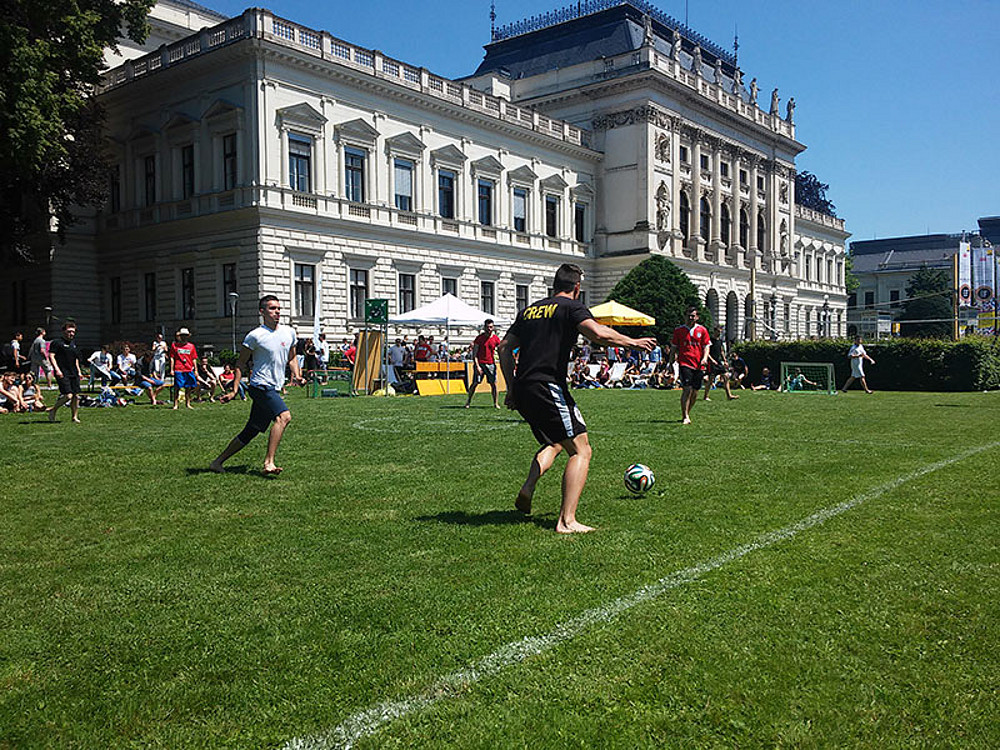
20 Teams aus aller Welt traten beim Barefoot World Cup 2015 gegeneinander an.

20 Teams aus aller Welt traten beim Barefoot World Cup 2015 gegeneinander an.

Nach einem packenden Finale inklusive Elfmeterschießen ging der Wanderpokal zum zweiten Mal in Folge an das Team von Slowenien.

Nach einem packenden Finale inklusive Elfmeterschießen ging der Wanderpokal zum zweiten Mal in Folge an das Team von Slowenien.

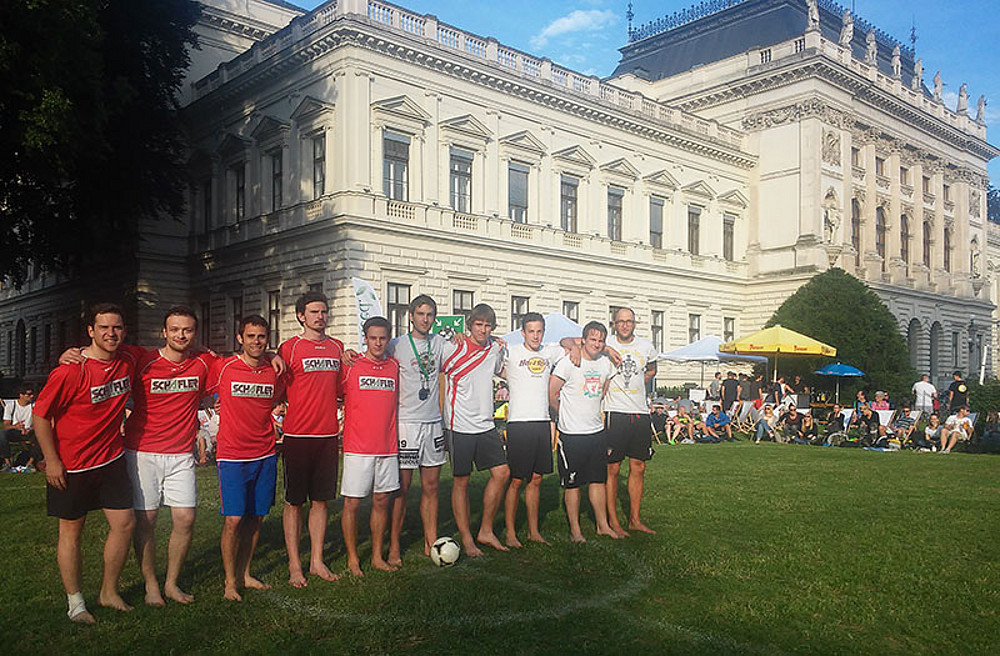
Vor dem Finale: In Rot die Mannschaft des Vatikan, in Weiß das Slowenien-Team. In der Mitte, mit Stoppuhr und Pfeife, der Hauptorganisator des Turniers, Christoph Hofstätter. Alle Fotos: Salentinig/Radeschnig.

Vor dem Finale: In Rot die Mannschaft des Vatikan, in Weiß das Slowenien-Team. In der Mitte, mit Stoppuhr und Pfeife, der Hauptorganisator des Turniers, Christoph Hofstätter. Alle Fotos: Salentinig/Radeschnig.

Slowenien siegte beim Barefoot World Cup 2015 im Finale gegen den Vatikan

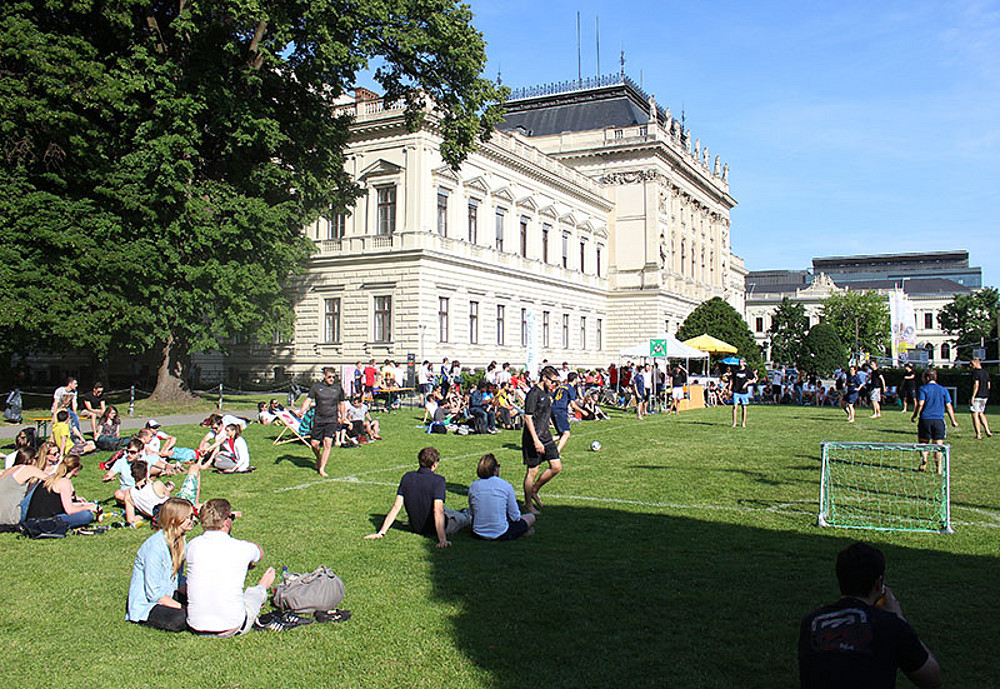
Besseres Wetter  hätten sich die Veranstalter des diesjährigen Barefoot World Cup am vergangenen Freitag, 29. Mai 2015, für ihr Turnier gar nicht wünschen können: 24 Grad und strahlender Sonnenschein boten perfekte Bedingungen für die sechste Auflage der jährlich stattfindenden Weltmeisterschaft im Barfuß-Fußball am Campus der Karl-Franzens-Universität Graz.


Die Organisatoren Christoph Hofstätter, Thomas Leitner, Matthias Petritsch, Thomas Salentinig, Matthias Pendl, Gernot Papst und Matthias Scharfe hatten, wie schon in den vergangenen Jahren, auch heuer wieder viel Zeit und Energie in die Vorbereitungsarbeiten des Turniers investiert. „Es ist  mittlerweile für viele Studierende und MitarbeiterInnen der Universität Graz einen Fixtermin eines jeden Sommersemesters“, weiß das Veranstalter-Team.


Spektakulär lesen sich die nackten Zahlen des Turniers: 20 Teams aus aller Welt, rund 120 TeilnehmerInnen, 40 Vorrundenspiele, 8 K.O.-Spiele, 6 Entscheidungen nach Elfmeterschießen – es dauerte bis 19:04 Uhr, ehe nach einem packenden Finale inklusive Elfmeterschießen der Wanderpokal zum zweiten Mal in Folge an das Team von Slowenien ging, das sich knapp gegen den Vatikan durchsetzte. Den dritten Platz sicherte sich, ebenfalls im Elfmeterschießen, das Team von Samoa gegen Italien.


Souverän moderiert wurde das Turnier heuer von Univ.-Prof. DDr. Bernd Wieser, der für den kurzfristig erkrankten Ass.-Prof. Dr. Armin Stolz einsprang. Den Ehrenankick führte heuer REWI-Dekan Joseph Marko durch. Für das leibliche Wohl sorgte erneut das Team der „Feierlaune“, in dessen Lokal im Anschluss an das Turnier auch die Aftershowparty samt Siegerehrung über die Bühne ging. „Großer Dank gilt allen FörderInnen dieser Veranstaltung, allen voran dem Vizerektorat für Studium und Lehre, dem Feierlaune-Team sowie allen TeilnehmerInnen und ZuschauerInnen“, blicken Christoph Hofstätter und sein Team stolz auf den Barefoot World Cup 2015 zurück. Eine Neuauflage im Mai 2016 ist bereits fix.  

created by Thomas Salentinig & Gerhild Kastrun

Related news

Sport beyond the World Cup: the TV channel “Welt der Wunder” features diabetes research from the University of Graz

Keeping blood sugar levels in check during physical exertion is a particular challenge for people with type 1 diabetes. Othmar Moser examines how those affected manage to balance physical activity, sport and their metabolic disorder.

"Mathematics explains the world"

How can life be quantified? And what can science reveal that remains hidden from the naked eye? The 14th European Conference on Mathematical and Theoretical Biology at the University of Graz is dedicated to these questions. From 13 to 17 July, around 1,300 researchers from all over the world will gather on campus to discuss models, biological processes and the future of data-driven medicine. Klemens Fellner, Dean of the Faculty of Natural Sciences and Mathematics and a mathematician, talks about the language that explains the world

Internationally up-to-date: University of Graz offers new degree programmes in art studies

From the Old Masters to AI art – three newly designed degree programmes offer students at the University of Graz fresh perspectives on artistic production. In addition to historical art, the programmes place a greater emphasis on contemporary and global developments. The registration period is open.

The Nazi elite school Napola: Historian seeks memories and personal documents

They were to be brought up to become the future elite of National Socialism: boys and girls aged ten and over who, following the ‘Anschluss’ of Austria to the German Reich, attended a so-called Napola (short for Nationalpolitische Lehranstalt; also known as NPEA, Nationalpolitische Erziehungsanstalt). There were nine such institutions in what is now Austria between 1939 and 1945.

Begin of page section:
Additional information:

University of Graz
Universitaetsplatz 3
8010 Graz
Austria
  • Contact
  • Web Editors
  • Moodle
  • UNIGRAZonline
  • Imprint
  • Data Protection Declaration
  • Accessibility Declaration
Weatherstation
Uni Graz

End of this page section. Go to overview of page sections

End of this page section. Go to overview of page sections

Begin of page section:

End of this page section. Go to overview of page sections