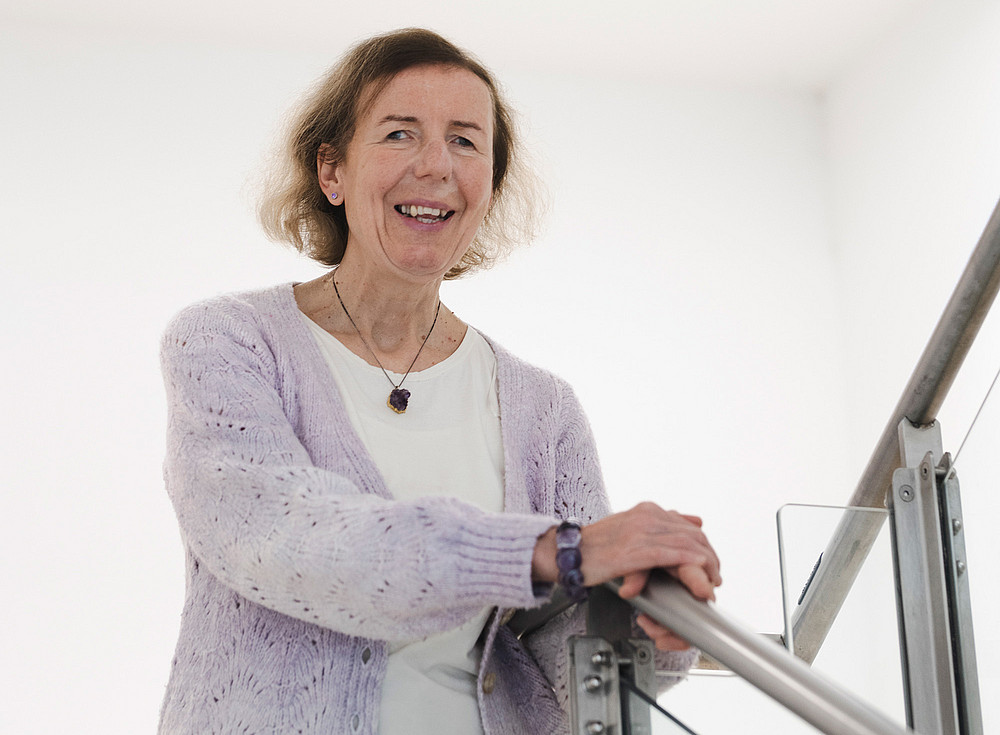
The course catalogue is a thick, printed book. Barbara Levc, a blind student of educational sciences at the University of Graz, asks a friend to help her compile her courses for the first semester. That was in 1989, and today she can do it conveniently online. Just as many other things have become much easier for students with disabilities. Levc has made a decisive contribution to this.
In 1994, the Ministry of Science under Erhard Busek created one full-time position for a disability officer at each of the universities of Vienna, Graz, Innsbruck, Salzburg and Klagenfurt. The Austrian National Union of Students (ÖH), which had been well connected throughout Austria since the late 1980s through its disability departments, and a few other committed individuals had done some convincing beforehand. One of them was Barbara Levc. When she became the first disability officer at the University of Graz, she faced a mammoth task. Until then, there had been no support for students with disabilities from the university – except for one person in the university library who scanned books and made them digitally accessible.
Lone warriors
Those who dared to study with a disability into the 1990s had to more or less fight their way through alone. Barbara Levc was one of these pioneers, of whom there were not many. "At that time, the Department of Educational Science was still located in Hans-Sachs-Gasse in the town centre. I marched into the secretariat with my guide dog and got information on where to find which rooms," she says. In the lectures, she sat with a "technically antediluvian device," as she describes it today, which she could use to take notes. Sometimes she also had a recording device with her. Barbara Levc made study literature accessible to herself by sending the books to the association of blind students in Germany, where they were read on cassettes. “It took some time before I received and listened to them, so I always had to arrange a relatively late date for presentations or exams.”
Statistics was a particular challenge: "A good friend went to the lectures with me, took notes and explained the graphics to me afterwards," says Levc. Unlike most courses, she was unable to take an oral exam in this subject. "I sat in Professor Rossmann's office with an ordinary portable typewriter and a Braille typewriter. He read the questions to me. I wrote them down in Braille, did the calculations and then typed up the results on the portable typewriter. As all this took its time, Prof. Rossmann went for a walk with my dog," explains Levc.
Disability Resource Centre
Today, the Disability Resource Centre (ZIS) provides a note-taking assistant if needed. This is particularly useful for people who are hard of hearing or have limited hand mobility. There is now comprehensive support for exams. "If, for example, students with a disability need more time for exams, they can take them with us. We provide the supervision," reports Levc. This also applies to people with diagnosed neurodivergence, such as ADHD or dyslexia. They often have difficulty concentrating and therefore need a distraction-free environment. This also applies to people who cannot write for themselves. They dictate their answers to ZIS employees, who then transcribe them. Sometimes questions and assignments also have to be adapted to be barrier-free. The ZIS conducts around 300 exams a year. This also supports the teaching staff.
Removing barriers
"I've never seen a wheelchair user at our university," Levc recalls, amused by the argument of an opponent of her first efforts as disability officer to make the campus barrier-free. “No wonder, when you could hardly get anywhere in a wheelchair. Some of the old buildings were totally inaccessible for physically disabled people. There was a lift in the main building, but even that didn't reach all areas.”
It may be hard to believe, but there was a lot of resistance to the plans for barrier-free redesign at the beginning. "One of the first measures was to pave a strip in front of the main building so that wheelchair users could get to the main entrance without running into the cobblestones," reports Levc. However, they still had to be carried up the steps.
Then, in 1996, a revolution took place: the Bundesimmobiliengesellschaft, the owner of the university buildings, launched a barrier-free initiative together with the University of Graz. "An architect was commissioned to explore which structural measures could be implemented and where," recalls Levc. Among other things, a ramp was then built in front of the lecture hall wing in the former “Vorklinik” and a lift was added in the courtyard of the building at Universitätsplatz 6. When the RESOWI Centre was being planned, accessibility was already taken into consideration. "In the Wall Building, adventurous stair lifts were installed for the mezzanine floors," says the former disability officer. With the Federal Disability Equality Act of 2006, it then became mandatory to ensure accessibility in all new and converted buildings. "That was a quantum leap. From then on, I no longer had to discuss this matter," says Levc happily. However, it does not seem to be as self-evident for everyone, as the solution in front of the main entrance of the new university library building, which opened in 2019, shows.
Once all entrances had been made barrier-free, further challenges had to be tackled. For example, students in wheelchairs who do not have a place in the permanently mounted or set-up rows in the lecture theatres should also be able to find a table at the very front or back for writing. For blind and visually impaired people, floor guidance systems followed. "Current projects include making the steps in the lecture theatres clearly visible using markings and installing a handrail on the wall," reports Levc.
Another major task is digital accessibility. To ensure that it can be implemented well, it is important that those affected are involved in the creation of websites, emphasises the head of ZIS. At the University of Graz, this is her colleague of many years, Jakob Putz. He was involved in the university's most recent web relaunch.
Growing with the tasks
Barbara Levc's first office as disability officer was in the basement of the university's main building. In 2007, Jakob Putz became her first colleague. Today, the ZIS team consists of eight people and is located on the first floor of the university library building. The range of tasks has also grown. "When I started my job here, there were two blind students at the university; now there are about 15. In total, we support around 100 people. This ranges from one-time counselling sessions to comprehensive support throughout their studies," explains Levc. The spectrum of impairments has also shifted. "In the first twenty years, students with mobility impairments, visual impairments and blindness made up the largest groups. Now it is those with neurodivergence and mental illnesses." For two years, the ZIS has also been offering counselling specifically for mental health issues.
The "main business", as Barbara Levc says, is conducting exams and adapting literature. Teaching and learning materials are scanned and digital files are adapted so that they can be enlarged on the computer for better readability, converted into braille using an additional device, or read aloud.
The ZIS also employs additional student assistants, for example to take notes or proofread scanned study materials. And finally, the AI has another important job. "It helps us describe photos and graphics. This is a big task given the increasing importance of images and in the context of digital accessibility," says Barbara Levc.