Begin of page section:
Page sections:

  • Go to contents (Accesskey 1)
  • Go to position marker (Accesskey 2)
  • Go to main navigation (Accesskey 3)
  • Go to sub navigation (Accesskey 4)
  • Go to additional information (Accesskey 5)
  • Go to page settings (user/language) (Accesskey 8)
  • Go to search (Accesskey 9)

End of this page section. Go to overview of page sections

Begin of page section:
Page settings:

English en
Deutsch de
Search
Login

End of this page section. Go to overview of page sections

Begin of page section:
Search:

Search for details about Uni Graz
Close

End of this page section. Go to overview of page sections


Search

Begin of page section:
Main navigation:

Page navigation:

  • University

    University
    • About the University
    • Organisation
    • Faculties
    • Library
    • Working at University of Graz
    • Campus
    Developing solutions for the world of tomorrow - that is our mission. Our students and our researchers take on the great challenges of society and carry the knowledge out.
  • Research Profile

    Research Profile
    • Our Expertise
    • Research Questions
    • Research Portal
    • Promoting Research
    • Research Transfer
    • Ethics in Research
    Scientific excellence and the courage to break new ground. Research at the University of Graz creates the foundations for making the future worth living.
  • Studies

    Studies
    • Prospective Students
    • Students
  • Community

    Community
    • International
    • Location
    • Research and Business
    • Alumni
    The University of Graz is a hub for international research and brings together scientists and business experts. Moreover, it fosters the exchange and cooperation in study and teaching.
  • Spotlight
Topics
  • Our digital Advent calendar
  • Sustainable University
  • Researchers answer
  • Work for us
Close menu

End of this page section. Go to overview of page sections

Begin of page section:
You are here:

University of Graz News Trees, soil crusts and soy: what influences the Earth's nitrogen balance

End of this page section. Go to overview of page sections

Tuesday, 01 July 2025

Trees, soil crusts and soy: what influences the Earth's nitrogen balance

Soya cultivation

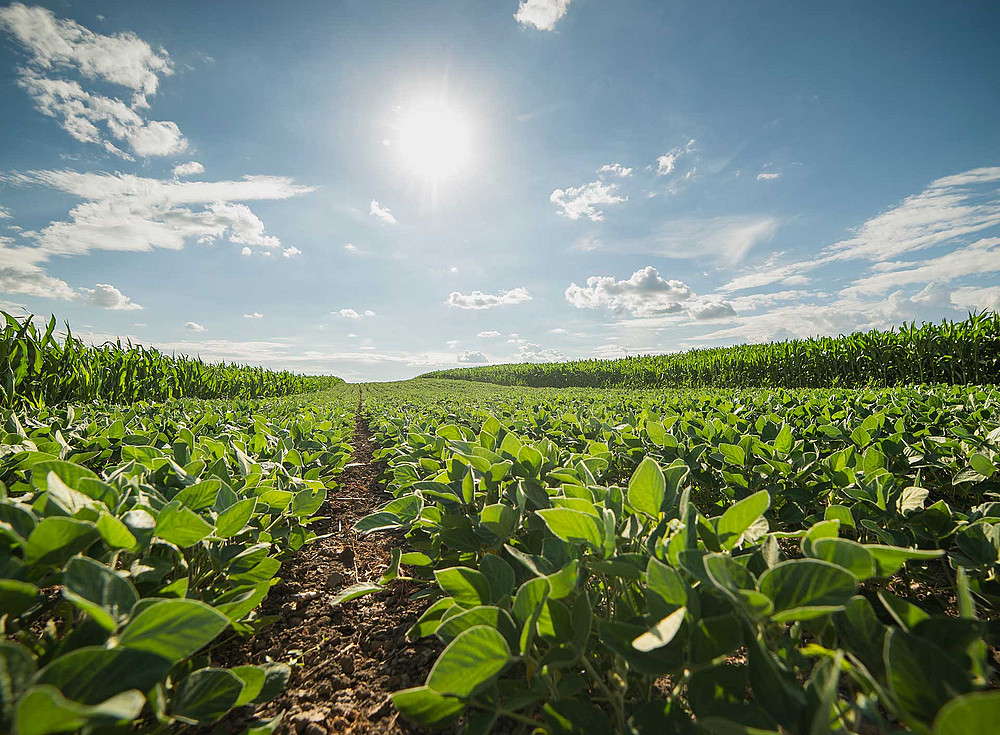
Soya cultivation is now responsible for 60 per cent of nitrogen fixation in the agricultural sector. Photo: Vesna - stock.adobe.com

You can't smell it, you can't see it, but it ensures our survival: nitrogen makes up 78 per cent of the Earth's atmosphere. Bettina Weber, a biologist at the University of Graz, emphasises its importance: “Nitrogen serves as an essential nutrient and is needed for the formation of biomass and the regulation of all living organisms.” In order to be used, the element must be fixed with the help of microorganisms. This biological binding occurs in natural habitats, but also on agricultural land. While the proportion of natural areas is declining, fixation caused by agriculture has increased by 75 percent over the past 20 years. A key cause is the cultivation of soy, according to an international study which was published in the renowned journal Nature.

An international team of researchers has now gained a comprehensive picture of global biological nitrogen fixation. Carla Reis Ely from Oregon State University (USA) led the study, which involved a total of 24 scientists: “Our new estimate of natural nitrogen fixation, based on improved scientific understanding, suggests that less new nitrogen enters natural ecosystems.” As a result, these ecosystems may store less carbon dioxide and mitigate climate change to a lesser extent.
“The amount of data has quadrupled over the past 25 years. In addition, significantly more habitats were taken into account and realistic average values were calculated, enabling us to describe global processes much more accurately,” explains Bettina Weber, co-author of the paper. “These data provide an essential basis for global calculations and modelling of Earth system processes. They are needed to understand how global biogeochemical cycles function and to take effective countermeasures in the event of undesirable developments.”

Importance of soil crusts

Worldwide, more than half (56 percent) of the nitrogen fixation by microorganisms takes place in natural landscapes, such as forests and soils without human use. However, this figure is up to two-thirds lower than was assumed 25 years ago. In this context, soils contribute 26 per cent, trees 19 per cent, herbs 17 per cent and shrubs nine per cent. Biological soil crusts have a previously unrecognised importance. They account for 18 per cent of the nitrogen fixation in natural environments. Biologist Bettina Weber: “This community of bacteria, fungi, mosses, lichens and algae, which occurs everywhere in arid areas, acts as a kind of local fertiliser, ensuring that other plants can settle and thus preventing desertification.” 

Balance of the Earth's atmosphere

In addition to natural areas, nitrogen fixation also plays a role in fields and pastures, where special plants, known as legumes, have fixing bacteria in nodules on their roots. Scientists attribute the 75 percent increase over the past two decades to intensification and the near doubling of the area under soybean cultivation. Soybeans are now responsible for 60 percent of nitrogen fixation in the agricultural sector, while 33 percent is accounted for by meadows and pastures, mainly clover, and seven percent by other agricultural products.
“If too much nitrogen is added to the soil, conversion processes can release more gaseous compounds into the atmosphere,” warns Bettina Weber, referring to the emission of degradation products such as nitrogen oxides and nitrous oxide. These may interfere with the balance of the Earth's atmosphere and alter or disrupt climate processes.

created by Andreas Schweiger

Related news

Chemical Christmas show at the University of Graz: An explosive evening at the Schauspielh

At the beginning of December, the University of Graz transformed the theater into a laboratory: as part of “Chemical Life,” teacher training students staged a chemical Christmas show for Styrian school classes—complete with ethanol rockets, nitrogen snow, and glowing effects. An evening designed to inspire interest in studying chemistry.

Train by train: Koralm railway accelerates exchange between the Universities

Lectures at the University of Klagenfurt in the morning, seminars at the University of Graz in the afternoon: Austria's longest tunnel and a journey time of around 45 minutes make it easy. The Koralm railway increases the speed of networking between the two university locations. The collaboration builds on existing cooperation - for example in the areas of teacher training, Slavic studies and as employers, the universities are well coordinated.

On the trail of the Big Bang: University of Graz receives 1.5 million euros for doctoral programmes

The Austrian Science Fund FWF has selected the Doctoral Programme in Theoretical Particle Physics at the University of Graz for funding from the Doc.funds. Six young scientists will be funded for 3.5 years. They will gain fundamentally new insights into the origins of the world.

From trans women and knee prostheses: sports science prizes awarded

Walking better with a prosthesis, successfully getting rid of excess weight, training more effectively, more fairness for trans people in sport: these were the topics addressed by the students at the University of Graz who were awarded the sports science prizes for their Master's theses on 3 December 2025.

Begin of page section:
Additional information:

University of Graz
Universitaetsplatz 3
8010 Graz
Austria
  • Contact
  • Web Editors
  • Moodle
  • UNIGRAZonline
  • Imprint
  • Data Protection Declaration
  • Accessibility Declaration
Weatherstation
Uni Graz

End of this page section. Go to overview of page sections

End of this page section. Go to overview of page sections

Begin of page section:

End of this page section. Go to overview of page sections