Begin of page section:
Page sections:

  • Go to contents (Accesskey 1)
  • Go to position marker (Accesskey 2)
  • Go to main navigation (Accesskey 3)
  • Go to sub navigation (Accesskey 4)
  • Go to additional information (Accesskey 5)
  • Go to page settings (user/language) (Accesskey 8)
  • Go to search (Accesskey 9)

End of this page section. Go to overview of page sections

Begin of page section:
Page settings:

English en
Deutsch de
Search
Login

End of this page section. Go to overview of page sections

Begin of page section:
Search:

Search for details about Uni Graz
Close

End of this page section. Go to overview of page sections


Search

Begin of page section:
Main navigation:

Page navigation:

  • University

    University
    • About the University
    • Organisation
    • Faculties
    • Library
    • Working at University of Graz
    • Campus
    Developing solutions for the world of tomorrow - that is our mission. Our students and our researchers take on the great challenges of society and carry the knowledge out.
  • Research Profile

    Research Profile
    • Our Expertise
    • Research Questions
    • Research Portal
    • Promoting Research
    • Research Transfer
    • Ethics in Research
    Scientific excellence and the courage to break new ground. Research at the University of Graz creates the foundations for making the future worth living.
  • Studies

    Studies
    • Prospective Students
    • Students
  • Community

    Community
    • International
    • Location
    • Research and Business
    • Alumni
    The University of Graz is a hub for international research and brings together scientists and business experts. Moreover, it fosters the exchange and cooperation in study and teaching.
  • Spotlight
Topics
  • Our digital Advent calendar
  • Sustainable University
  • Researchers answer
  • Work for us
Close menu

End of this page section. Go to overview of page sections

Begin of page section:
You are here:

University of Graz News Semester abroad without barriers: University of Graz wins award for promoting inclusion

End of this page section. Go to overview of page sections

Friday, 12 December 2025

Semester abroad without barriers: University of Graz wins award for promoting inclusion

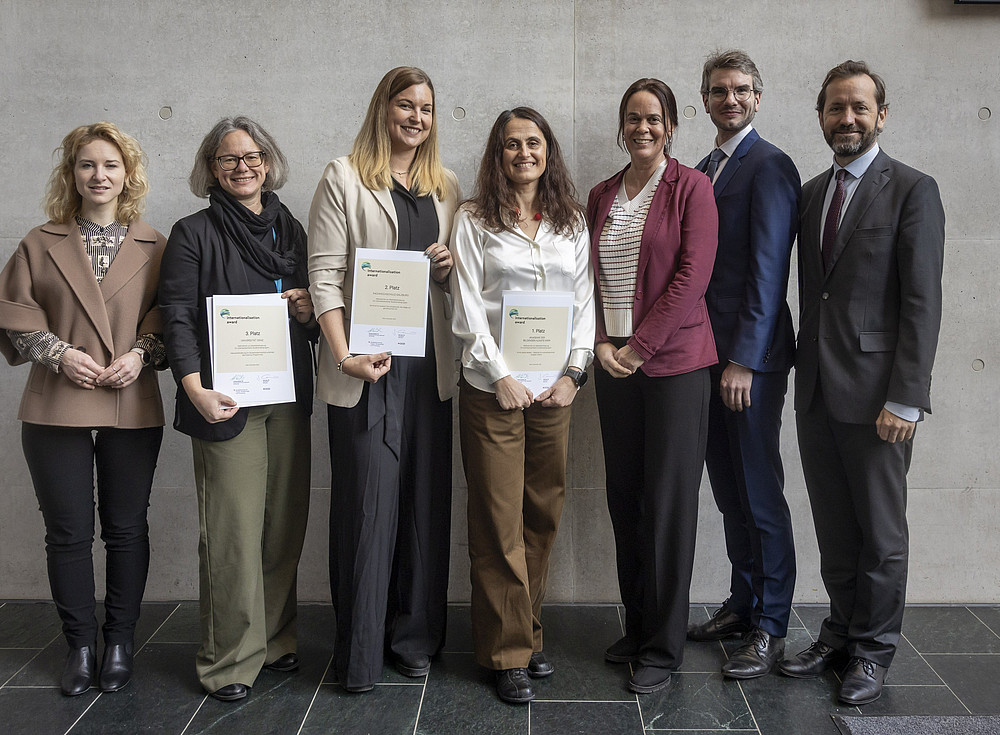
A group of seven people are standing side by side in front of a gray wall. Three people in the middle are holding certificates in their hands. The people are mostly dressed formally, in blazers, shirts, and suit pants. The floor is covered with dark tiles. ©OeAD/APA-Fotoservice/Hetfleisch

Minister of Science and Research Eva-Maria Holzleitner (first from left) and OeAD Managing Director Jakob Calice (first from right) with the award winners and runners-up in the category “Measures to promote mobility for underrepresented student groups.”

The University of Graz has been awarded the Internationalization Award for its new inclusion initiative. Students with fewer opportunities now also receive financial support for their semester abroad outside Europe.

For many students, a semester abroad is one of the highlights of their studies. To make this dream come true, there is the Erasmus+ program, which has been supporting applicants for decades in transferring to a European university. Such a leap into the unknown requires a good dose of courage from everyone. All the more so when there are additional personal limitations. The Erasmus+ program also offers funding opportunities for this.

However, these special mobility programs are limited to the European higher education area. At least until now. The University of Graz has now launched its own inclusion funding program for student mobility outside the Erasmus program, which is specifically aimed at people with fewer opportunities. For this, it was awarded the “Internationalization Award” by the Federal Ministry of Women, Science and Research (BMFWF) and the OeAD, Austria's Agency for Education and Internationalization. Among twelve award-winning projects, the University of Graz came in third place in the category “Measures to promote mobility for underrepresented student groups.”

“We were repeatedly asked why comparable support to that offered by the Erasmus+ program did not also exist for other stays abroad,” explains Petra Rabitsch, who initiated the project together with Karin Schwach, Sarah Zapusek from the Coordination Office for Gender Studies and Equality, and Barbara Levc from the Center for Integrated Studies. “That got us thinking. After all, our goal is to make it as easy as possible for students to go abroad, and that means all students. So, with support from other departments, we began to develop an application process that is as barrier-free as possible.”

New opportunities

At the award ceremony, Minister of Science Eva-Maria Holzleitner emphasized the importance of international mobility: “It creates opportunities and opens doors, broadens horizons, and strengthens social cohesion in a global world. Everyone should have the opportunity to learn, research, and develop new perspectives across borders, regardless of gender, origin, or financial means,” emphasized Science Minister Eva-Maria Holzleitner at the award ceremony. OeAD Managing Director Calice also highlighted this diversity: “The Internationalization Award brings outstanding examples to the fore, which should inspire other universities to continue investing in their international orientation.”

For Vice Rector for Internationalization & Equality, Mireille van Poppel, the award is an important confirmation on the path to greater equality. “International mobility should not be a privilege. At the University of Graz, we want to make this experience possible for all students, regardless of their personal, social, or financial circumstances.”

In the first application phase for students, there were already two applications that were approved. And since there is currently no upper limit, students can apply for funding flexibly at any time.

All information about opportunities for a semester abroad, internships abroad, summer schools, and short-term programs can be found at the Office for International Relations.

created by Roman Vilgut

Related news

Fair distribution: Researchers determine just greenhouse gas budgets for all EU regions

Ten years ago, on 12 December 2015, the Paris Climate Agreement was signed at the UN Climate Conference. In order to limit global warming to well below two degrees, only a certain amount of CO2 may be emitted worldwide. While the focus was originally on national emission targets, more than 200 subnational regions and almost 300 cities have now adopted their own targets. But how many emissions are they fairly entitled to? Researchers at the University of Graz have now developed transparent criteria for fair distribution at the subnational level for the first time and determined corresponding greenhouse gas budgets for all European regions. The paper was published today in the scientific journal Nature Communications.

Chemical Christmas show at the University of Graz: An explosive evening at the Schauspielh

At the beginning of December, the University of Graz transformed the theater into a laboratory: as part of “Chemical Life,” teacher training students staged a chemical Christmas show for Styrian school classes—complete with ethanol rockets, nitrogen snow, and glowing effects. An evening designed to inspire interest in studying chemistry.

Train by train: Koralm railway accelerates exchange between the Universities

Lectures at the University of Klagenfurt in the morning, seminars at the University of Graz in the afternoon: Austria's longest tunnel and a journey time of around 45 minutes make it easy. The Koralm railway increases the speed of networking between the two university locations. The collaboration builds on existing cooperation - for example in the areas of teacher training, Slavic studies and as employers, the universities are well coordinated.

On the trail of the Big Bang: University of Graz receives 1.5 million euros for doctoral programmes

The Austrian Science Fund FWF has selected the Doctoral Programme in Theoretical Particle Physics at the University of Graz for funding from the Doc.funds. Six young scientists will be funded for 3.5 years. They will gain fundamentally new insights into the origins of the world.

Begin of page section:
Additional information:

University of Graz
Universitaetsplatz 3
8010 Graz
Austria
  • Contact
  • Web Editors
  • Moodle
  • UNIGRAZonline
  • Imprint
  • Data Protection Declaration
  • Accessibility Declaration
Weatherstation
Uni Graz

End of this page section. Go to overview of page sections

End of this page section. Go to overview of page sections

Begin of page section:

End of this page section. Go to overview of page sections