



Begin of page section:
Page sections:

  • Go to contents (Accesskey 1)
  • Go to position marker (Accesskey 2)
  • Go to main navigation (Accesskey 3)
  • Go to sub navigation (Accesskey 4)
  • Go to additional information (Accesskey 5)
  • Go to page settings (user/language) (Accesskey 8)
  • Go to search (Accesskey 9)

End of this page section. Go to overview of page sections

Begin of page section:
Page settings:

English en
Deutsch de
Search
Login

End of this page section. Go to overview of page sections

Begin of page section:
Search:

Search for details about Uni Graz
Close

End of this page section. Go to overview of page sections


Search

Begin of page section:
Main navigation:

Page navigation:

  • University

    University
    • About the University
    • Organisation
    • Faculties
    • Library
    • Working at University of Graz
    • Campus
    Developing solutions for the world of tomorrow - that is our mission. Our students and our researchers take on the great challenges of society and carry the knowledge out.
  • Research Profile

    Research Profile
    • Our Expertise
    • Research Questions
    • Research Portal
    • Promoting Research
    • Research Transfer
    • Ethics in Research
    • Commission for Scientific Integrity
    Scientific excellence and the courage to break new ground. Research at the University of Graz creates the foundations for making the future worth living.
  • Studies

    Studies
    • Prospective Students
    • Students
    • Welcome Weeks for First Year Students
  • Community

    Community
    • International
    • Location
    • Research and Business
    • Alumni
    The University of Graz is a hub for international research and brings together scientists and business experts. Moreover, it fosters the exchange and cooperation in study and teaching.
Topics
  • Sustainable University
  • Researchers answer
  • Work for us
Close menu

End of this page section. Go to overview of page sections

Begin of page section:
You are here:

University of Graz News Ausgezeichnete Pionierleistung

End of this page section. Go to overview of page sections

Friday, 13 January 2017

Ausgezeichnete Pionierleistung

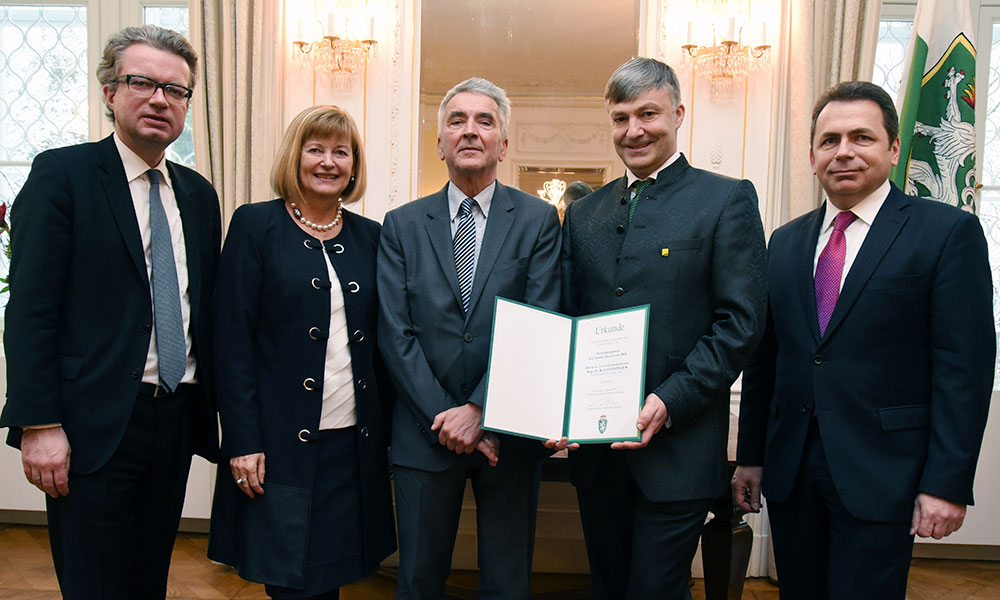
Landesrat Christopher Drexler, Rektorin Christa Neuper, Laudator Stefan Schleicher, Preisträger Karl Steininger, Dekan Thomas Foscht (v.l.). Foto: Uni Graz/Pichler

Landesrat Christopher Drexler, Rektorin Christa Neuper, Laudator Stefan Schleicher, Preisträger Karl Steininger, Dekan Thomas Foscht (v.l.). Foto: Uni Graz/Pichler

Uni-Graz-Ökonom Karl Steininger erhält Forschungspreis des Landes Steiermark für Studie zu Folgekosten des Klimawandels

Sie hat einen neuen Standard in der wirtschaftlichen Beurteilung des Klimawandels gesetzt: Die Studie aus dem Projekt „COIN“ zeigt nicht nur erstmals die Folgekosten des Klimawandels für Österreich bis 2050 auf, sie ist darüber hinaus in der Berücksichtigung relevanter Faktoren umfassender als alle anderen ähnlichen Untersuchungen weltweit. Der Leiter der Untersuchung, Ökonom Ao.Univ.-Prof. Dr. Karl Steininger vom Institut für Volkswirtschaftslehre und dem Wegener Center für Klima und Globalen Wandel der Karl-Franzens-Universität Graz, wurde für diese herausragende Arbeit mit dem Forschungspreis des Landes Steiermark 2016 ausgezeichnet. Landesrat Christopher Drexler überreichte den Preis am 13. Jänner 2017 im Weißen Saal der Grazer Burg.
„Die Auszeichnung dieser Arbeit unterstreicht die Bedeutung und herausragende Qualität der Forschungen von Karl Steininger und seinem Team im Bereich der Klimaökonomik. Diese bildet eine wesentliche Säule im Forschungsschwerpunkt Umwelt und Globaler Wandel, mit dem die Universität Graz der hohen gesellschaftlichen Relevanz dieses Themas Rechnung trägt“, betont Rektorin Christa Neuper.
Vergeben wurden neben dem Forschungspreis auch der Erzherzog-Johann-Forschungspreis an den Hobby-Vogelforscher Dr. Ernst Albegger sowie der Förderungspreis für Wissenschaft und Forschung an Dr. Julia Langer von der TU Graz und Dr. Nina Schalk von der Montanuniversität Leoben.

Der Klimawandel macht sich in Österreich von Jahr zu Jahr deutlicher bemerkbar. Im Winter bekommen das im Besonderen die traditionellen Skigebiete zu spüren. Die Veränderungen schlagen aber grundsätzlich in allen Sektoren der Wirtschaft zu Buche. Im Rahmen einer Studie unter der Leitung von Karl Steininger wurden erstmals die Folgekosten des Klimawandels in Österreich bis 2050 umfassend berechnet. „Die Kosten aus wetter- und klimabedingten Ereignissen werden in den kommenden Jahrzehnten auf vier bis fünf Milliarden Euro jährlich steigen“, warnt der Ökonom, „wobei dieser Betrag nur bereits verlässlich absehbare Schäden berücksichtigt und zudem einen Mittelwert darstellt. Extremereignisse belasten uns in einzelnen Jahren noch weit höher“, so Steininger.

Gefördert wurde das Projekt COIN (Cost of Inaction: Assessing the costs of climate change for Austria), an dem 42 WissenschafterInnen von 18 Forschungsgruppen aus ganz Europa beteiligt waren, mit 378.000 Euro aus dem Klima- und Energiefonds. Die Studie ist unter dem Titel „Economic Evaluation of Climate Change Impacts“ 2015 im Springer Verlag erschienen, ein zusammenfassender Artikel wurde im Journal „Climate Services“ veröffentlicht.

In Bezug auf die Breite der Klimawandelfolgekosten übertrifft die Studie alle bisherigen Untersuchungen dieser Art, einschließlich des US National Climate Assessment sowie des EU PESETA Project, und kann zukünftig als Vorbild dienen. Sie beschreibt aktuelle klimatisch und wetterbedingte Schäden und identifiziert zusätzliche Auswirkungen, die durch die globale Erwärmung in Zukunft zu erwarten sind. Dabei berücksichtigt sie aber nicht nur – wie andere Studien – steigende Temperaturen und veränderte Niederschläge, sondern auch das wachsende Risiko extremer Wetterereignisse. Doch gerade diese lassen große Schäden erwarten und werden wohl für den Löwenanteil der Kostenerhöhung verantwortlich sein.

>> mehr Informationen

Ein Interview mit Karl Steininger hören Sie im Webradio der Grazer Universitäten.

created by Gudrun Pichler

Related news

Jurassic Sounds: Biologist reconstructs insect songs from 165 million years ago

It was apparently not just the roars of the dinosaurs that made up the soundscape of the animal world during the Jurassic period. Crickets and grasshoppers communicated through a variety of songs and high-pitched sounds, as Thorin Jonsson from the Institute of Biology at the University of Graz discovered together with colleagues from the universities of Lincoln, Bristol (UK), Beijing (China) and Tempe (USA). The findings on what are so far the oldest traces of sound on Earth have just been published in the journal PNAS.

EU funding boosts international exchange between universities

The University of Graz is further expanding its international study opportunities through the European university alliance Arqus and is taking the lead in two key projects. In future, students will benefit from even more joint degree programmes and from simplified recognition of academic achievements through the Joint European Degree Label.

Rescue and risks: Researchers have surveyed public perceptions of AI

The use of artificial intelligence has had to be made transparent since 2 August 2026. The EU’s AI Act, which has been in force since then, also sets out how risky an application is and which security measures apply as a result. However, the assessment of risks by the legislation differs in some cases significantly from the perceptions of the Austrian public. This is the finding of a representative study carried out by data scientist Stefan Thalmann from the University of Graz and his team.

The Healing Sea: Researchers discover new approaches to treating chronic inflammation in sponges

Chronic inflammation plays a key role in many diseases, ranging from metabolic disorders and cardiovascular diseases to tissue damage following injuries or infections. “Normally, the body is able to resolve inflammation on its own. If this process becomes unbalanced, immune cells remain permanently active and continue to drive negative changes in the tissue,” explains Andreas Koeberle, a pharmacist at the University of Graz.

Begin of page section:
Additional information:

University of Graz
Universitaetsplatz 3
8010 Graz
Austria
  • Contact
  • Web Editors
  • Moodle
  • UNIGRAZonline
  • Imprint
  • Data Protection Declaration
  • Accessibility Declaration
Weatherstation
Uni Graz

End of this page section. Go to overview of page sections

End of this page section. Go to overview of page sections

Begin of page section:

End of this page section. Go to overview of page sections