Begin of page section:
Page sections:

  • Go to contents (Accesskey 1)
  • Go to position marker (Accesskey 2)
  • Go to main navigation (Accesskey 3)
  • Go to sub navigation (Accesskey 4)
  • Go to additional information (Accesskey 5)
  • Go to page settings (user/language) (Accesskey 8)
  • Go to search (Accesskey 9)

End of this page section. Go to overview of page sections

Begin of page section:
Page settings:

English en
Deutsch de
Search
Login

End of this page section. Go to overview of page sections

Begin of page section:
Search:

Search for details about Uni Graz
Close

End of this page section. Go to overview of page sections


Search

Begin of page section:
Main navigation:

Page navigation:

  • University

    University
    • About the University
    • Organisation
    • Faculties
    • Library
    • Working at University of Graz
    • Campus
    Developing solutions for the world of tomorrow - that is our mission. Our students and our researchers take on the great challenges of society and carry the knowledge out.
  • Research Profile

    Research Profile
    • Our Expertise
    • Research Questions
    • Research Portal
    • Promoting Research
    • Research Transfer
    • Ethics in Research
    Scientific excellence and the courage to break new ground. Research at the University of Graz creates the foundations for making the future worth living.
  • Studies

    Studies
    • Prospective Students
    • Students
  • Community

    Community
    • International
    • Location
    • Research and Business
    • Alumni
    The University of Graz is a hub for international research and brings together scientists and business experts. Moreover, it fosters the exchange and cooperation in study and teaching.
  • Spotlight
Topics
  • Our digital Advent calendar
  • Sustainable University
  • Researchers answer
  • Work for us
Close menu

End of this page section. Go to overview of page sections

Begin of page section:
You are here:

University of Graz News Ausgezeichnete Forschung

End of this page section. Go to overview of page sections

Wednesday, 24 June 2015

Ausgezeichnete Forschung

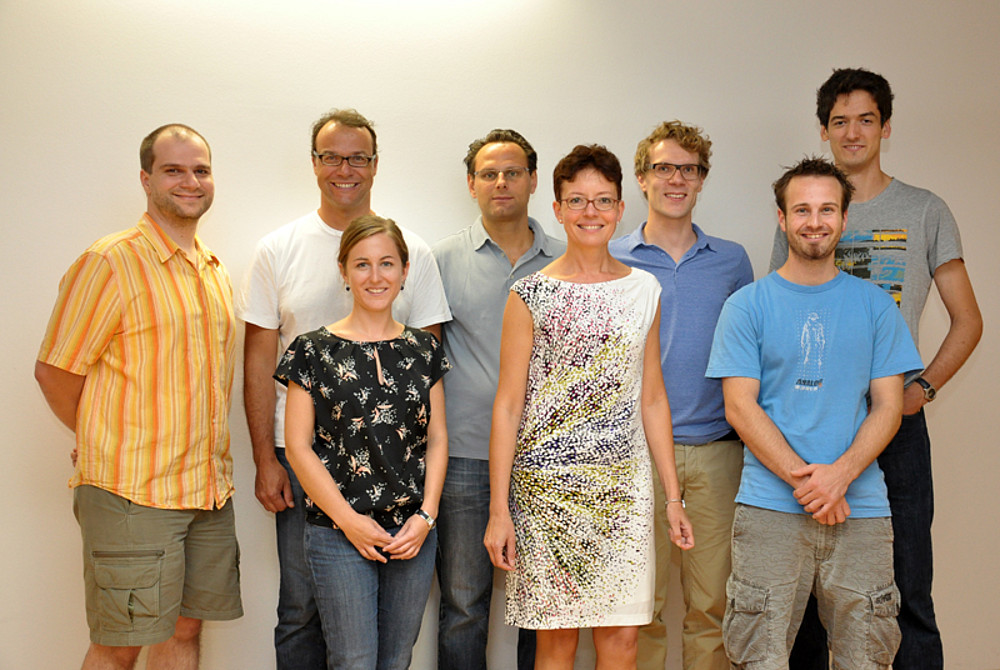
Stefan Schild (Uni Graz), Rolf Breinbauer (TU Graz), Kathrin Herzog (Med Uni Graz), Christoph Högenauer (Med Uni Graz), Ellen Zechner (Uni Graz), Georg Schneditz (Uni Graz), Sandro Roier (Uni Graz) und Jakob Pletz (TU Graz). Foto: Uni Graz/IMB

Konnten den molekularen Mechanismus der Entstehung einer Antibiotika-assoziierten Darmentzündung aufklären: (v.l.) Stefan Schild (Uni Graz), Rolf Breinbauer (TU Graz), Kathrin Herzog (Med Uni Graz), Christoph Högenauer (Med Uni Graz), Ellen Zechner (Uni Graz), Georg Schneditz (Uni Graz), Sandro Roier (Uni Graz) und Jakob Pletz (TU Graz). Foto: Uni Graz/IMB

Grazer Publikation aus den Molekularen Biowissenschaften wurde mit dem Wewalka-Preis 2015 prämiert

Eine Antibiotika-Therapie stört häufig das Gleichgewicht zwischen Darmflora und Wirt. Speziell Penicillin-Antibiotika können die übermäßige Vermehrung des Bakteriums Klebsiella oxytoca auslösen und zu Antibiotika-assoziierter Kolitis (AAHC), einer schweren Darmentzündung, führen. ForscherInnen der Arbeitsgruppe um Ao.Univ.-Prof. Dr. Ellen Zechner vom Institut für Molekulare Biowissenschaften der Uni Graz konnten erstmals zeigen, dass Klebsiella oxytoca durch die Produktion des toxischen Stoffwechselprodukts Tilivalline (TLV) Antibiotika-assoziierte Kolitis verursacht.

Für diese Arbeit, die im renommierten US-Fachjournal PNAS (Proceedings of the National Academy of Sciences) publiziert wurde, erhielten die Grazer ForscherInnen am 19. Juni 2015 den mit 4.000 Euro dotierten Wewalka-Preis, der von der Österreichischen Gesellschaft für Gastroenterologie und Hepatologie (ÖGGH) vergeben wird. Erstautor Dr. Georg Schneditz, Absolvent des Doktoratskollegs „Molekulare Enzymologie“ und derzeit Marie Curie Fellow an der University of Cambridge, UK, nahm die Auszeichnung bei der Jahrestagung der ÖGGH in Salzburg entgegen.

„Dass diese Arbeit prämiert wurde, freut uns besonders, weil die Forschungen gemeinsam mit KollegInnen der Medizinischen Universität und der TU Graz durchgeführt wurden“, unterstreicht Ellen Zechner. Unterstützung erfuhr das Projekt sowohl durch den Österreichischen Wissenschaftsfonds FWF im Rahmen des Doktoratskollegs „Molekulare Enzymologie“ als auch durch die Kooperationen NAWI Graz und BioTechMed Graz.

In der ausgezeichneten Arbeit wiesen die WissenschafterInnen auch nach, dass TLV den programmierten Zelltod im Epithel – das sind Zellschichten, welche die inneren und äußeren Körperoberflächen bedecken – auslöst und damit die epitheliale Barriere zerstört. TLV weist strukturelle Ähnlichkeiten zu Pyrrolobenzodiazepinen auf. „Erstmalig konnten wir einen Vertreter dieser Substanzklasse mit einer menschlichen Erkrankung kausal in Verbindung bringen und den molekularen Mechanismus der Entstehung von Antibiotika-assoziierter Kolitis aufklären“, so Zechner.

Publikation:
Enterotoxicity of a nonribosomal peptide causes antibiotic-associated colitis
Georg Schneditz, Jana Rentner, Sandro Roier, Kathrin A. T. Herzog, Roland Bücker, Hanno Troeger, Stefan Schild, Hansjörg Weber, Rolf Breinbauer, Gregor Gorkiewicz, Christoph Högenauer, Ellen L. Zechner
PNAS 2014 September 9; 111(36): 13181–13186

Der Wewalka-Preis ist nach einem renommierten Klinikchef der Gastroenterologie der Wiener Klinik benannt. Er wird einmal jährlich für junge WissenschafterInnen bis 40 Jahre ausgeschrieben und für die beste gastroenterologische beziehungsweise hepatologische Publikation des letzten Jahres vergeben. Der/die PreisträgerIn wird durch ein Reviewverfahren ermittelt.

created by Gudrun Pichler

Related news

Chemical Christmas show at the University of Graz: An explosive evening at the Schauspielh

At the beginning of December, the University of Graz transformed the theater into a laboratory: as part of “Chemical Life,” teacher training students staged a chemical Christmas show for Styrian school classes—complete with ethanol rockets, nitrogen snow, and glowing effects. An evening designed to inspire interest in studying chemistry.

Train by train: Koralm railway accelerates exchange between the Universities

Lectures at the University of Klagenfurt in the morning, seminars at the University of Graz in the afternoon: Austria's longest tunnel and a journey time of around 45 minutes make it easy. The Koralm railway increases the speed of networking between the two university locations. The collaboration builds on existing cooperation - for example in the areas of teacher training, Slavic studies and as employers, the universities are well coordinated.

On the trail of the Big Bang: University of Graz receives 1.5 million euros for doctoral programmes

The Austrian Science Fund FWF has selected the Doctoral Programme in Theoretical Particle Physics at the University of Graz for funding from the Doc.funds. Six young scientists will be funded for 3.5 years. They will gain fundamentally new insights into the origins of the world.

From trans women and knee prostheses: sports science prizes awarded

Walking better with a prosthesis, successfully getting rid of excess weight, training more effectively, more fairness for trans people in sport: these were the topics addressed by the students at the University of Graz who were awarded the sports science prizes for their Master's theses on 3 December 2025.

Begin of page section:
Additional information:

University of Graz
Universitaetsplatz 3
8010 Graz
Austria
  • Contact
  • Web Editors
  • Moodle
  • UNIGRAZonline
  • Imprint
  • Data Protection Declaration
  • Accessibility Declaration
Weatherstation
Uni Graz

End of this page section. Go to overview of page sections

End of this page section. Go to overview of page sections

Begin of page section:

End of this page section. Go to overview of page sections