Begin of page section:
Page sections:

  • Go to contents (Accesskey 1)
  • Go to position marker (Accesskey 2)
  • Go to main navigation (Accesskey 3)
  • Go to sub navigation (Accesskey 4)
  • Go to additional information (Accesskey 5)
  • Go to page settings (user/language) (Accesskey 8)
  • Go to search (Accesskey 9)

End of this page section. Go to overview of page sections

Begin of page section:
Page settings:

English en
Deutsch de
Search
Login

End of this page section. Go to overview of page sections

Begin of page section:
Search:

Search for details about Uni Graz
Close

End of this page section. Go to overview of page sections


Search

Begin of page section:
Main navigation:

Page navigation:

  • University

    University
    • About the University
    • Organisation
    • Faculties
    • Library
    • Working at University of Graz
    • Campus
    Developing solutions for the world of tomorrow - that is our mission. Our students and our researchers take on the great challenges of society and carry the knowledge out.
  • Research Profile

    Research Profile
    • Our Expertise
    • Research Questions
    • Research Portal
    • Promoting Research
    • Research Transfer
    • Ethics in Research
    • Commission for Scientific Integrity
    Scientific excellence and the courage to break new ground. Research at the University of Graz creates the foundations for making the future worth living.
  • Studies

    Studies
    • Prospective Students
    • Students
    • Registration for Study Programme (Winter semester 2026/27)
    • Study Days 22-26 June 2026
  • Community

    Community
    • International
    • Location
    • Research and Business
    • Alumni
    The University of Graz is a hub for international research and brings together scientists and business experts. Moreover, it fosters the exchange and cooperation in study and teaching.
Topics
  • Sustainable University
  • Researchers answer
  • Work for us
Close menu

End of this page section. Go to overview of page sections

Begin of page section:
You are here:

University of Graz News Aufbauen

End of this page section. Go to overview of page sections

Monday, 03 January 2022

Aufbauen

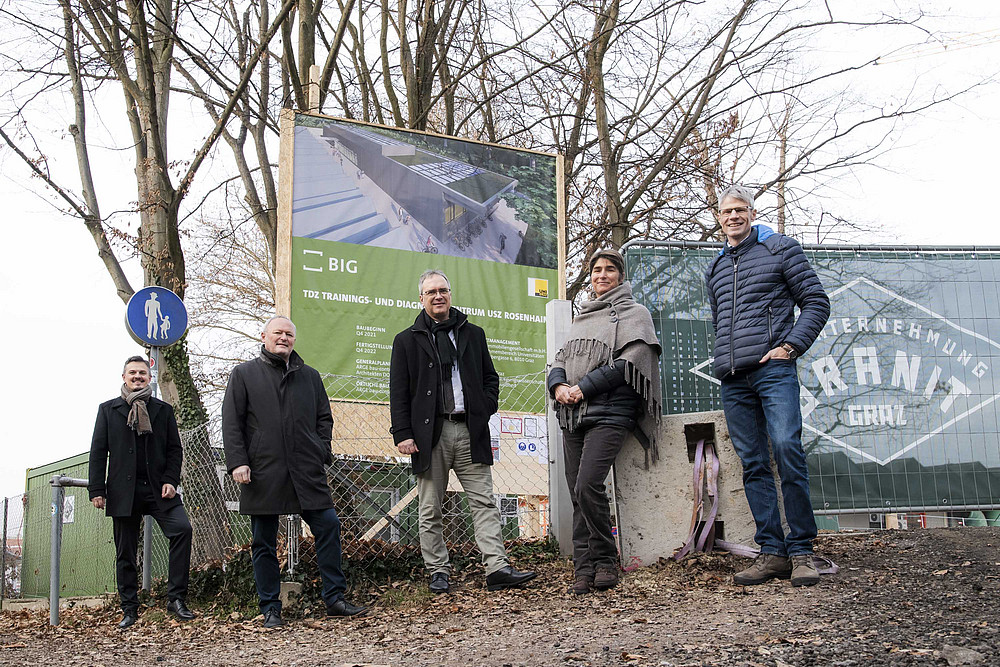
Die Trainingshalle entsteht in unmittelbarer Nachbarschaft zum neuen Institutsgebäude am Rosenhain. Geschäftsführender Rektor Peter Riedler (Mitte), BIG-Projektleiter Stefan Gautsch (links) sowie die ForscherInnen Peter Hofmann, Mireille van Poppel und Markus Tilp bei der Begehung vor Weihnachten. Foto: Uni Graz/Tzivanopoulos
Die Trainingshalle entsteht in unmittelbarer Nachbarschaft zum neuen Institutsgebäude am Rosenhain. Geschäftsführender Rektor Peter Riedler (Mitte), BIG-Projektleiter Stefan Gautsch (links) sowie die ForscherInnen Peter Hofmann, Mireille van Poppel und Markus Tilp bei der Begehung vor Weihnachten. Foto: Uni Graz/Tzivanopoulos

Eine neue Halle beim Universitätssportzentrum verstärkt die Forschung für Bewegungswissenschaften

Mit der umfassenden Sanierung des Jesuitenrefektoriums am Rosenhain wurde bereits im November 2021 der Grundstein für ein modernes Gebäude für das Institut für Bewegungswissenschaften, Sport und Gesundheit gelegt. Nun wird am Areal des Universitätsportzentrums (USZ) umgebaut und erweitert. Im Bereich der Tennisplätze errichtet die Bundesimmobiliengesellschaft (BIG) ein Trainings- und Diagnostikzentrum. Die neue Halle soll Ende 2022 bezugsfertig sein und Trainingsflächen, Umkleiden sowie spezielle Labors beherbergen.

Physiologie- und Bewegungslabor
Im Inneren des zweigeschossigen Baus sollen die Forschungsgruppen „Biomechanik, Bewegungs- und Trainingswissenschaft“ sowie „Sportphysiologie, Trainingswissenschaften & Trainingstherapie“ des Instituts ein neues Zuhause finden. Letztere ist derzeit direkt am USZ-Gelände in einem Nebengebäude untergebracht. „Unsere derzeitigen Labors für Biomechanik und Physiologie sind auf zwei Standorte verteilt und teilweise nicht mehr zeitgemäß. Dennoch wurde unser Institut 2020 in den Shanghai-Rankings als einziges österreichisches sportwissenschaftliches Institut unter die Top 100 gereiht. Wir sind ehrgeizig und wollen noch besser werden“, ist Mireille Van Poppel, Leiterin des Instituts, überzeugt. Peter Hofmann, Leiter des sportphysiologischen Labors, betont: „Die neuen Flächen sind für eine zeitgemäße Lehre und Forschung von größter Bedeutung und bedeuten eine deutliche Qualitätsverbesserung." Die Gruppe „Biomechanik“ unter der Leitung von Markus Tilp wird vom Keller des ZMB-Gebäudes aus der Humboldtstraße in die Max-Mell-Allee 11 ziehen. „Die Räumlichkeiten am Areal des USZ ermöglichen uns neben den Analysen im Labor nun erstmals auch die Durchführung von Studien in eigenen Trainingsräumlichkeiten unter kontrollierten Bedingungen“, so Tilp.

Nachhaltige Bauweise
Der Neubau wird nach den besonders hohen Nachhaltigkeitsstandards der BIG realisiert. „Ich freue mich besonders, dass die Umsetzung des Projekts ganz im Zeichen der Nachhaltigkeit steht. Die Tragkonstruktion besteht zum größten Teil aus Holzelementen, zudem wird die Fassade mit Lärchenholz verkleidet. Das begrünte Flachdach wird mit einer Photovoltaik-Anlage ausgestattet und fügt sich so nahtlos und optisch in das Naherholungsgebiet Rosenhain“, betont der geschäftsführende Rektor der Universität Graz, Peter Riedler.

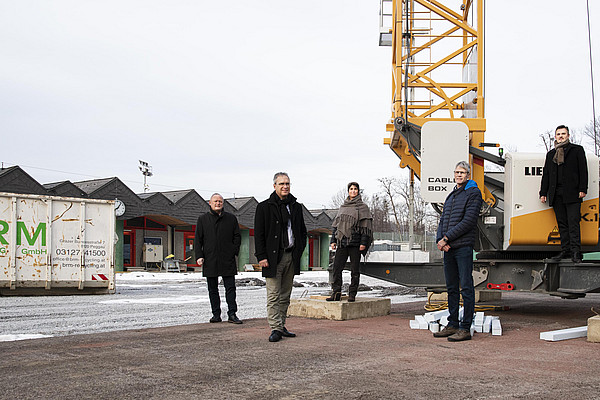
Die Tennisplätze wurden bereits aufgelöst und der Baukran steht. Foto: Uni Graz/Tzivanopoulos
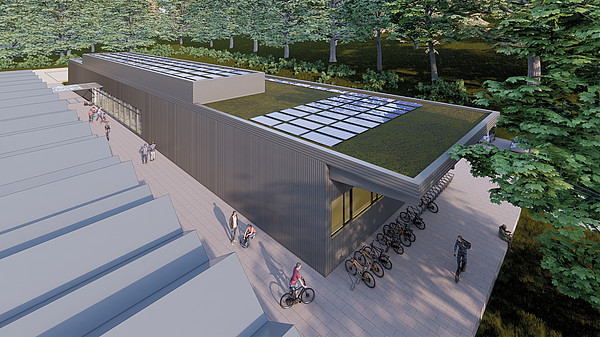
Die Halle wird größtenteils aus einer Holzkonstruktion bestehen. Das Dach wird begrünt und die Fassade ebenfalls mit Holz verkleidet.

created by Konstantin Tzivanopoulos

Related news

Full effort in the heat: the Sports Centre was in full swing at the Kleeblattlauf

On 19 June 2026, 2,000 runners and hundreds of supporters made their way to the Rosenhain for a sporting end-of-term event.

Save, invest or guarantee: What Austrians expect from the state

Austria needs to make savings. But where? And what should the Republic actually be spending its money on? The answers are provided by the initial findings of a major study involving the University of Graz. 99 per cent of those surveyed are in favour of the state ensuring healthcare provision. Almost three-quarters would like to see more public funding for education, whilst only around three per cent are in favour of cuts in this sector.

Science meets blockbuster: Campus cinema at the University of Graz

A cinematic treat for the scientific community: the courtyard of the University of Graz’s main building is once again being transformed into an atmospheric open-air cinema this year. From 29 June to 10 July 2026 (Mondays to Fridays from 8.30 pm), blockbusters and documentaries will be shown on the open-air screen. Academics from the University of Graz will be taking a closer look at the films shown, examining them to distinguish fact from fiction.

Complying with the norm: Why Do Standards Shape Our Lives, Elisabeth Staudegger?

Standards determine whether a sheet of paper fits in a printer or whether a charging plug can power multiple devices. These standards shape our everyday lives. But who actually sets these standards? Where are the weaknesses, and how could science help to improve them? Elisabeth Staudegger, Head of the ‘Law and IT’ Department at the Institute for Legal Foundations at the University of Graz, host the Academic Standards Day on 16 June. Here she relays how sciences can contribute to the topic of standardisation and reveals her personal favourite standard.

Begin of page section:
Additional information:

University of Graz
Universitaetsplatz 3
8010 Graz
Austria
  • Contact
  • Web Editors
  • Moodle
  • UNIGRAZonline
  • Imprint
  • Data Protection Declaration
  • Accessibility Declaration
Weatherstation
Uni Graz

End of this page section. Go to overview of page sections

End of this page section. Go to overview of page sections

Begin of page section:

End of this page section. Go to overview of page sections