Begin of page section:
Page sections:

  • Go to contents (Accesskey 1)
  • Go to position marker (Accesskey 2)
  • Go to main navigation (Accesskey 3)
  • Go to sub navigation (Accesskey 4)
  • Go to additional information (Accesskey 5)
  • Go to page settings (user/language) (Accesskey 8)
  • Go to search (Accesskey 9)

End of this page section. Go to overview of page sections

Begin of page section:
Page settings:

English en
Deutsch de
Search
Login

End of this page section. Go to overview of page sections

Begin of page section:
Search:

Search for details about Uni Graz
Close

End of this page section. Go to overview of page sections


Search

Begin of page section:
Main navigation:

Page navigation:

  • University

    University
    • About the University
    • Organisation
    • Faculties
    • Library
    • Working at University of Graz
    • Campus
    Developing solutions for the world of tomorrow - that is our mission. Our students and our researchers take on the great challenges of society and carry the knowledge out.
  • Research Profile

    Research Profile
    • Our Expertise
    • Research Questions
    • Research Portal
    • Promoting Research
    • Research Transfer
    • Ethics in Research
    • Commission for Scientific Integrity
    Scientific excellence and the courage to break new ground. Research at the University of Graz creates the foundations for making the future worth living.
  • Studies

    Studies
    • Prospective Students
    • Students
    • Welcome Weeks for First Year Students
  • Community

    Community
    • International
    • Location
    • Research and Business
    • Alumni
    The University of Graz is a hub for international research and brings together scientists and business experts. Moreover, it fosters the exchange and cooperation in study and teaching.
Topics
  • Sustainable University
  • Researchers answer
  • Work for us
Close menu

End of this page section. Go to overview of page sections

Begin of page section:
You are here:

University of Graz News Gewürdigt

End of this page section. Go to overview of page sections

Friday, 27 November 2020

Gewürdigt

Im Corona-Jahr wurde der Anton-Schelnast-Preis online verliehen

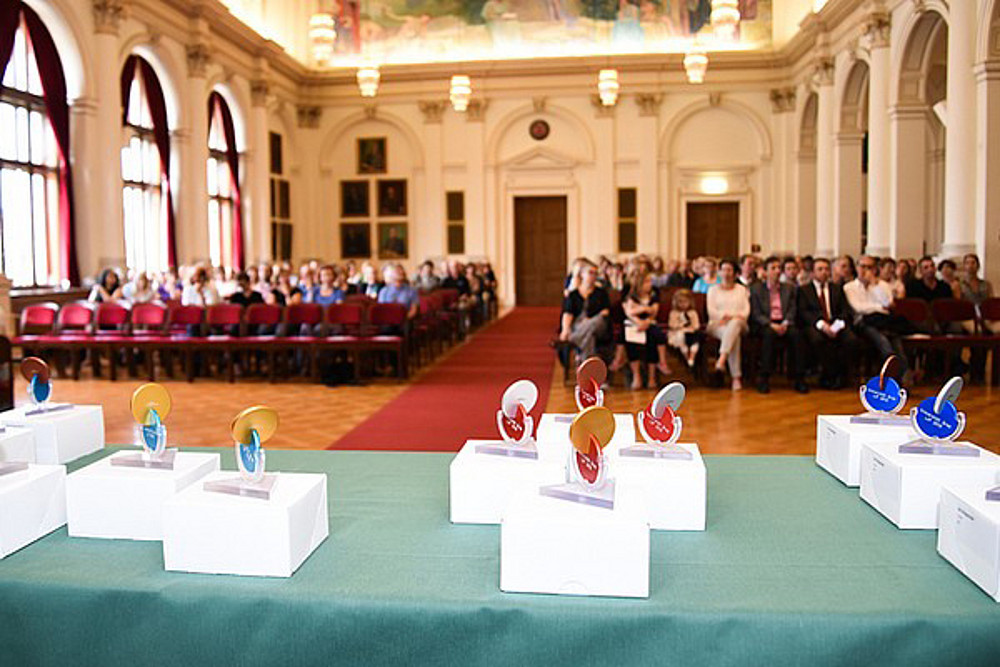
Mitten im zweiten, harten Corona-Lockdown, der Teile des öffentlichen Lebens in Österreich stilllegt, hatte die Universität Graz einen Grund zu feiern. Sie zeichnete am 26. November 2020 in einem Online-Format MitarbeiterInnen des allgemeinen Personals mit dem Anton-Schelnast-Preis für Leistung und Innovation aus. Der Preis, der auf den 2017 verstorbenen Uni-Graz-Mitarbeiter und Initiator der Auszeichnung Anton Schelnast zurückgeht, wird mittlerweile jährlich für herausragende Leistungen während eines Jahres an Einzelpersonen und Gruppen vergeben. Virtuell überreicht wurden sie von Rektor Martin Polaschek und Personalressort-Leiter Kurt-Martin Lugger. Ehrenpreise bekamen in diesem Jahr Kurt Ansperger, pensionierter Leiter der Physik-Werkstatt sowie die langjährige Vizerektorin für Personal und Gleichstellung Renate Dworczak.

Im Rahmen der Veranstaltung wird von Kurt-Martin Lugger auch immer den Verstorbenen des vergangenen Jahres gedacht. Diesmal wurde eine Schweigeminute für Chen Yu, Egon Mack, Peter Gryzbeck, Hugo Keiper und Andreas Reiser abgehalten.


Die GewinnerInnen 2020 sind:

Kategorie "Innovation - Einzel"

  1. Florian Haller
  2. Georg Stegmüller
  3. Stefan Schuh
  4. Anja Hoffmann
  5. Anand Natampalli


Kategorie "Innovation - Team"

  1. Marianne Pasterk und Zoe Steiner
  2. Gerhild Leljak und Christian Stalzer


Kategorie "Kooperation - Einzel" 

  1. Sylvia Umschaden
  2. Christien Schönhuber
  3. Daniela Scheer
  4. Renate Zmuck
  5. Evamaria Schafzahl


Kategorie "Kooperation - Team"

  1. Robert Fuchs, Mario Müller, Gerald Lind, Stefanie Lerch
  2. Eva Regele, Eva Schellnast, Barbara Hey, Ulrike Schustaczek
  3. Monika Valentini, Bianca Gollmann, Lisa Scheer, Ilse Wieser


Kategorie "Engagement - Einzel"

  1. Rupert Schwarzl
  2. Isabella Wilfing
  3. Margarethe Irrasch
  4. Kurt Bischof
  5. Alexandra Binder
  6. Anzelika Sabaleva
  7. Birgit Tschandl
  8. Sabine Schmid
  9. Jonas Berger
  10. Katharina Gingl
  11. Monika Steyer
  12. Sabine List
  13. Julia Hiebler
  14. Gernot Gölles
  15. Verena Sernetz


Kategorie "Engagement - Team"

  1. Andrea Granitz, Elke Handl, Ingrid Hable, Christine Schönhuber
  2. Sara Riegler, Silvia Baumgartner
  3. Othmar Dittrich, Cornelia Kerschberger, Birgit Theiss


Kategorie "Corona-Einzel" - alle Plätze ex aequo, Reihung alphabetisch:

  • Alexandra Binder
  • Dieter Cerny
  • Gabriela Gnus
  • Elke Handl
  • Michael Hirczy
  • Anna Hutter
  • Martin Koller
  • Dieter Lang
  • Claudia Puschenjak
  • Ingeborg Röllig
  • Stefan Schuh
  • Wolfgang Schleifer
  • Jürgen Tremer
  • Bernhard Weber
  • Leo Wohofsky

Kategorie "Corona-Team" - alle Plätze ex aequo, Reihung alphabetisch:

  • Botanischer Garten
  • Informationsmanagement
  • Portiere 
  • Universitätsbibliothek
created by Konstantin Tzivanopoulos

Related news

Electrifying: Researchers film the first moments on the way from light to electricity

Physicists at the University of Graz (Austria), in collaboration with colleagues from Marburg University and Forschungszentrum Jülich (Germany), have achieved a scientific breakthrough. For the first time, the generation of electrical energy from light has been filmed and described theoretically. This work is of far-reaching significance, not least for optimising sustainable energy production from photovoltaics. This is because it provides fundamental building blocks for understanding the physical processes that take place, for example, in organic solar cells. The paper was published in the journal Physical Review X, one of the world’s most prestigious physics journals.

University of Graz: Working together to make Styria a sustainable centre of learning

Round table calls for sustainable funding for the 2028–2030 performance agreement period between the five Styrian universities and the federal government.

How can we teach using YouTube and AI? The University of Graz is strengthening media education in schools

A journey through the blood vessels using VR headsets brings biology lessons to life. An interactive quiz brings physics to life. The YouTube video explains the First World War. Whilst mobile phones are increasingly being banned from the classroom, social media platforms, apps and AI are playing an ever-greater role in knowledge transfer at school. But how can teaching with media be made even more effective? What are the challenges in media-based teaching? At the University of Graz, researchers are discussing these issues at a conference being held in Austria for the first time.

Jurassic Sounds: Biologist reconstructs insect songs from 165 million years ago

It was apparently not just the roars of the dinosaurs that made up the soundscape of the animal world during the Jurassic period. Crickets and grasshoppers communicated through a variety of songs and high-pitched sounds, as Thorin Jonsson from the Institute of Biology at the University of Graz discovered together with colleagues from the universities of Lincoln, Bristol (UK), Beijing (China) and Tempe (USA). The findings on what are so far the oldest traces of sound on Earth have just been published in the journal PNAS.

Begin of page section:
Additional information:

University of Graz
Universitaetsplatz 3
8010 Graz
Austria
  • Contact
  • Web Editors
  • Moodle
  • UNIGRAZonline
  • Imprint
  • Data Protection Declaration
  • Accessibility Declaration
Weatherstation
Uni Graz

End of this page section. Go to overview of page sections

End of this page section. Go to overview of page sections

Begin of page section:

End of this page section. Go to overview of page sections