



Begin of page section:
Page sections:

  • Go to contents (Accesskey 1)
  • Go to position marker (Accesskey 2)
  • Go to main navigation (Accesskey 3)
  • Go to sub navigation (Accesskey 4)
  • Go to additional information (Accesskey 5)
  • Go to page settings (user/language) (Accesskey 8)
  • Go to search (Accesskey 9)

End of this page section. Go to overview of page sections

Begin of page section:
Page settings:

English en
Deutsch de
Search
Login

End of this page section. Go to overview of page sections

Begin of page section:
Search:

Search for details about Uni Graz
Close

End of this page section. Go to overview of page sections


Search

Begin of page section:
Main navigation:

Page navigation:

  • University

    University
    • About the University
    • Organisation
    • Faculties
    • Library
    • Working at University of Graz
    • Campus
    Developing solutions for the world of tomorrow - that is our mission. Our students and our researchers take on the great challenges of society and carry the knowledge out.
  • Research Profile

    Research Profile
    • Our Expertise
    • Research Questions
    • Research Portal
    • Promoting Research
    • Research Transfer
    • Ethics in Research
    • Commission for Scientific Integrity
    Scientific excellence and the courage to break new ground. Research at the University of Graz creates the foundations for making the future worth living.
  • Studies

    Studies
    • Prospective Students
    • Students
    • Registration for Study Programme (Winter semester 2026/27)
  • Community

    Community
    • International
    • Location
    • Research and Business
    • Alumni
    The University of Graz is a hub for international research and brings together scientists and business experts. Moreover, it fosters the exchange and cooperation in study and teaching.
Topics
  • Sustainable University
  • Researchers answer
  • Work for us
Close menu

End of this page section. Go to overview of page sections

Begin of page section:
You are here:

University of Graz News Ans Licht gebracht

End of this page section. Go to overview of page sections

Friday, 10 July 2020

Ans Licht gebracht

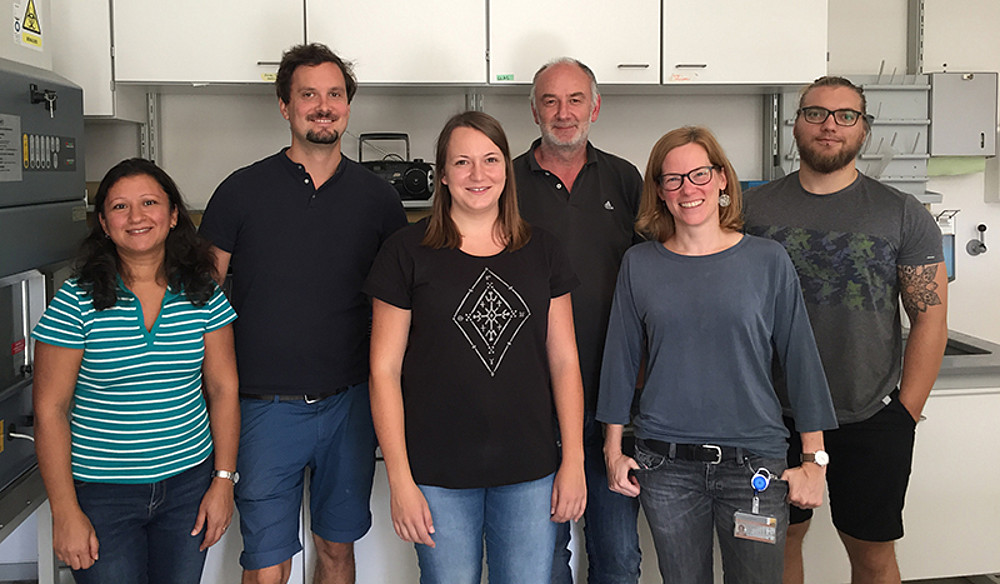
Die Arbeitsgruppe rund um Robert Zimmermann (3.v.r.) hat den Stoffwechsel des Phospholipids BMP ein Stück weit entschlüsselt. Foto: Gernot Grabner.

Die Arbeitsgruppe rund um Robert Zimmermann (3.v.r.) hat den Stoffwechsel des Phospholipids BMP ein Stück weit entschlüsselt. Foto: Gernot Grabner.

ForscherInnen entschlüsseln den Stoffwechsel eines wichtigen Biomarker-Lipids

Im Rahmen des gemeinsamen Spezialforschungsbereiches „Lipid Hydrolysis“ von Universität Graz und Medizinischer Universität Graz beschäftigt sich die Arbeitsgruppe von Robert Zimmermann, Institut für Molekulare Biowissenschaften der Uni Graz, unter anderem mit dem Stoffwechsel eines speziellen Phospholipids namens Bis(monoacylglycero)phosphat, kurz BMP.

Robert Zimmermann erklärt: „BMP fördert den Abbau und den Export von Lipiden aus den Lysosomen, den so genannten ‚Mägen‘ einer Zelle. Wenn diese die nicht richtig funktionieren, ist BMP stark erhöht. Daher ist es ein wichtiger Biomarker für bestimmte Erkrankungen, die mit fehlerhaften Lysosomen zusammenhängen.“ Obwohl BMP schon 1967 entdeckt wurde, wusste man bislang nur wenig über dessen Stoffwechsel. Nun ist dank einer aktuellen Publikation der Arbeitsgruppe im Journal of Lipid Research etwas mehr Licht in diese Angelegenheit gekommen.

So konnten die ForscherInnen einige grundlegende Fragen klären, die für ein besseres Verständnis des BMP-Stoffwechsels notwendig sind. „Dazu gehört zum Beispiel die Verteilung von BMP in verschiedenen Geweben und dessen Regulation durch Fasten beziehungsweise Nahrungsaufnahme“, schildert Zimmermann und führt weiter aus: „Unsere Ergebnisse zeigen, dass BMP in allen Geweben vorkommt und in den meisten Zelltypen im Fastenzustand hochreguliert wird. Das war zu erwarten, da im Fastenzustand energiereiche Bestandteile der Zelle in Lysosomen abgebaut werden und BMP diesen Prozess unterstützt.“
 
Interessant war für die WissenschafterInnen, dass sie eine enorm starke Regulation von BMP in der Bauchspeicheldrüse beobachtet konnten. Dieses Organ hat zwei wichtige Funktionen: einerseits produziert es Hormone, die den Energiestoffwechsel im Körper stark beeinflussen, wie zum Beispiel Insulin. Andererseits erzeugt es auch Enzyme, die zum Verdau der Nahrung wichtig sind. Weitere Experimente werden zeigen, ob BMP diese beiden Funktionen der Bauchspeicheldrüse beeinflusst.

Auch für das so genannte braune Fettgewebe spielt BMP eine wichtige Rolle. Braunes Fettgewebe ist essenziell zur zitterfreien Wärmeerzeugung, weshalb Babys oder auch Tiere, die Winterschlaf halten, besonders viel davon haben. Die Arbeitsgruppe rund um Robert Zimmermann konnte zeigen, dass BMP stark ansteigt, wenn die Außentemperatur fällt. „Das lässt darauf schließen, dass die Lysosomen sich an äußere Umstände anpassen, und bei Kälte energiereiche Verbindungen mittels BMP effizienter abbauen. Die Energie kann dann für eine verstärkte Wärmeproduktion bei winterlicher Kälte verwendet werden“, fasst der Forscher zusammen.


Zur Publikation: https://www.jlr.org/content/early/2020/04/29/jlr.RA119000516.abstract

created by Gerhild Leljak

Related news

Staying fit during the holidays: summer sports on the University of Graz campus

The Kleeblattlauf is not the end of the fitness term. Following last year’s successful launch, the University of Graz is once again offering summer sports on campus this year. From 30 June to 16 July 2026, there will be a free exercise programme in the open air. On the shady Südwiese (between the main building and Universitätsplatz 2), anyone interested can get in shape in the afternoons with body workouts, fascia training and yoga.

Getting even hotter: Researchers predict global warming of 1.7 degrees by 2027

While Europe is currently sweltering in the heat, global temperatures are also rising towards concerning record levels. In 2026, Earth’s surface air temperature is expected to reach 1.62 degrees, and in 2027 even 1.71 degrees Celsius above pre-industrial levels. The long-term temperature rise – an average over a 20-year period – is predicted to exceed the 1.5-degree threshold of the Paris Agreement as of 2026 already. For the first time, researchers at the University of Graz have been able to make such a forecast so far in advance. The intensifying El Niño climate event favors forecast skill and thereby facilitates a reliable computation.

Forest fire at Rosenhain: Volunteer fire brigade carried out an evacuation drill at the Jesuit refectory

Thick smoke in the stairwell, flames at the edge of the forest, people missing in the Jesuit refectory at the University of Graz: at Rosenhain, the Graz Volunteer Fire Brigade carried out a drill simulating a scenario that is becoming increasingly realistic given the heat and drought

Full effort in the heat: the Sports Centre was in full swing at the Kleeblattlauf

On 19 June 2026, 2,000 runners and hundreds of supporters made their way to the Rosenhain for a sporting end-of-term event.

Begin of page section:
Additional information:

University of Graz
Universitaetsplatz 3
8010 Graz
Austria
  • Contact
  • Web Editors
  • Moodle
  • UNIGRAZonline
  • Imprint
  • Data Protection Declaration
  • Accessibility Declaration
Weatherstation
Uni Graz

End of this page section. Go to overview of page sections

End of this page section. Go to overview of page sections

Begin of page section:

End of this page section. Go to overview of page sections


