Begin of page section:
Page sections:

  • Go to contents (Accesskey 1)
  • Go to position marker (Accesskey 2)
  • Go to main navigation (Accesskey 3)
  • Go to sub navigation (Accesskey 4)
  • Go to additional information (Accesskey 5)
  • Go to page settings (user/language) (Accesskey 8)
  • Go to search (Accesskey 9)

End of this page section. Go to overview of page sections

Begin of page section:
Page settings:

English en
Deutsch de
Search
Login

End of this page section. Go to overview of page sections

Begin of page section:
Search:

Search for details about Uni Graz
Close

End of this page section. Go to overview of page sections


Search

Begin of page section:
Main navigation:

Page navigation:

  • University

    University
    • About the University
    • Organisation
    • Faculties
    • Library
    • Working at University of Graz
    • Campus
    Developing solutions for the world of tomorrow - that is our mission. Our students and our researchers take on the great challenges of society and carry the knowledge out.
  • Research Profile

    Research Profile
    • Our Expertise
    • Research Questions
    • Research Portal
    • Promoting Research
    • Research Transfer
    • Ethics in Research
    Scientific excellence and the courage to break new ground. Research at the University of Graz creates the foundations for making the future worth living.
  • Studies

    Studies
    • Prospective Students
    • Students
  • Community

    Community
    • International
    • Location
    • Research and Business
    • Alumni
    The University of Graz is a hub for international research and brings together scientists and business experts. Moreover, it fosters the exchange and cooperation in study and teaching.
  • Spotlight
Topics
  • Our digital Advent calendar
  • Sustainable University
  • Researchers answer
  • Work for us
Close menu

End of this page section. Go to overview of page sections

Begin of page section:
You are here:

University of Graz News Ans Licht gebracht

End of this page section. Go to overview of page sections

Friday, 10 July 2020

Ans Licht gebracht

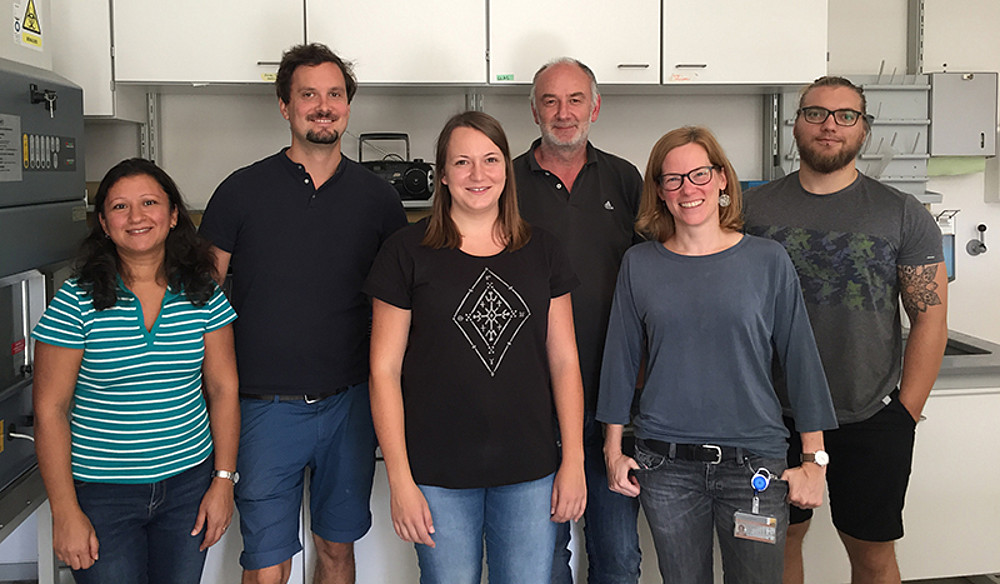
Die Arbeitsgruppe rund um Robert Zimmermann (3.v.r.) hat den Stoffwechsel des Phospholipids BMP ein Stück weit entschlüsselt. Foto: Gernot Grabner.

Die Arbeitsgruppe rund um Robert Zimmermann (3.v.r.) hat den Stoffwechsel des Phospholipids BMP ein Stück weit entschlüsselt. Foto: Gernot Grabner.

ForscherInnen entschlüsseln den Stoffwechsel eines wichtigen Biomarker-Lipids

Im Rahmen des gemeinsamen Spezialforschungsbereiches „Lipid Hydrolysis“ von Universität Graz und Medizinischer Universität Graz beschäftigt sich die Arbeitsgruppe von Robert Zimmermann, Institut für Molekulare Biowissenschaften der Uni Graz, unter anderem mit dem Stoffwechsel eines speziellen Phospholipids namens Bis(monoacylglycero)phosphat, kurz BMP.

Robert Zimmermann erklärt: „BMP fördert den Abbau und den Export von Lipiden aus den Lysosomen, den so genannten ‚Mägen‘ einer Zelle. Wenn diese die nicht richtig funktionieren, ist BMP stark erhöht. Daher ist es ein wichtiger Biomarker für bestimmte Erkrankungen, die mit fehlerhaften Lysosomen zusammenhängen.“ Obwohl BMP schon 1967 entdeckt wurde, wusste man bislang nur wenig über dessen Stoffwechsel. Nun ist dank einer aktuellen Publikation der Arbeitsgruppe im Journal of Lipid Research etwas mehr Licht in diese Angelegenheit gekommen.

So konnten die ForscherInnen einige grundlegende Fragen klären, die für ein besseres Verständnis des BMP-Stoffwechsels notwendig sind. „Dazu gehört zum Beispiel die Verteilung von BMP in verschiedenen Geweben und dessen Regulation durch Fasten beziehungsweise Nahrungsaufnahme“, schildert Zimmermann und führt weiter aus: „Unsere Ergebnisse zeigen, dass BMP in allen Geweben vorkommt und in den meisten Zelltypen im Fastenzustand hochreguliert wird. Das war zu erwarten, da im Fastenzustand energiereiche Bestandteile der Zelle in Lysosomen abgebaut werden und BMP diesen Prozess unterstützt.“
 
Interessant war für die WissenschafterInnen, dass sie eine enorm starke Regulation von BMP in der Bauchspeicheldrüse beobachtet konnten. Dieses Organ hat zwei wichtige Funktionen: einerseits produziert es Hormone, die den Energiestoffwechsel im Körper stark beeinflussen, wie zum Beispiel Insulin. Andererseits erzeugt es auch Enzyme, die zum Verdau der Nahrung wichtig sind. Weitere Experimente werden zeigen, ob BMP diese beiden Funktionen der Bauchspeicheldrüse beeinflusst.

Auch für das so genannte braune Fettgewebe spielt BMP eine wichtige Rolle. Braunes Fettgewebe ist essenziell zur zitterfreien Wärmeerzeugung, weshalb Babys oder auch Tiere, die Winterschlaf halten, besonders viel davon haben. Die Arbeitsgruppe rund um Robert Zimmermann konnte zeigen, dass BMP stark ansteigt, wenn die Außentemperatur fällt. „Das lässt darauf schließen, dass die Lysosomen sich an äußere Umstände anpassen, und bei Kälte energiereiche Verbindungen mittels BMP effizienter abbauen. Die Energie kann dann für eine verstärkte Wärmeproduktion bei winterlicher Kälte verwendet werden“, fasst der Forscher zusammen.


Zur Publikation: https://www.jlr.org/content/early/2020/04/29/jlr.RA119000516.abstract

created by Gerhild Leljak

Related news

Semester abroad without barriers: University of Graz wins award for promoting inclusion

The University of Graz has been awarded the Internationalization Award for its new inclusion initiative. Students with fewer opportunities now also receive financial support for their semester abroad outside Europe.

Fair distribution: Researchers determine just greenhouse gas budgets for all EU regions

Ten years ago, on 12 December 2015, the Paris Climate Agreement was signed at the UN Climate Conference. In order to limit global warming to well below two degrees, only a certain amount of CO2 may be emitted worldwide. While the focus was originally on national emission targets, more than 200 subnational regions and almost 300 cities have now adopted their own targets. But how many emissions are they fairly entitled to? Researchers at the University of Graz have now developed transparent criteria for fair distribution at the subnational level for the first time and determined corresponding greenhouse gas budgets for all European regions. The paper was published today in the scientific journal Nature Communications.

Chemical Christmas show at the University of Graz: An explosive evening at the Schauspielh

At the beginning of December, the University of Graz transformed the theater into a laboratory: as part of “Chemical Life,” teacher training students staged a chemical Christmas show for Styrian school classes—complete with ethanol rockets, nitrogen snow, and glowing effects. An evening designed to inspire interest in studying chemistry.

Train by train: Koralm railway accelerates exchange between the Universities

Lectures at the University of Klagenfurt in the morning, seminars at the University of Graz in the afternoon: Austria's longest tunnel and a journey time of around 45 minutes make it easy. The Koralm railway increases the speed of networking between the two university locations. The collaboration builds on existing cooperation - for example in the areas of teacher training, Slavic studies and as employers, the universities are well coordinated.

Begin of page section:
Additional information:

University of Graz
Universitaetsplatz 3
8010 Graz
Austria
  • Contact
  • Web Editors
  • Moodle
  • UNIGRAZonline
  • Imprint
  • Data Protection Declaration
  • Accessibility Declaration
Weatherstation
Uni Graz

End of this page section. Go to overview of page sections

End of this page section. Go to overview of page sections

Begin of page section:

End of this page section. Go to overview of page sections