Begin of page section:
Page sections:

  • Go to contents (Accesskey 1)
  • Go to position marker (Accesskey 2)
  • Go to main navigation (Accesskey 3)
  • Go to sub navigation (Accesskey 4)
  • Go to additional information (Accesskey 5)
  • Go to page settings (user/language) (Accesskey 8)
  • Go to search (Accesskey 9)

End of this page section. Go to overview of page sections

Begin of page section:
Page settings:

English en
Deutsch de
Search
Login

End of this page section. Go to overview of page sections

Begin of page section:
Search:

Search for details about Uni Graz
Close

End of this page section. Go to overview of page sections


Search

Begin of page section:
Main navigation:

Page navigation:

  • University

    University
    • About the University
    • Organisation
    • Faculties
    • Library
    • Working at University of Graz
    • Campus
    Developing solutions for the world of tomorrow - that is our mission. Our students and our researchers take on the great challenges of society and carry the knowledge out.
  • Research Profile

    Research Profile
    • Our Expertise
    • Research Questions
    • Research Portal
    • Promoting Research
    • Research Transfer
    • Ethics in Research
    Scientific excellence and the courage to break new ground. Research at the University of Graz creates the foundations for making the future worth living.
  • Studies

    Studies
    • Prospective Students
    • Students
  • Community

    Community
    • International
    • Location
    • Research and Business
    • Alumni
    The University of Graz is a hub for international research and brings together scientists and business experts. Moreover, it fosters the exchange and cooperation in study and teaching.
  • Spotlight
Topics
  • Our digital Advent calendar
  • Sustainable University
  • Researchers answer
  • Work for us
Close menu

End of this page section. Go to overview of page sections

Begin of page section:
You are here:

University of Graz News Am Puls

End of this page section. Go to overview of page sections

Wednesday, 20 July 2022

Am Puls

Wolfgang Kern. Foto: Simon Orlob

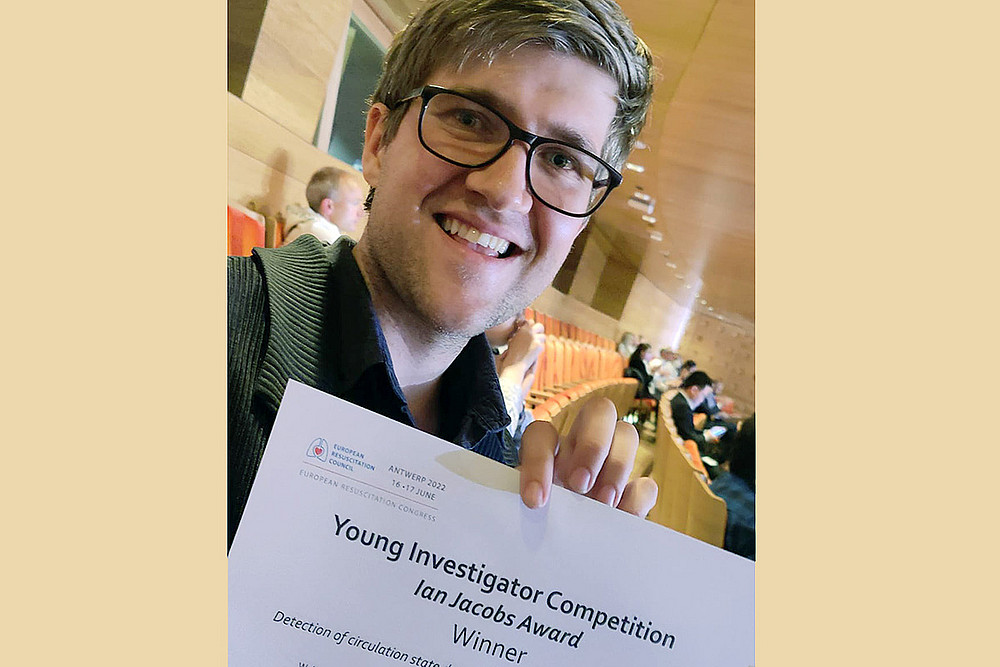
Wolfgang Kern freute sich über den Ian Jacobs Award. Foto: Simon Orlob

Europäischer Rat für Wiederbelebung zeichnet Grazer Jungforscher aus

Mit Herzdruckmassage und Defibrillation können viele Menschen gerettet werden, die einen unerwarteten Kreislaufstillstand erlitten haben. Dabei ist es für NotärztInnen eine große Herausforderung zu erkennen, ob das Herz wieder zu schlagen begonnen hat. Denn das ist in einer solchen Situation im EKG nicht ersichtlich. Und auch händisch lässt sich der Puls häufig nicht sicher ertasten. Eine Gruppe Grazer Wissenschafter hat in Kooperation mit Ärzten vom Institut für Rettungs- und Notfallmedizin der Universitätsklinik Schleswig-Holstein in Kiel und dem deutschen Reanimationsregister einen Algorithmus entwickelt, der den Herzschlag erkennt. Er kann bei der Erstversorgung von PatientInnen helfen, schnell die richtigen Entscheidungen zu treffen. Für ihre Arbeit wurden die Forscher vom Europäischen Rat für Wiederbelebung mit dem Ian Jacobs Award ausgezeichnet.

Viele Defibrillatoren verfügen über einen Beschleunigungssensor, der als Hilfestellung bei der Wiederbelebung Rückmeldung über Drucktiefe und -Frequenz der Herzdruckmassage gibt. Dieser Sensor kann beim schlagenden Herz auch das Anstoßen der Herzspitze an die vordere Brustwand registrieren. „Unser Algorithmus, den wir mit Machine-Learning-Methoden trainiert haben, verwendet die biomedizinischen Signale des EKG und des Beschleunigungssensors, die während der Reanimation aufgezeichnet werden, um festzustellen, ob das Herz wieder schlägt“, erklärt Wolfgang Kern vom Institut für Mathematik und Wissenschaftliches Rechnen der Universität Graz. „Damit liefert er ÄrztInnen neben EKG und händischer Pulsmessung eine weitere Information, um rasch Entscheidungen zu treffen und die geeigneten lebensrettenden Maßnahmen zu setzen“, unterstreicht Simon Orlob von der Medizinischen Universität Graz die Bedeutung der Entwicklung.

Ein zusätzlicher Pluspunkt: „Der Algorithmus benötigt nur Daten, die bereits ohnehin von vielen Defibrillatoren aufgezeichnet werden“, erklärt Martin Holler, Leiter der Forschungsgruppe „Mathematics of Data Science“ an der Universität Graz. Für die Anwendung muss also im Prinzip nur die Software des Defibrillators upgedatet werden. Nachdem die Wissenschafter zeigen konnten, dass das Konzept funktioniert, sollen nun weitere Studien zur klinischen Umsetzung folgen.

Ian Jacobs Award
Auf der diesjährigen Konferenz des Europäischen Rats für Wiederbelebung – European Resuscitation Council (ERC) – im Juni in Antwerpen erhielten die Forscher für ihren Konferenzbeitrag „Detection of circulation state during cardiac arrest treatment employing accelerometry“ den Ian Jacobs Award. Der nach dem australischen Wissenschafter, Arzt und Pionier der Reanimation benannte Preis zeichnet herausragende Arbeiten junger ForscherInnen aus.

Publikationen
Detection of circulation state during cardiac arrest treatment employing accelerometry
Wolfgang Kern, Simon Orlob, Andreas Bohn, Wolfgang Toller, Jan-Thorsten Gräsner, Jan Wnent und Martin Holler
Resuscitation 175, S5. DOI: 10.1016/S0300-9572(22)00378-1

Preprint:
Accelerometry-based classification of circulatory states during out-of-hospital cardiac arrest
Wolfgang Kern, Simon Orlob, Andreas Bohn, Wolfgang Toller, Jan-Thorsten Gräsner, Jan Wnent und Martin Holler
arxiv.org/abs/2205.06540

created by Gudrun Pichler

Related news

Semester abroad without barriers: University of Graz wins award for promoting inclusion

The University of Graz has been awarded the Internationalization Award for its new inclusion initiative. Students with fewer opportunities now also receive financial support for their semester abroad outside Europe.

Fair distribution: Researchers determine just greenhouse gas budgets for all EU regions

Ten years ago, on 12 December 2015, the Paris Climate Agreement was signed at the UN Climate Conference. In order to limit global warming to well below two degrees, only a certain amount of CO2 may be emitted worldwide. While the focus was originally on national emission targets, more than 200 subnational regions and almost 300 cities have now adopted their own targets. But how many emissions are they fairly entitled to? Researchers at the University of Graz have now developed transparent criteria for fair distribution at the subnational level for the first time and determined corresponding greenhouse gas budgets for all European regions. The paper was published today in the scientific journal Nature Communications.

Chemical Christmas show at the University of Graz: An explosive evening at the Schauspielh

At the beginning of December, the University of Graz transformed the theater into a laboratory: as part of “Chemical Life,” teacher training students staged a chemical Christmas show for Styrian school classes—complete with ethanol rockets, nitrogen snow, and glowing effects. An evening designed to inspire interest in studying chemistry.

Train by train: Koralm railway accelerates exchange between the Universities

Lectures at the University of Klagenfurt in the morning, seminars at the University of Graz in the afternoon: Austria's longest tunnel and a journey time of around 45 minutes make it easy. The Koralm railway increases the speed of networking between the two university locations. The collaboration builds on existing cooperation - for example in the areas of teacher training, Slavic studies and as employers, the universities are well coordinated.

Begin of page section:
Additional information:

University of Graz
Universitaetsplatz 3
8010 Graz
Austria
  • Contact
  • Web Editors
  • Moodle
  • UNIGRAZonline
  • Imprint
  • Data Protection Declaration
  • Accessibility Declaration
Weatherstation
Uni Graz

End of this page section. Go to overview of page sections

End of this page section. Go to overview of page sections

Begin of page section:

End of this page section. Go to overview of page sections