Begin of page section:
Page sections:

  • Go to contents (Accesskey 1)
  • Go to position marker (Accesskey 2)
  • Go to main navigation (Accesskey 3)
  • Go to sub navigation (Accesskey 4)
  • Go to additional information (Accesskey 5)
  • Go to page settings (user/language) (Accesskey 8)
  • Go to search (Accesskey 9)

End of this page section. Go to overview of page sections

Begin of page section:
Page settings:

English en
Deutsch de
Search
Login

End of this page section. Go to overview of page sections

Begin of page section:
Search:

Search for details about Uni Graz
Close

End of this page section. Go to overview of page sections


Search

Begin of page section:
Main navigation:

Page navigation:

  • University

    University
    • About the University
    • Organisation
    • Faculties
    • Library
    • Working at University of Graz
    • Campus
    Developing solutions for the world of tomorrow - that is our mission. Our students and our researchers take on the great challenges of society and carry the knowledge out.
  • Research Profile

    Research Profile
    • Our Expertise
    • Research Questions
    • Research Portal
    • Promoting Research
    • Research Transfer
    • Ethics in Research
    • Commission for Scientific Integrity
    Scientific excellence and the courage to break new ground. Research at the University of Graz creates the foundations for making the future worth living.
  • Studies

    Studies
    • Prospective Students
    • Students
  • Community

    Community
    • International
    • Location
    • Research and Business
    • Alumni
    The University of Graz is a hub for international research and brings together scientists and business experts. Moreover, it fosters the exchange and cooperation in study and teaching.
  • Spotlight
Topics
  • Sustainable University
  • Researchers answer
  • Work for us
Close menu

End of this page section. Go to overview of page sections

Begin of page section:
You are here:

University of Graz News Am Präsentierteller

End of this page section. Go to overview of page sections

Wednesday, 30 November 2016

Am Präsentierteller

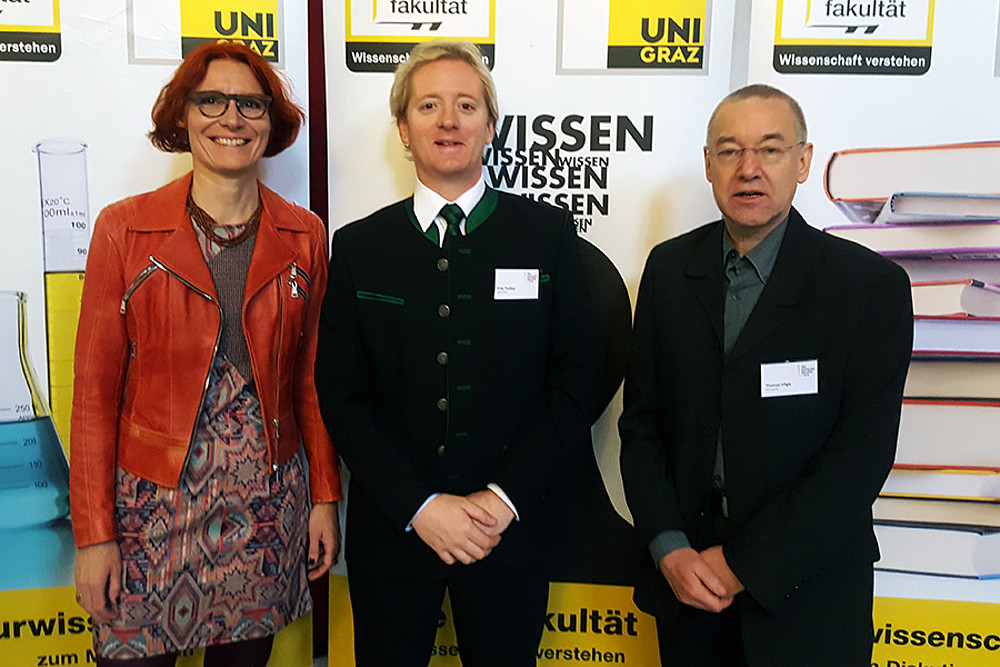
Fritz Treiber (Mitte) vom Geschmacklabor der Uni Graz konnte für die Tagung Barbara Bohle und Thomas Vilgis gewinnen. Foto: Uni Graz/Treiber

Fritz Treiber (Mitte) vom Geschmacklabor der Uni Graz konnte für die Tagung Barbara Bohle und Thomas Vilgis gewinnen. Foto: Uni Graz/Treiber

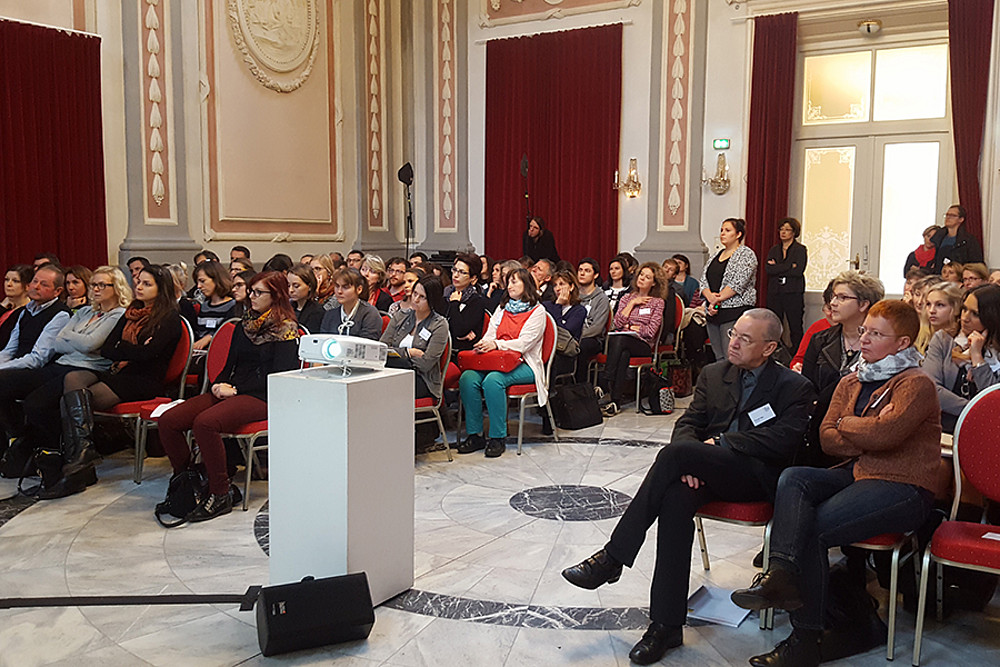
Großes Interesse: 120 BesucherInnen kamen zur Tagung ins Meerscheinschlössl.

Großes Interesse: 120 BesucherInnen kamen zur Tagung ins Meerscheinschlössl.

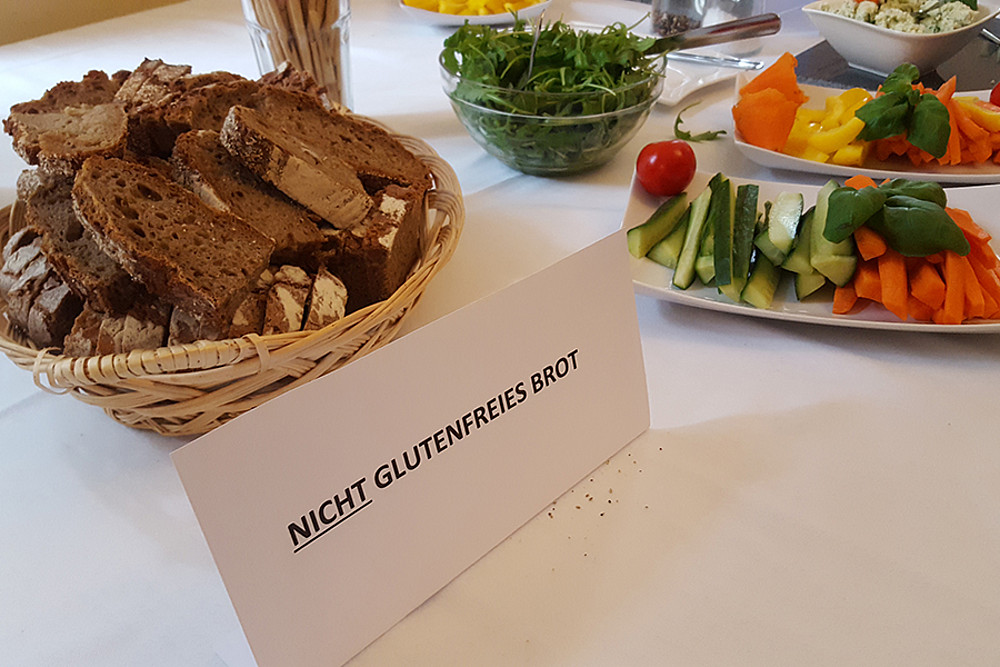
Kostproben gab's nicht nur aus der Wissesnchaft, sondern auch am Pausenbuffet.

Kostproben gab's nicht nur aus der Wissesnchaft, sondern auch am Pausenbuffet.

ForscherInnen servierten Wissenswertes zur Unverträglichkeit von Lebensmitteln leicht verständlich

Laktosefreie Milch, Brot ohne Gluten, Saucen ohne Glutamat: Die Supermarktregale sind voll mit Lebensmitteln, die auf KonsumentInnen mit Allergien und Unverträglichkeiten Rücksicht nehmen. „Wissenschaftliche Studien haben bestätigt, dass nur ein Prozent der Bevölkerung in der westlichen Welt an Zöliakie leidet und daher gänzlich auf Produkte mit Gluten verzichtet werden muss. Laut einer Umfrage in Österreich fühlen sich jedoch mehr als 15 Prozent unwohl, wenn sie Produkte mit Gluten konsumieren“, erläuterte Dr. Fritz Treiber vom Geschmackslabor der Uni Graz. Gründe genug, die wissenschaftlichen Hintergründe zu beleuchten: fundiert, leicht verständlich und aus verschiedenen Blickwinkeln. So geschehen im Rahmen der Tagung „Nahrungsmittelunverträglichkeit – Was Sie schon immer darüber wissen wollten“ am 26. November 2016 im Meerscheinschlössl der Karl-Franzens-Universität.
120 BesucherInnen informierten sich über den aktuellen Stand der Forschung. ExpertInnen klärten über die Hintergründe auf, das Publikum beteiligte sich rege an den anschließenden Diskussionen.

Prof. Dr. Thomas Vilgis vom Max-Planck Institut in Mainz berichtete, dass Glutamat zwar den Geschmack verstärkt aber auf keinen Fall die Ursache für das „China Restaurant Syndrom“ ist.
Prof. Barbara Bohle von der MedUni Wien erklärte, wie es zu einer Kreuzallergie in Bezug auf Nahrungsmitteln kommen kann und wie sich diese ausprägt.
Univ.-Prof. Dr. Andrea Grisold von der Med Uni Graz veranschaulichte die häufigsten Ursachen für Lebensmittelinfektionen: „Nicht jedes Bauchweh muss gleich eine Unverträglichkeit sein.“
Assoz. Prof. Dr. Sandra Holasek von der Med Uni Graz zeigte die Unterschiede zwischen Zöliakie und Weizensensitivität auf. Auch glutenfreie Alternativen in Bezug auf Brot und Gebäck wurden besprochen.
Prof. Frank Wuketits, Evolutionsbiologe und Philosoph von der Uni Wien, regte die TeilnehmerInnen mit seinem Vortrag „Werden wir unserer Natur noch gerecht – ein Plädoyer für artgerechte Menschenhaltung“ zum Nachdenken an.

Das Geschmackslabor ist Teil der 7. fakultät, des Zentrums frü Gesellschaft, Wissen und Kommunikation der Uni Graz. >> Mehr Info

created by Andreas Schweiger

Related news

Studying at the University of Graz: How to enrol

Ready for a new chapter in your life with the start of your studies at the University of Graz in the winter semester 2026/27? Here you will find information on deadlines, admission procedures, registration, and everything else you need to successfully start your studies in the fall.

Interpreting data: Why studies sometimes get it wrong

Hilmar Brohmer and Ziva Korda from the Institute of Psychology, together with 500 international colleagues, have re-evaluated a hundred scientific publications and have often come to different conclusions.

Crystal-clear: AI method revolutionises solar observation

The Sun makes life on Earth possible. However, its magnetic fields can also cause massive disruption. This makes it all the more important to gain a better understanding of the processes taking place on our nearest star. A research team from the University of Graz and the High Altitude Observatory in Boulder (USA) has succeeded in doing just that. The astrophysicists have developed an AI-supported method that makes even the smallest structures on the Sun visible. The scientists are convinced that this will bring about a lasting change in solar observation and that the new method can be used for the planned European Solar Telescope.

Long Night of Research: How many languages are there in the world?

From a linguistic perspective, there are worlds of difference between Bern, Berlin and Vienna. A dialect impersonator will demonstrate live just how varied German can sound. How many languages are there in the world? What are their distinctive features? Which of these are spoken in Austria? These and other questions will be answered during the Long Night of Research at the University of Graz: on Friday, 24 April 2025, from 5 pm to 11 pm, in the University Library. Visitors can immerse themselves in the diversity of languages without travelling far by taking part in a quiz at the station.

Begin of page section:
Additional information:

University of Graz
Universitaetsplatz 3
8010 Graz
Austria
  • Contact
  • Web Editors
  • Moodle
  • UNIGRAZonline
  • Imprint
  • Data Protection Declaration
  • Accessibility Declaration
Weatherstation
Uni Graz

End of this page section. Go to overview of page sections

End of this page section. Go to overview of page sections

Begin of page section:

End of this page section. Go to overview of page sections