Begin of page section:
Page sections:

  • Go to contents (Accesskey 1)
  • Go to position marker (Accesskey 2)
  • Go to main navigation (Accesskey 3)
  • Go to sub navigation (Accesskey 4)
  • Go to additional information (Accesskey 5)
  • Go to page settings (user/language) (Accesskey 8)
  • Go to search (Accesskey 9)

End of this page section. Go to overview of page sections

Begin of page section:
Page settings:

English en
Deutsch de
Search
Login

End of this page section. Go to overview of page sections

Begin of page section:
Search:

Search for details about Uni Graz
Close

End of this page section. Go to overview of page sections


Search

Begin of page section:
Main navigation:

Page navigation:

  • University

    University
    • About the University
    • Organisation
    • Faculties
    • Library
    • Working at University of Graz
    • Campus
    Developing solutions for the world of tomorrow - that is our mission. Our students and our researchers take on the great challenges of society and carry the knowledge out.
  • Research Profile

    Research Profile
    • Our Expertise
    • Research Questions
    • Research Portal
    • Promoting Research
    • Research Transfer
    • Ethics in Research
    Scientific excellence and the courage to break new ground. Research at the University of Graz creates the foundations for making the future worth living.
  • Studies

    Studies
    • Prospective Students
    • Students
  • Community

    Community
    • International
    • Location
    • Research and Business
    • Alumni
    The University of Graz is a hub for international research and brings together scientists and business experts. Moreover, it fosters the exchange and cooperation in study and teaching.
  • Spotlight
Topics
  • Sustainable University
  • Researchers answer
  • Work for us
Close menu

End of this page section. Go to overview of page sections

Begin of page section:
You are here:

University of Graz News Alles im Blick

End of this page section. Go to overview of page sections

Friday, 22 July 2022

Alles im Blick

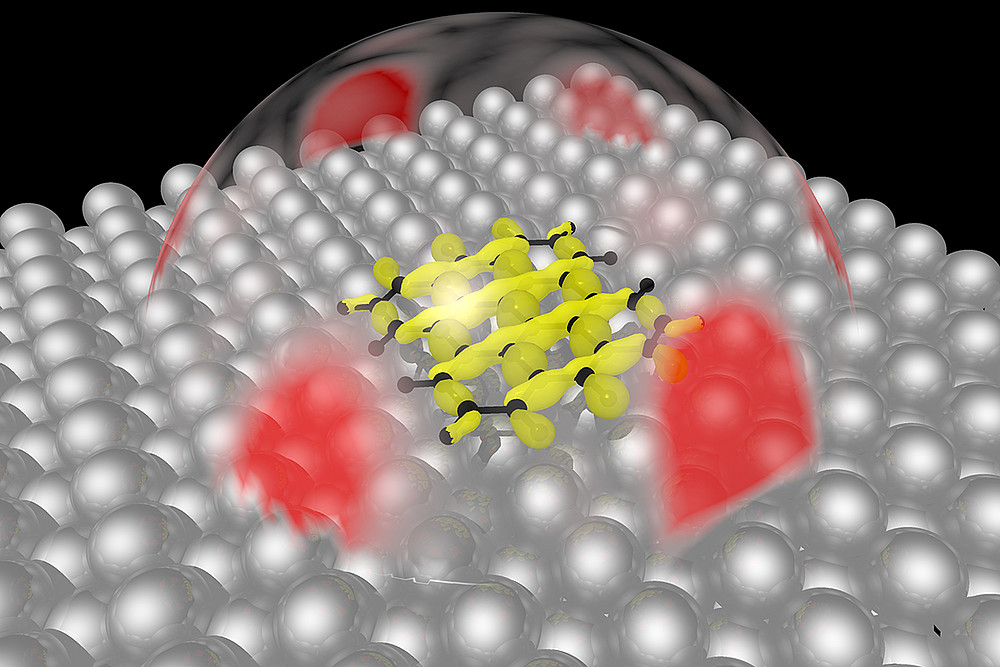
Illustration der Photoemissions-Orbital-Tomographie: Elektronen werden aus einem Sigma-Orbital (gelb) des Nanographene-Moleküls C28H14 (schwarz) herausgelöst, und deren Winkelverteilung wird gemessen (rot). Bild: P. Puschnig/Uni Graz ©Bild: P. Puschnig/Uni Graz

Illustration der Photoemissions-Orbital-Tomographie: Elektronen werden aus einem Sigma-Orbital (gelb) des Nanographene-Moleküls C28H14 (schwarz) herausgelöst, und deren Winkelverteilung wird gemessen (rot). Bild: P. Puschnig/Uni Graz

Neues Verfahren bildet Molekülorbitale umfassend ab

Orbitale zeigen – ähnlich wie eine Aufnahme mit Langzeitbelichtung –, wo sich Elektronen um ein Atom oder Molekül herum aufhalten. PhysikerInnen aus Graz, Jülich und Marburg ist nun ein wichtiger Schritt bei der Abbildung dieser räumlichen Verteilung geglückt. Ihnen gelang es erstmals, neben den sogenannten Pi-Orbitalen auch Sigma-Orbitale zu erfassen. Letztere sind insbesondere für die Bindungen zu Wasserstoffatomen in Kohlenwasserstoffen verantwortlich. Sie spielen somit eine wichtige Rolle bei chemischen Prozessen, die für die Speicherung von Wasserstoff – einem Energieträger der Zukunft – relevant sind. Die Darstellung hilft, den Ablauf chemischer Reaktionen auf molekularer Ebene noch genauer zu beobachten, wie die Forschenden in der renommierten Fachzeitschrift Science Advances berichten.

Vor einem Jahr hatten PhysikerInnen der Universität Graz, des Forschungszentrums Jülich und der Universitär Marburg eine Methode entwickelt, um Bilder von Elektronenorbitalen in extrem hoher zeitlicher Auflösung aufzunehmen. Die Ergebnisse erschienen im bekannten Fachjournal Science. Nun gelang es ihnen erstmals, durch eine Erweiterung des Energiebereichs mit dem Verfahren neben den Pi- auch Sigma-Orbitale sichtbar zu machen. „Dazu nutzen wir das an der Universität Graz entwickelte Messverfahren der Photoemissions-Orbital-Tomographie“, erläutert Peter Puschnig. „Bislang war es nicht möglich, die für die Bindung von Wasserstoffatomen relevanten Sigma-Orbitale abzubilden, weil zum einen die Energie der verwendeten Photonen nicht ausreichte und zum anderen die Analyse der Messdaten zu herausfordernd war.“ Das erste Problem konnte nun durch die neuen Experimente mit Synchrotronstrahlung an der Physikalisch-Technischen Bundesanstalt in Berlin in Zusammenarbeit mit Mathias Richter und Alexander Gottwald gelöst werden. Und für die Auswertung der Messdaten wurde in Puschnigs Arbeitsgruppe an der Universität Graz ein eigenes Softwarepaket entwickelt, das die detaillierte Analyse der Sigma-Orbitale erstmalig ermöglichte.

Die Arbeit ist das Ergebnis einer Kooperation der Uni-Graz-Physiker Peter Puschnig und Michael. G. Ramsey mit der Arbeitsgruppe um Stefan Tautz am Forschungszentrum Jülich. Michael Gottfried von der Universität Marburg unterstützte bei der Vorbereitung der Experimente.

Publikation
Momentum-space imaging of σ-orbitals for chemical analysis
Anja Haags, Xiaosheng Yang, Larissa Egger, Dominik Brandstetter, Hans Kirschner, François C. Bocquet, Georg Koller, Alexander Gottwald, Mathias Richter, J. Michael Gottfried, Michael G. Ramsey, Peter Puschnig, Serguei Soubatch, F. Stefan Tautz
Science Advances, 22.07.2022, DOI: 10.1126/sciadv.abn0819

created by Gudrun Pichler

Related news

Cosmetics in the environment: University of Graz proves danger to ants

Titanium dioxide, which is found in cosmetics, for example, is increasingly entering the environment in the form of nanoparticles. This could also put insects at risk. If ants ingest the substance in combination with the pesticide glyphosate, it disturbs the development of their offspring. Scientists at the University of Graz are drawing attention to the negative consequences of this toxic cocktail.

How are tech companies changing democracy? Uni Graz designs exhibition for schools

Filtered information, conspiracy theories, fake news – certain groups and corporations are using social media and algorithms to try to influence public opinion in their favour. Their goal: to weaken fundamental rights and diversity of opinion and seize power. In a new exhibition, researchers at the University of Graz are working with pupils to explore the impact of social media and AI on democracy. In accompanying workshops, the scientists want to encourage young people to develop their own ideas for a socially and ecologically viable future and to actively help shape it. The exhibition, designed as a travelling exhibition for schools, will open on 9 March 2026 at the Dreihackengasse Gymnasium in Graz.

Step by step: What motivates Mireille van Poppel as a scientist and vice-rector

Improving people's health and eliminating inequalities: Mireille van Poppel pursues these goals both as a public health researcher and as vice-rector for Internationalisation and Equality. In both roles, she pays particular attention to individual needs.

Master's degree in psychotherapy in Graz: registration opens in March

Graz is becoming a hotspot for psychotherapy: from 2026, the University of Graz and the Medical University of Graz will jointly offer the new master's programme. Registration for the admission procedure for the 140 study places will start in March.

Begin of page section:
Additional information:

University of Graz
Universitaetsplatz 3
8010 Graz
Austria
  • Contact
  • Web Editors
  • Moodle
  • UNIGRAZonline
  • Imprint
  • Data Protection Declaration
  • Accessibility Declaration
Weatherstation
Uni Graz

End of this page section. Go to overview of page sections

End of this page section. Go to overview of page sections

Begin of page section:

End of this page section. Go to overview of page sections