Begin of page section:
Page sections:

  • Go to contents (Accesskey 1)
  • Go to position marker (Accesskey 2)
  • Go to main navigation (Accesskey 3)
  • Go to sub navigation (Accesskey 4)
  • Go to additional information (Accesskey 5)
  • Go to page settings (user/language) (Accesskey 8)
  • Go to search (Accesskey 9)

End of this page section. Go to overview of page sections

Begin of page section:
Page settings:

English en
Deutsch de
Search
Login

End of this page section. Go to overview of page sections

Begin of page section:
Search:

Search for details about Uni Graz
Close

End of this page section. Go to overview of page sections


Search

Begin of page section:
Main navigation:

Page navigation:

  • University

    University
    • About the University
    • Organisation
    • Faculties
    • Library
    • Working at University of Graz
    • Campus
    Developing solutions for the world of tomorrow - that is our mission. Our students and our researchers take on the great challenges of society and carry the knowledge out.
  • Research Profile

    Research Profile
    • Our Expertise
    • Research Questions
    • Research Portal
    • Promoting Research
    • Research Transfer
    • Ethics in Research
    • Commission for Scientific Integrity
    Scientific excellence and the courage to break new ground. Research at the University of Graz creates the foundations for making the future worth living.
  • Studies

    Studies
    • Prospective Students
    • Students
    • Registration for Study Programme (Winter semester 2026/27)
    • Welcome Weeks for First Year Students
  • Community

    Community
    • International
    • Location
    • Research and Business
    • Alumni
    The University of Graz is a hub for international research and brings together scientists and business experts. Moreover, it fosters the exchange and cooperation in study and teaching.
Topics
  • Sustainable University
  • Researchers answer
  • Work for us
Close menu

End of this page section. Go to overview of page sections

Begin of page section:
You are here:

University of Graz News Of mussels and machines

End of this page section. Go to overview of page sections

Tuesday, 24 September 2024

Of mussels and machines

Biologists from the University of Graz have brought a water quality monitoring project ashore. The COLIBRI profile area is also organising the first conference on the Complexity of Life this week.

Animal-like robots that monitor water quality in lakes and oceans are to be developed in the EU-funded BioDiMoBot project. The Department of Biology is coordinating this project, which is funded with a total of eight million euros over five years. Partners are the Universities of Brussels, Pisa and Durham (UK), an English fishing company and a Graz-based business consultant.
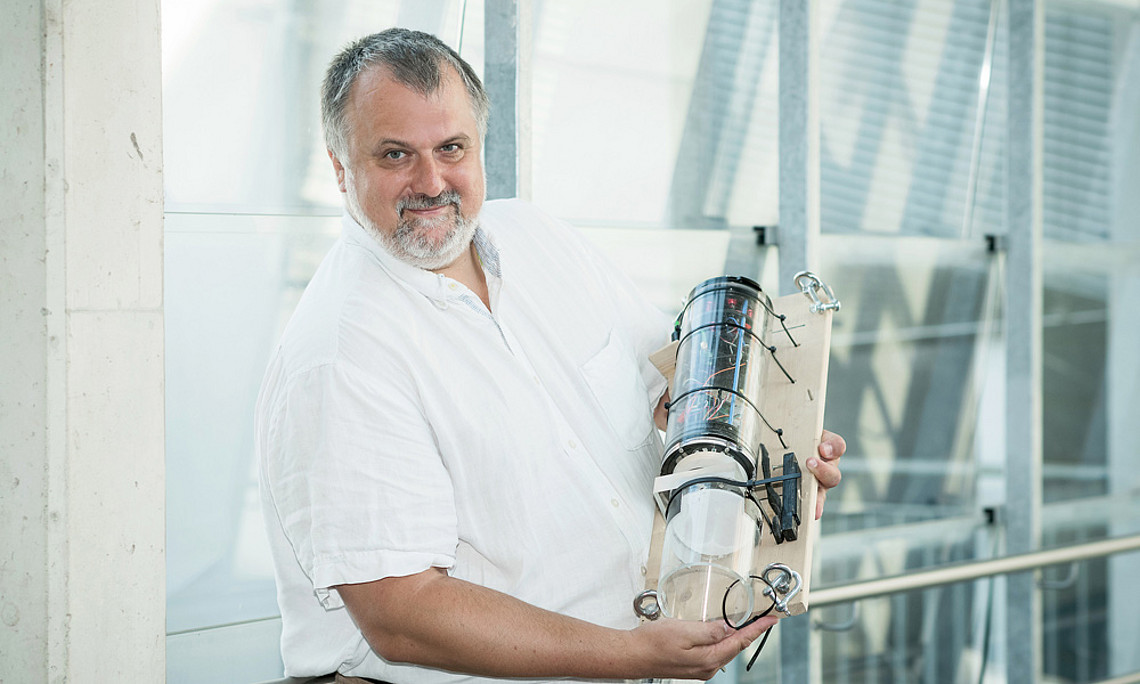
"Our aim is to produce so-called biohybrid robots that record the animals' behavioral data in addition to classic water quality parameters such as temperature, turbidity and pH value," reports coordinator Ronald Thenius. Artificial intelligence supports the scientists in evaluating the data. The measuring systems developed are to be made available to a broad scientific community and other interested groups in order to enable optimised water management and more sustainable yields in fisheries.
BioDiMoBot will be launched in 2025 and by the middle of next year, the robots will send information from Austrian lakes, coastal fisheries in England, Ireland, Iceland and Greenland as well as in natural areas in the same regions.

Linking biology and technology
The project builds on the results of previous research from the "Complexity of Life in Basic Research and Innovation" (COLIBRI) priority area, such as subCULTron and Robocoenosis, and extends their scope to include coastal marine ecosystems. How to decipher complex biological systems and their function is also the topic of the Complexity of Life Conference, which is taking place this week at the University of Graz. Scientists from various fields, from experimental biology to physics and mathematics, are coming together to discuss the latest advances in one of the most important research questions of the 21st century.


Ronald Thenius presents the prototype of a biohybrid robot. Photo: Christa Strobl
created by Dagmar Eklaude

Related news

Surprise, spectacle, science: Astrophysicists observed a partial solar eclipse

The star of the show was the sun, and the programme featured a natural spectacle: the partial solar eclipse on the evening of 12 August 2026 drew crowds to Graz’s Schloßberg. The ‘sun-downer’ was accompanied by a dash of science from astrophysicists at the University of Graz.

Discussions on Europe’s digital future are taking place in Graz

Exactly three months before the event, the Technology Impact Summit (TIS) team is unveiling the programme for this year’s think tank event.

Preserving cultural heritage: Graz researchers make Roman inscriptions legible again

Researchers from the University of Graz and Graz University of Technology are working to save inscriptions carved in stone in Styria during Roman times from disappearing. They have developed a simple and cost-effective method to make inscriptions on tombs and votive altars – which have been weathered or damaged – legible again. They are currently testing the method on Roman stones at several sites across Styria. The aim is to provide other historians with a tool to preserve cultural heritage when expensive research equipment is not available. The method was recently published in the research journal Heritage Science.

Muscheln zum Messen

In einem revolutionären Gerät ersetzen Lebewesen elektronische Sensoren

Begin of page section:
Additional information:

University of Graz
Universitaetsplatz 3
8010 Graz
Austria
  • Contact
  • Web Editors
  • Moodle
  • UNIGRAZonline
  • Imprint
  • Data Protection Declaration
  • Accessibility Declaration
Weatherstation
Uni Graz

End of this page section. Go to overview of page sections

End of this page section. Go to overview of page sections

Begin of page section:

End of this page section. Go to overview of page sections