


In mid-November 2026, the AI community is in a right state of excitement. But it is not a new model or a spectacular stock market flotation that is causing the stir; it is the co-founder of the chip manufacturer Nvidia, Jensen Huang. After news emerged of an affair with a Chinese spy who had smuggled modern AI chips from Nvidia into China despite embargoes, Huang stepped down as head of the company after 33 years. It is yet another sign of disillusionment. For months now, analysts have been questioning the business models of the major AI companies, and the reckless expansion of data centres in the US is likely one reason for the Democrats’ victory in the US elections in early November. Yet, despite all the criticism, one thing is clear to everyone: AI as a technology is here to stay.
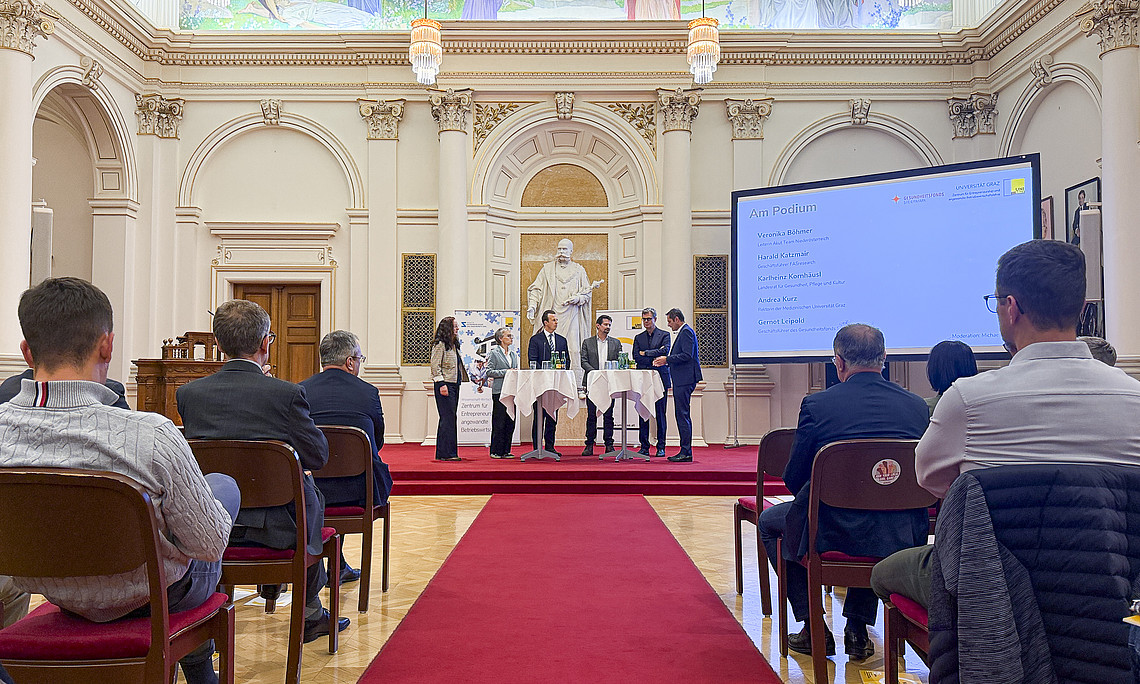
Consequently, the rules governing the use of AI systems in the EU are now becoming stricter. Despite opposition from technology conglomerates, the AI Act is being implemented step by step. From summer 2026, for example, AI-generated content must be labelled as such; the transition period for this expires in December. Amidst this complex situation, the University of Graz, Graz University of Technology, FH Joanneum and Joanneum Research hosted the Technology Impact Summit for the third time. A high-calibre group of experts gathered here to discuss what Europe’s future might look like in the digital age.
Equipping people with skills
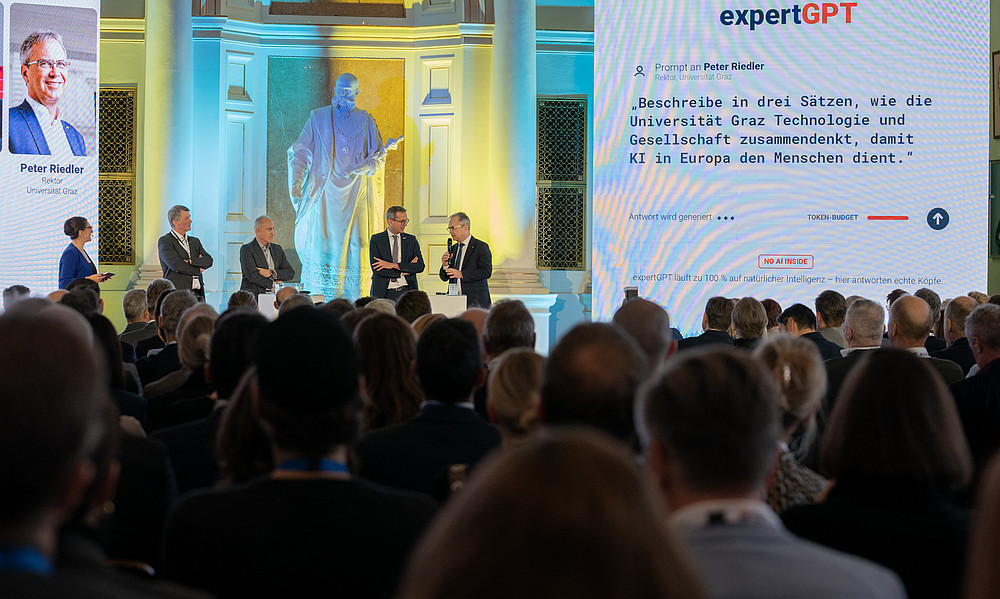
The event kicked off with the hosts, who were asked to share their perspectives on the future of their institutions in the age of digitalisation. Peter Riedler, Rector of the University of Graz, emphasised how important it is to familiarise staff and students with AI tools at an early stage. FH Joanneum Managing Director Martin Payer stressed that the AI race can only be won if skilled workers are equipped with the necessary skills. Heinz Mayer, Managing Director of Joanneum Research, highlighted just how much AI is already being used all around us today, from ‘listening’ tunnels to drones that save lives. Horst Bischof, Rector of Graz University of Technology, demonstrated how technology from Graz is already setting global standards.
Data centres are essential
Agnes Heftberger, Corporate Vice President & CEO at Microsoft Germany & Austria, then explained why Europe cannot do without AI. “The long-term growth forecasts do not look good for Austria.” However, through the widespread use of AI tools, the country could generate up to 18 per cent additional growth in ten years’ time and put Austria back on the front foot.
Moreover, it is not so crucial where the models come from. “The much more important question is: how do we use the technology and make the most of it for ourselves?” And for that, two fundamental prerequisites are needed. “We must equip our staff with AI expertise and build up specialist knowledge in the application of these tools. And we need data centres, as these are the infrastructure of the future.”
Following this, Philipp Amann, an ECB cybersecurity expert; start-up founder Daniel Keinrath; AVL List manager Georg List; TU professor Stefan Mangard; and Austrian Startups managing director Hannah Wundsam debated the question of what a sovereign Europe actually means. There was consensus amongst the panellists on the topic of ‘humanising’ AI. Even the best Frontier models are still a long way from making their own decisions. Although the media may suggest otherwise, these agents do not act on their own initiative. They do exactly what humans tell them to do. Dependence on major cloud providers such as Microsoft is viewed critically. These companies are, after all, based in the US, and the authorities there have legal access to the data, regardless of where it is stored. Nevertheless, one should not resist AI, but rather use it to strengthen one’s own sovereignty.
In practice
Eight real-world examples presented in the afternoon demonstrated how this can be acchieved. Andreas Diensthuber and Martin Holler, a professor at the University of Graz, presented the DaphOS system. This AI tool enables the automation of planning processes in the healthcare sector. The first step was the creation of duty rosters, which is a particularly time-consuming task in hospitals. What previously took up to 1.5 hours of working time can now be done in a matter of minutes. In a further phase of development, predictive models are now to be created based on existing information to make bed planning more efficient.
Susanne Stein-Pressl and Leif-Nissen Lundbaek have equipped the long-established legal publisher Manz with an AI model. The result is Manz-Noxtua. The system can search through Austrian laws and other legal provisions. As accuracy is particularly important in the legal field, great emphasis was placed on processing the data correctly. The results must be transparent and, above all, citable. In addition to research, Manz-Noxtua can also be used to analyse and review documents.
However, not every company wishes to process sensitive data via cloud services. Helmut Lindner and Sabine Proßnegg from FH Joanneum have developed Radius, an AI prototype that can run directly on a company’s own hardware. Whilst this is not as comprehensive as the well-known AI chatbots in the cloud, it does mean the company has everything under its own control. Cost analyses have shown that, in the long term, this can be more cost-effective than cloud solutions even for firms with as few as 25 users.
Innovation causes division
The event concluded with a presentation by futurologist Tristan Horx. He highlighted that the era of megatrends is over, as there are now numerous counter-trends, not only in society but also in politics. In the field of social media in particular, the rule of law has, to a greater or lesser extent, allowed an entire generation to grow up without rules. However, this is changing.
That said, this is not solely due to the planned age restrictions. Rather, it is AI chatbots in particular that are providing a counterbalance to the social division fuelled by social media. Generation Alpha, born after 2010, simply asks the AI instead of Google or Instagram. And the AI tends to provide more politically balanced answers. Horx’s thesis: following a generation without rules on social media, a new wave of innovation is now bringing about a correction.
Translated with DeepL