Begin of page section:
Page sections:

  • Go to contents (Accesskey 1)
  • Go to position marker (Accesskey 2)
  • Go to main navigation (Accesskey 3)
  • Go to sub navigation (Accesskey 4)
  • Go to additional information (Accesskey 5)
  • Go to page settings (user/language) (Accesskey 8)
  • Go to search (Accesskey 9)

End of this page section. Go to overview of page sections

Begin of page section:
Page settings:

English en
Deutsch de
Search
Login

End of this page section. Go to overview of page sections

Begin of page section:
Search:

Search for details about Uni Graz
Close

End of this page section. Go to overview of page sections


Search

Begin of page section:
Main navigation:

Page navigation:

  • University

    University
    • About the University
    • Organisation
    • Faculties
    • Library
    • Working at University of Graz
    • Campus
    Developing solutions for the world of tomorrow - that is our mission. Our students and our researchers take on the great challenges of society and carry the knowledge out.
  • Research Profile

    Research Profile
    • Our Expertise
    • Research Questions
    • Research Portal
    • Promoting Research
    • Research Transfer
    • Ethics in Research
    • Commission for Scientific Integrity
    Scientific excellence and the courage to break new ground. Research at the University of Graz creates the foundations for making the future worth living.
  • Studies

    Studies
    • Prospective Students
    • Students
    • Registration for Study Programme (Winter semester 2026/27)
  • Community

    Community
    • International
    • Location
    • Research and Business
    • Alumni
    The University of Graz is a hub for international research and brings together scientists and business experts. Moreover, it fosters the exchange and cooperation in study and teaching.
Topics
  • Sustainable University
  • Researchers answer
  • Work for us
Close menu

End of this page section. Go to overview of page sections

Begin of page section:
You are here:

University of Graz News Allen voran

End of this page section. Go to overview of page sections

Wednesday, 18 December 2019

Allen voran

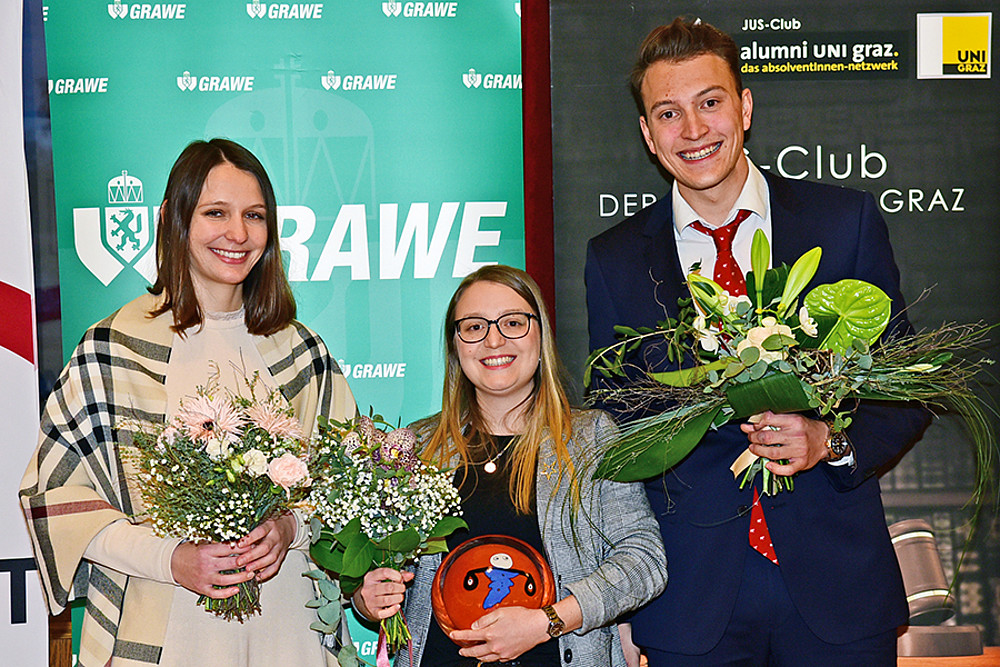
Die besten drei AbsolventInnen des Diplomstudiums der Rechtswissenschaften 2018/19 (v.l.): Christina Seewald (3.), Yvonne Kraudinger (1.) und Julian Stefan Schnur (2.). Foto: Uni Graz/Pichler

Die besten drei AbsolventInnen des Diplomstudiums der Rechtswissenschaften 2018/19 (v.l.): Christina Seewald (3.), Yvonne Kraudinger (1.) und Julian Stefan Schnur (2.). Foto: Uni Graz/Pichler

Die Rechtswissenschaftliche Fakultät zeichnete ihre besten AbsolventInnen und Dissertationen des Studienjahres 2018/19 aus

Ihre Namen eingraviert in einer Tafel, angebracht im RESOWI-Zentrum der Universität Graz – so werden die besten drei AbsolventInnen des Diplomstudiums der Rechtswissenschaften eines jeden Studienjahres verewigt. Heuer sind dies Yvonne Kraudinger (1.), Julian Stefan Schnur (2.) und Christina Seewald (3.). Am 13. Dezember 2019 wurden sie im Rahmen von „Best of REWI“ in der Aula ausgezeichnet.
Die Veranstaltung würdigt seit 21 Jahren hervorragende Studienleistungen. Im Rampenlicht stehen die 15 besten AbsolventInnen, wobei über das Ranking der Notendurchschnitt, kombiniert mit der Studiendauer, entscheidet. Unter den Abschlussarbeiten wurden heuer die acht hervorragendsten Dissertationen der Rechtswissenschaftlichen Fakultät prämiert.

Alle Ausgezeichneten durften sich über eine Urkunde und Preise freuen und wurden in das "Ehrenbuch der Fakultät" aufgenommen. Auf die Jahrgangsbeste wartete der traditionelle REWI-Award, kreiert vom Glaskünstler H.W. Hundstorfer. Langjähriger Sponsor ist die Grazer Wechselseitige Versicherung, ebenso wie der JUS-Club, eine Sektion des alumni UNI graz, sowie die Grazer Juristische Gesellschaft.

Die Top 15 von 286 AbsolventInnen des Diplomstudiums der Rechtswissenschaften im Studienjahr 2018/19 in absteigender Reihenfolge:
Yvonne Kraudinger, Julian Stefan Schnur, Christina Seewald, Julian Pekler, David Michael Schneeberger, Kathrin Wawra, Nikolas Raunigg, Manuel Ciarnau, Jakub Bojkovsky, Magdalena Christina Weichsler, Sophie Klocker, Nina Kerschbaumer, Daniel Sudi, Stefan Heiß, Anna Josefa Kumpitsch

Die besten Dissertationen des vergangenen Studienjahres:

  • Florian Caks: Potential and Limits of Information as A Means of Consumer Protection: Normative Conclusions from Behavioural Insights in the Effectiveness of Pre-Contractual Information Provisions for Mobile Telecommunications and Financial Services
  • Sebastian Gölly: § 2 StGB –  Begehung durch Unterlassung im österreichischen Strafrecht
  • Georg Jeremias: Die Deckungsablehnung des Versicherers nach § 12 VersVG
  • Rahim Rastegar: Die Gesellschafterklage in der GmbH
  • Stefan Salomon: Constructing Europe. A Spatial-theoretical Analysis of the Construction of Territory in International Law and EU Law
  • Christina Schnittler: Ausbildungsverhältnisse aus arbeits- und sozialrechtlicher Perspektive
  • Anja Stahr: Zivilrechtliche Aspekte der medizinischen Behandlung Minderjähriger
  • Sandra Tauß-Grill: Internationale Abgabenbehördenkooperation im Spannungsfeld zwischen Geheimnisschutz und öffentlichem Besteuerungsinteresse. Eine Untersuchung im Bereich der direkten Steuern
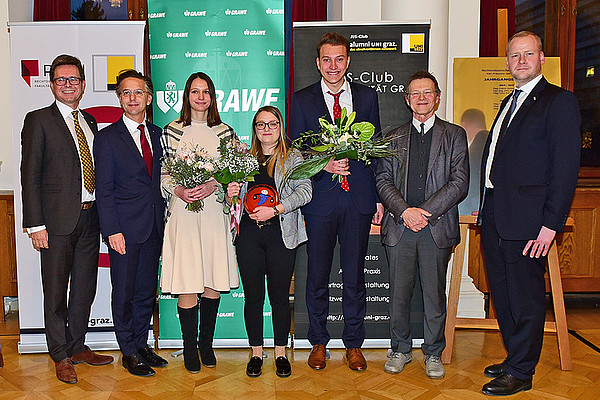
V.l.: Rektor Martin Polaschek, GRAWE-Generaldir.-Stv. Gernot Reiter, die Top 3 Christina Seewald (3), Yvonne Kraudinger (1), Julian Schnur (2), Günther Löschnigg, Vorsitzender Best-of-REWI-Kommission, REWI-Dekan Christoph Bezemek. Foto: Uni Graz/Pichler
V.l.: Rektor Martin Polaschek, GRAWE-Generaldirektor-Stellvertreter Gernot Reiter, die Top-AbsolventInnen Christina Seewald (3.), Yvonne Kraudinger (1.) und Julian Stefan Schnur (2.), der Vorsitzende der Best-of-REWI-Kommission Günther Löschnigg und Christoph Bezemek, Dekan der Rechtswissenschaftlichen Fakultät. Foto: Uni Graz/Pichler
created by Gudrun Pichler

Related news

Complying with the norm: Why Do Standards Shape Our Lives, Elisabeth Staudegger?

Standards determine whether a sheet of paper fits in a printer or whether a charging plug can power multiple devices. These standards shape our everyday lives. But who actually sets these standards? Where are the weaknesses, and how could science help to improve them? Elisabeth Staudegger, Head of the ‘Law and IT’ Department at the Institute for Legal Foundations at the University of Graz, host the Academic Standards Day on 16 June. Here she relays how sciences can contribute to the topic of standardisation and reveals her personal favourite standard.

More body awareness than a culture war

In Italy, sex education lessons will in future only be permitted with parental consent, and will be banned entirely in nurseries and primary schools. At the same time, Pride Month highlights why knowledge about the body, relationships, boundaries and diversity is important for young people. A study by the University of Graz shows how important knowledge about the body, contraception, relationship skills and protection against violence is

Will Austria win the World Cup? Mathematician reveals calculation method

Michael Fischer uses the football tournament as a practical example for highschool lessons.

Survival strategies: How plants respond to drought

According to Geosphere Austria, this spring was the driest in Austria since records began around 170 years ago. The low rainfall put particular pressure on the agricultural sector. And climate change is set to make the situation even worse in the coming decades. We asked Johannes Liesche, a professor at the Department of Biology at the University of Graz, how plants react to water shortages and how they survive periods of drought.

Begin of page section:
Additional information:

University of Graz
Universitaetsplatz 3
8010 Graz
Austria
  • Contact
  • Web Editors
  • Moodle
  • UNIGRAZonline
  • Imprint
  • Data Protection Declaration
  • Accessibility Declaration
Weatherstation
Uni Graz

End of this page section. Go to overview of page sections

End of this page section. Go to overview of page sections

Begin of page section:

End of this page section. Go to overview of page sections