Begin of page section:
Page sections:

  • Go to contents (Accesskey 1)
  • Go to position marker (Accesskey 2)
  • Go to main navigation (Accesskey 3)
  • Go to sub navigation (Accesskey 4)
  • Go to additional information (Accesskey 5)
  • Go to page settings (user/language) (Accesskey 8)
  • Go to search (Accesskey 9)

End of this page section. Go to overview of page sections

Begin of page section:
Page settings:

English en
Deutsch de
Search
Login

End of this page section. Go to overview of page sections

Begin of page section:
Search:

Search for details about Uni Graz
Close

End of this page section. Go to overview of page sections


Search

Begin of page section:
Main navigation:

Page navigation:

  • University

    University
    • About the University
    • Organisation
    • Faculties
    • Library
    • Working at University of Graz
    • Campus
    Developing solutions for the world of tomorrow - that is our mission. Our students and our researchers take on the great challenges of society and carry the knowledge out.
  • Research Profile

    Research Profile
    • Our Expertise
    • Research Questions
    • Research Portal
    • Promoting Research
    • Research Transfer
    • Ethics in Research
    Scientific excellence and the courage to break new ground. Research at the University of Graz creates the foundations for making the future worth living.
  • Studies

    Studies
    • Prospective Students
    • Students
  • Community

    Community
    • International
    • Location
    • Research and Business
    • Alumni
    The University of Graz is a hub for international research and brings together scientists and business experts. Moreover, it fosters the exchange and cooperation in study and teaching.
  • Spotlight
Topics
  • Our digital Advent calendar
  • Sustainable University
  • Researchers answer
  • Work for us
Close menu

End of this page section. Go to overview of page sections

Begin of page section:
You are here:

University of Graz News Alle für eineN

End of this page section. Go to overview of page sections

Friday, 12 March 2021

Alle für eineN

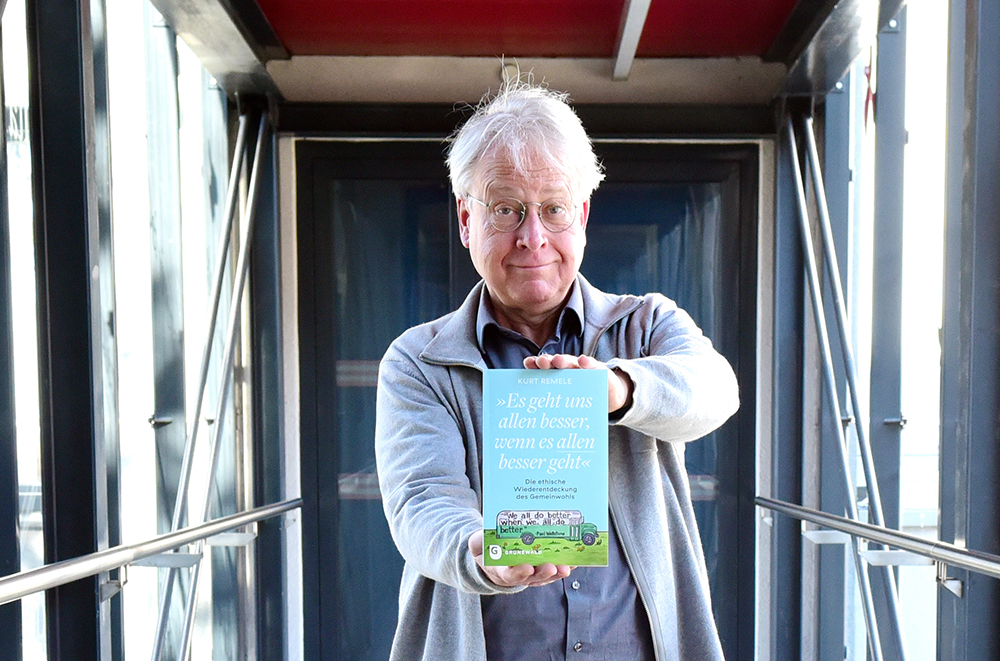
Ethiker Kurt Remele Foto: Uni Graz/Schweiger

Ethiker Kurt Remele: "Wir haben das Gemeinwohl wiederentdeckt." Foto: Uni Graz/Schweiger

Geht es mir besser, wenn es den anderen gut geht? Ja, sagt Ethiker Kurt Remele. Wir haben das Gemeinwohl wiederentdeckt.

Viele schränken sich ein, viele verzichten. Um andere zu schützen. Gemeinwohl lautet die Parole, die mit der ersten Virus-Welle vor einem Jahr ausgegeben wurde. Von einer „Wiederentdeckung“ spricht Kurt Remele, Ethiker an der Universität Graz, in seinem neuen Buch „Es geht uns besser, wenn es allen gut geht.“ Remele ordnet dieses Revival auch als Reaktion ein: „auf ungezügelten Kapitalismus und soziokulturellen Narzissmus, politischen Nationalismus und digitalen Individualismus.“

Das Wohl der Gemeinschaft schließt jenes der Einzelnen aber keinesfalls aus. „Das Wohlergehen des Individuums und der Gesellschaft stehen immer in Beziehung, es muss etwa Grund- und Menschenrechte sowie Minderheiten berücksichtigen“, appelliert der Professor für Ethik und Gesellschaftslehre. Tiere gehören für ihn ebenso zum Gemeinwohl wie Fragen des Klimawandels. Diese Themen seien ja meist mit Einschränkungen verbunden. Letztendlich geht es darum, die Balance zu finden und sinnstiftend zu vermitteln.

„Gemeinwohl muss stets ausverhandelt werden, egal ob in einer Gesellschaft, in einem Staat oder in der Familie.“ Aber es wurde auch ideologisch missbraucht, wie er in seinem Buch aufzeigt.

Als Theologe setzt sich der Autor naturgemäß mit der katholischen Soziallehre auseinander: „Solidarität füreinander ist nicht so sehr Schranke und Begrenzung des eigenen Freiheitsdrangs, sondern ergänzt und ermöglicht vor allem die Selbstverwirklichung und Selbstgestaltung der einzelnen Person.“ Das beschreibt Kurt Remele zu Beginn seines neuen Buches am Beispiel des anglikanischen Bischofs David Sheppard und seines katholischen Amtsbruders Derek Worlock. Die beiden haben sich Ende des 20. Jahrhunderts im britischen Liverpool in Klassen- und Straßenkämpfe und gesellschaftliche Auseinandersetzungen eingemischt und sind tatkräftig für das Gemeinwohl der Menschen eingetreten.

„Es geht uns besser, wenn es allen gut geht. Die ethische Wiederentdeckung des Gemeinwohls." von Kurt Remele ist im Verlag Grünewald erschienen.

created by Andreas Schweiger

Related news

Semester abroad without barriers: University of Graz wins award for promoting inclusion

The University of Graz has been awarded the Internationalization Award for its new inclusion initiative. Students with fewer opportunities now also receive financial support for their semester abroad outside Europe.

Fair distribution: Researchers determine just greenhouse gas budgets for all EU regions

Ten years ago, on 12 December 2015, the Paris Climate Agreement was signed at the UN Climate Conference. In order to limit global warming to well below two degrees, only a certain amount of CO2 may be emitted worldwide. While the focus was originally on national emission targets, more than 200 subnational regions and almost 300 cities have now adopted their own targets. But how many emissions are they fairly entitled to? Researchers at the University of Graz have now developed transparent criteria for fair distribution at the subnational level for the first time and determined corresponding greenhouse gas budgets for all European regions. The paper was published today in the scientific journal Nature Communications.

Chemical Christmas show at the University of Graz: An explosive evening at the Schauspielh

At the beginning of December, the University of Graz transformed the theater into a laboratory: as part of “Chemical Life,” teacher training students staged a chemical Christmas show for Styrian school classes—complete with ethanol rockets, nitrogen snow, and glowing effects. An evening designed to inspire interest in studying chemistry.

Train by train: Koralm railway accelerates exchange between the Universities

Lectures at the University of Klagenfurt in the morning, seminars at the University of Graz in the afternoon: Austria's longest tunnel and a journey time of around 45 minutes make it easy. The Koralm railway increases the speed of networking between the two university locations. The collaboration builds on existing cooperation - for example in the areas of teacher training, Slavic studies and as employers, the universities are well coordinated.

Begin of page section:
Additional information:

University of Graz
Universitaetsplatz 3
8010 Graz
Austria
  • Contact
  • Web Editors
  • Moodle
  • UNIGRAZonline
  • Imprint
  • Data Protection Declaration
  • Accessibility Declaration
Weatherstation
Uni Graz

End of this page section. Go to overview of page sections

End of this page section. Go to overview of page sections

Begin of page section:

End of this page section. Go to overview of page sections