Begin of page section:
Page sections:

  • Go to contents (Accesskey 1)
  • Go to position marker (Accesskey 2)
  • Go to main navigation (Accesskey 3)
  • Go to sub navigation (Accesskey 4)
  • Go to additional information (Accesskey 5)
  • Go to page settings (user/language) (Accesskey 8)
  • Go to search (Accesskey 9)

End of this page section. Go to overview of page sections

Begin of page section:
Page settings:

English en
Deutsch de
Search
Login

End of this page section. Go to overview of page sections

Begin of page section:
Search:

Search for details about Uni Graz
Close

End of this page section. Go to overview of page sections


Search

Begin of page section:
Main navigation:

Page navigation:

  • University

    University
    • About the University
    • Organisation
    • Faculties
    • Library
    • Working at University of Graz
    • Campus
    Developing solutions for the world of tomorrow - that is our mission. Our students and our researchers take on the great challenges of society and carry the knowledge out.
  • Research Profile

    Research Profile
    • Our Expertise
    • Research Questions
    • Research Portal
    • Promoting Research
    • Research Transfer
    • Ethics in Research
    Scientific excellence and the courage to break new ground. Research at the University of Graz creates the foundations for making the future worth living.
  • Studies

    Studies
    • Prospective Students
    • Students
  • Community

    Community
    • International
    • Location
    • Research and Business
    • Alumni
    The University of Graz is a hub for international research and brings together scientists and business experts. Moreover, it fosters the exchange and cooperation in study and teaching.
  • Spotlight
Topics
  • Our digital Advent calendar
  • Sustainable University
  • Researchers answer
  • Work for us
Close menu

End of this page section. Go to overview of page sections

Begin of page section:
You are here:

University of Graz News Cell Tools

End of this page section. Go to overview of page sections

Tuesday, 11 October 2022

Cell Tools

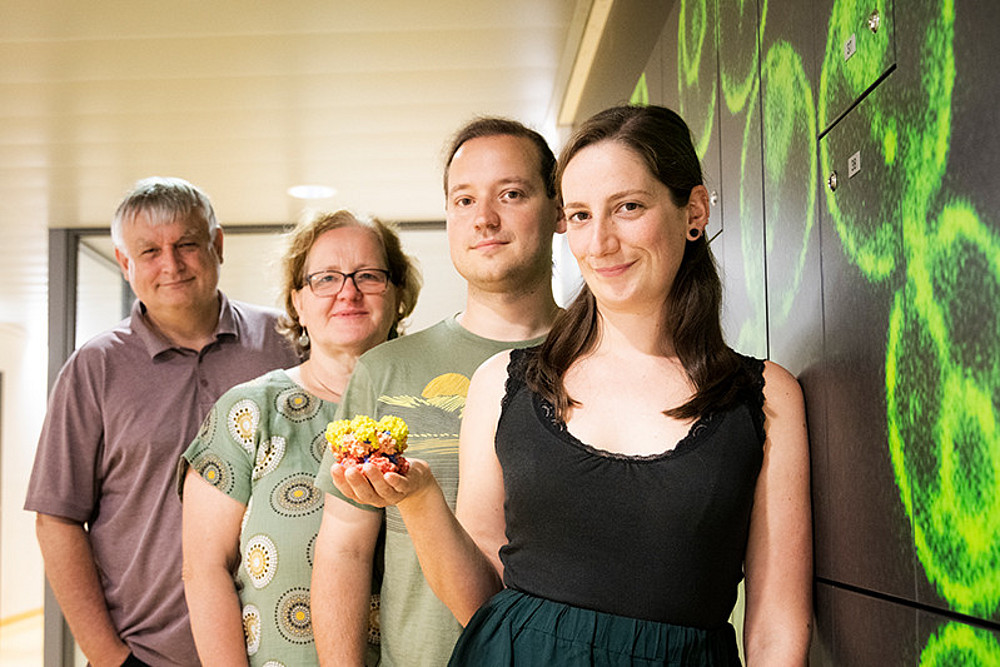
Helmut Bergler, Gertrude Zisser, Michael Prattes and Magdalena Gerhalter (from left) with a 3D print of the protein Drg1. It plays an important role in the assembly of ribosomes. Photo: Uni Graz/Tzivanopoulos.

Helmut Bergler, Gertrude Zisser, Michael Prattes and Magdalena Gerhalter (from left) with a 3D print of the protein Drg1. It plays an important role in the assembly of ribosomes. Photo: Uni Graz/Tzivanopoulos.

Researchers observe molecular machines at work

For a cell to survive, it needs protein. It can produce these proteins itself, using ribosomes. Even these “biological machines”, however, first need to be assembled – and this assembly is an ongoing process. Like all complex machines, ribosomes are made up of many different individual elements. A team of researchers from the Institute of Molecular Biosciences at the University of Graz and the Research Institute of Molecular Pathology (IMP) in Vienna has now made an important step in this production process visible at the molecular level for the first time. “This special process is vital for ensuring that ribosomes are assembled correctly,” explains first author Michael Prattes from the Molecular Biology Department at the University of Graz. The results can be read as a cover story in the September issue of the journal Nature Structural and Molecular Biology.

Their work specifically concerns a protein called Drg1, which binds to preribosomal particles during assembly, and sequesters certain “tools”. “These proteins are also responsible for transporting and assembling individual elements and checking the general progress at the assembly site,” explains last author Helmut Bergler. The timely displacement of these tools is vital because, by this point, they are already needed elsewhere. “If there is a bottleneck in the production chain, the entire process is at risk. This can help tumours grow or disrupt brain development,” says David Haselbach from IMP Vienna. The research team has now been able to observe how Drg1 converts chemical energy into mechanical work and thus successfully detaches the protein tool after completing its task.

This glimpse into the innermost “gears” is essential for the treatment of various diseases. Cancer cells, for example, divide very quickly, meaning that they need to produce more ribosomes than healthy cells. Substances that slow down the production of ribosomes could, therefore, be promising candidates for new drugs to combat cancer. However a better understanding of Drg1 can also prove useful when conducting research into certain hereditary diseases. If a person carries mutations in this gene, it can cause epilepsy, brain abnormalities and hearing loss.

Publication: Prattes et. al. Visualizing maturation factor extraction from the nascent ribosome by the AAA-ATPase Drg1 (2022). Nature Structural and Molecular Biology. DOI: 10.1038/s41594-022-00832-5

The research is part of the Field of Excellence BioHealth at the University of Graz. 
Credit of the music in the video below: Bensound.com/royalty-free-music

>> Video 

created by Gerhild Leljak

Related news

Chemical Christmas show at the University of Graz: An explosive evening at the Schauspielh

At the beginning of December, the University of Graz transformed the theater into a laboratory: as part of “Chemical Life,” teacher training students staged a chemical Christmas show for Styrian school classes—complete with ethanol rockets, nitrogen snow, and glowing effects. An evening designed to inspire interest in studying chemistry.

Train by train: Koralm railway accelerates exchange between the Universities

Lectures at the University of Klagenfurt in the morning, seminars at the University of Graz in the afternoon: Austria's longest tunnel and a journey time of around 45 minutes make it easy. The Koralm railway increases the speed of networking between the two university locations. The collaboration builds on existing cooperation - for example in the areas of teacher training, Slavic studies and as employers, the universities are well coordinated.

On the trail of the Big Bang: University of Graz receives 1.5 million euros for doctoral programmes

The Austrian Science Fund FWF has selected the Doctoral Programme in Theoretical Particle Physics at the University of Graz for funding from the Doc.funds. Six young scientists will be funded for 3.5 years. They will gain fundamentally new insights into the origins of the world.

From trans women and knee prostheses: sports science prizes awarded

Walking better with a prosthesis, successfully getting rid of excess weight, training more effectively, more fairness for trans people in sport: these were the topics addressed by the students at the University of Graz who were awarded the sports science prizes for their Master's theses on 3 December 2025.

Begin of page section:
Additional information:

University of Graz
Universitaetsplatz 3
8010 Graz
Austria
  • Contact
  • Web Editors
  • Moodle
  • UNIGRAZonline
  • Imprint
  • Data Protection Declaration
  • Accessibility Declaration
Weatherstation
Uni Graz

End of this page section. Go to overview of page sections

End of this page section. Go to overview of page sections

Begin of page section:

End of this page section. Go to overview of page sections