Begin of page section:
Page sections:

  • Go to contents (Accesskey 1)
  • Go to position marker (Accesskey 2)
  • Go to main navigation (Accesskey 3)
  • Go to sub navigation (Accesskey 4)
  • Go to additional information (Accesskey 5)
  • Go to page settings (user/language) (Accesskey 8)
  • Go to search (Accesskey 9)

End of this page section. Go to overview of page sections

Begin of page section:
Page settings:

English en
Deutsch de
Search
Login

End of this page section. Go to overview of page sections

Begin of page section:
Search:

Search for details about Uni Graz
Close

End of this page section. Go to overview of page sections


Search

Begin of page section:
Main navigation:

Page navigation:

  • University

    University
    • About the University
    • Organisation
    • Faculties
    • Library
    • Working at University of Graz
    • Campus
    Developing solutions for the world of tomorrow - that is our mission. Our students and our researchers take on the great challenges of society and carry the knowledge out.
  • Research Profile

    Research Profile
    • Our Expertise
    • Research Questions
    • Research Portal
    • Promoting Research
    • Research Transfer
    • Ethics in Research
    Scientific excellence and the courage to break new ground. Research at the University of Graz creates the foundations for making the future worth living.
  • Studies

    Studies
    • Prospective Students
    • Students
  • Community

    Community
    • International
    • Location
    • Research and Business
    • Alumni
    The University of Graz is a hub for international research and brings together scientists and business experts. Moreover, it fosters the exchange and cooperation in study and teaching.
  • Spotlight
Topics
  • Our digital Advent calendar
  • Sustainable University
  • Researchers answer
  • Work for us
Close menu

End of this page section. Go to overview of page sections

Begin of page section:
You are here:

University of Graz News 650 Millionen Euro für die Fußball-EM: Lohnt sich das Spektakel?

End of this page section. Go to overview of page sections

Thursday, 27 June 2024

650 Millionen Euro für die Fußball-EM: Lohnt sich das Spektakel?

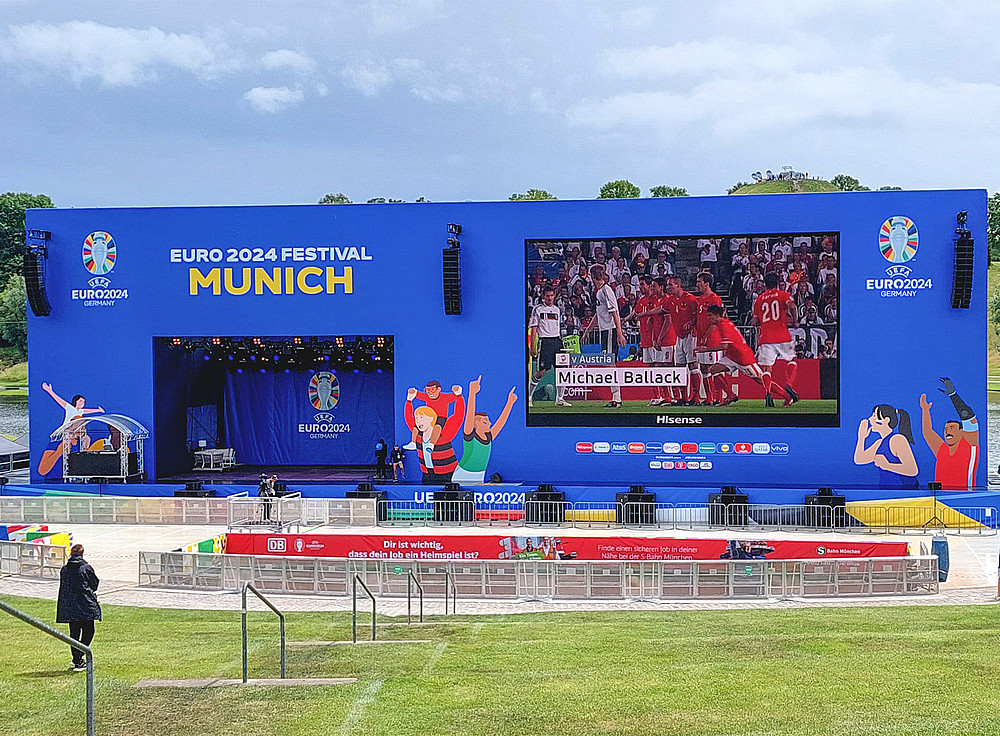
Ein leerer Platz mit einer großen LED-Leinwand, auf der ein Fußballspiel gezeigt wird.

In vielen Städten gibt es sogenannte Fan Zones, die nicht von der UEFA, sondern von den Städten selbst finanziert werden müssen. Foto: Privat/Angele

Die Europameisterschaft verschlingt viel Geld. Doch die Teilnehmerländer profitieren auch von solchen Sportereignissen, erklärt Wirtschaftshistoriker Walter Iber.

Die Fußball-EM kostet 650 Millionen Euro, wie Recherchen des ZDF und des Nachrichtenmagazins „Der Spiegel“ ergeben haben. Wirtschaftshistoriker Walter Iber untersucht vergleichbare Sportereignisse schon seit längerem und zeigt, ob sich das Spektakel auch positiv auf die Wirtschaft auswirkt. „Natürlich wird hier bei Veranstaltungen wie der aktuellen EM im Veranstalterland in der Regel eine entsprechende Wertschöpfung generiert. Zudem werden – und das haben nicht alle Gastgeber in der Vergangenheit getan – nachhaltige Investitionen in die Infrastruktur getätigt. Generell gilt: Es gibt für Ausrichter von Großveranstaltungen, wie Olympia, WM, EM, freilich immer auch ein gewisses finanzielles Risiko; die großen Sportverbände IOC, FIFA, UEFA verdienen gleichzeitig kräftig mit.“

Dass sich viele Länder gegen das Austragen derartiger Großereignisse entscheiden, ist keine Neuigkeit. Iber: „Autoritär regierte Ausrichterländer wie Katar, Russland und China hingegen sehen in den Großveranstaltungen Prestigeprojekte und scheuen dafür keine Kosten.“

Doch wie steht es um die Teilnehmerländer? Ob sich auch dort positive Effekte messen lassen, „hängt viel vom Abschneiden der eigenen Mannschaft und der Sportler:innen ab“, schildert Iber. „Man siehe zum Beispiel das so genannte Sommermärchen in Deutschland 2006. Wenn da eine gewisse Euphorie erzeugt wird, zieht das natürlich positive Auswirkungen nach sich, eben durch gut besuchte Fanmeilen oder durch den Verkauf von Fanartikeln.“

Auch in Österreich lässt sich dieser Effekt spüren. „Selbst kleinere Orte können sich in die Auslage spielen und entsprechend profitieren: etwa zuletzt Windischgarten, wohin zum Training des ÖFB-Teams Tausende Fans gepilgert sind“, schließt der Wirtschaftshistoriker ab.

created by Michael Angele

Related news

Fair distribution: Researchers determine just greenhouse gas budgets for all EU regions

Ten years ago, on 12 December 2015, the Paris Climate Agreement was signed at the UN Climate Conference. In order to limit global warming to well below two degrees, only a certain amount of CO2 may be emitted worldwide. While the focus was originally on national emission targets, more than 200 subnational regions and almost 300 cities have now adopted their own targets. But how many emissions are they fairly entitled to? Researchers at the University of Graz have now developed transparent criteria for fair distribution at the subnational level for the first time and determined corresponding greenhouse gas budgets for all European regions. The paper was published today in the scientific journal Nature Communications.

Chemical Christmas show at the University of Graz: An explosive evening at the Schauspielh

At the beginning of December, the University of Graz transformed the theater into a laboratory: as part of “Chemical Life,” teacher training students staged a chemical Christmas show for Styrian school classes—complete with ethanol rockets, nitrogen snow, and glowing effects. An evening designed to inspire interest in studying chemistry.

Train by train: Koralm railway accelerates exchange between the Universities

Lectures at the University of Klagenfurt in the morning, seminars at the University of Graz in the afternoon: Austria's longest tunnel and a journey time of around 45 minutes make it easy. The Koralm railway increases the speed of networking between the two university locations. The collaboration builds on existing cooperation - for example in the areas of teacher training, Slavic studies and as employers, the universities are well coordinated.

On the trail of the Big Bang: University of Graz receives 1.5 million euros for doctoral programmes

The Austrian Science Fund FWF has selected the Doctoral Programme in Theoretical Particle Physics at the University of Graz for funding from the Doc.funds. Six young scientists will be funded for 3.5 years. They will gain fundamentally new insights into the origins of the world.

Begin of page section:
Additional information:

University of Graz
Universitaetsplatz 3
8010 Graz
Austria
  • Contact
  • Web Editors
  • Moodle
  • UNIGRAZonline
  • Imprint
  • Data Protection Declaration
  • Accessibility Declaration
Weatherstation
Uni Graz

End of this page section. Go to overview of page sections

End of this page section. Go to overview of page sections

Begin of page section:

End of this page section. Go to overview of page sections