



Begin of page section:
Page sections:

  • Go to contents (Accesskey 1)
  • Go to position marker (Accesskey 2)
  • Go to main navigation (Accesskey 3)
  • Go to sub navigation (Accesskey 4)
  • Go to additional information (Accesskey 5)
  • Go to page settings (user/language) (Accesskey 8)
  • Go to search (Accesskey 9)

End of this page section. Go to overview of page sections

Begin of page section:
Page settings:

English en
Deutsch de
Search
Login

End of this page section. Go to overview of page sections

Begin of page section:
Search:

Search for details about Uni Graz
Close

End of this page section. Go to overview of page sections


Search

Begin of page section:
Main navigation:

Page navigation:

  • University

    University
    • About the University
    • Organisation
    • Faculties
    • Library
    • Working at University of Graz
    • Campus
    Developing solutions for the world of tomorrow - that is our mission. Our students and our researchers take on the great challenges of society and carry the knowledge out.
  • Research Profile

    Research Profile
    • Our Expertise
    • Research Questions
    • Research Portal
    • Promoting Research
    • Research Transfer
    • Ethics in Research
    • Commission for Scientific Integrity
    Scientific excellence and the courage to break new ground. Research at the University of Graz creates the foundations for making the future worth living.
  • Studies

    Studies
    • Prospective Students
    • Students
    • Welcome Weeks for First Year Students
  • Community

    Community
    • International
    • Location
    • Research and Business
    • Alumni
    The University of Graz is a hub for international research and brings together scientists and business experts. Moreover, it fosters the exchange and cooperation in study and teaching.
Topics
  • Sustainable University
  • Researchers answer
  • Work for us
Close menu

End of this page section. Go to overview of page sections

Begin of page section:
You are here:

University of Graz News 3.500 BesucherInnen im Haus der Wissenschaft

End of this page section. Go to overview of page sections

Tuesday, 12 June 2012

3.500 BesucherInnen im Haus der Wissenschaft

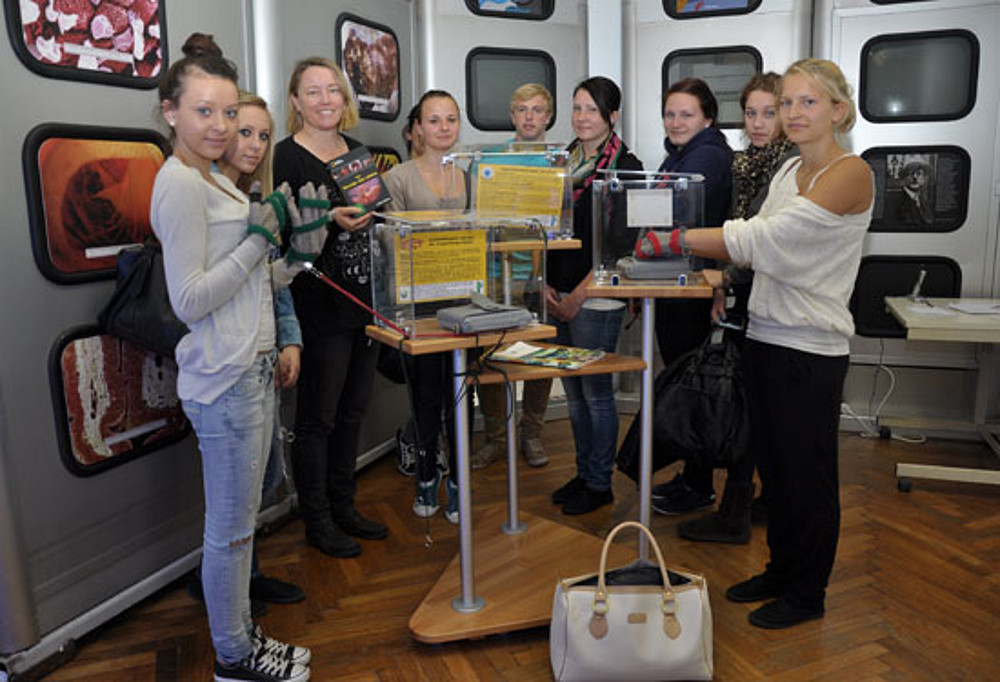
Erforschten das Wunder Mensch: Die SchülerInnen der HLW Schrödinger stellten zugleich auch den/die 3.500 BesucherIn der aktuellen Ausstellung.

Erforschten das Wunder Mensch: Die SchülerInnen der HLW Schrödinger stellten zugleich auch den/die 3.500 BesucherIn der aktuellen Ausstellung.

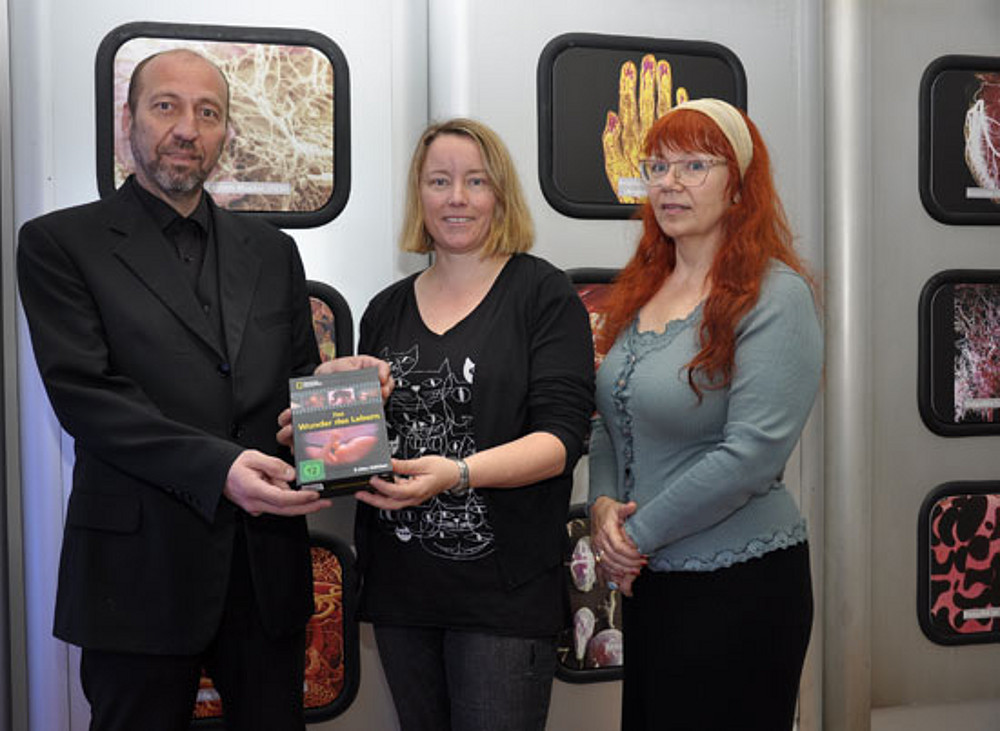
Stefan Riesenfellner (l.) und Ingrid Spörk (r.) überreichten Angelika Rodler die DVD-Reihe "Das Wunder des Lebens" als Preis.

Stefan Riesenfellner (l.) und Ingrid Spörk (r.) überreichten Angelika Rodler die DVD-Reihe "Das Wunder des Lebens" als Preis.

Die Ausstellung "Abenteuer Wissenschaft: Der Mensch, Version 2.0" fasziniert

Die aktuelle Ausstellung im Haus der Wissenschaft, "Abenteuer Wissenschaft, part five: Der Mensch. Version 2.0", zieht die Massen an: Am 11. Juni 2012 begrüßten Dr. Stefan Riesenfellner und Ao.Univ.-Prof. Dr. Ingrid Spörk ihre/n 3.500 BesucherIn: Die SchülerInnen der HLW Schrödinger, 2. FWGa, erforschten mit ihrer Biologielehrerin Mag. Angelika Rodler den menschlichen  Körper. Als Preis erhielt die Klasse die DVD-Reihe "Das Wunder des Lebens"/National Geographic. 


Die Ausstellung ist eine internationale Zusammenarbeit mit der größten deutschen Wissenschaftskommunikationsagentur "Wissenschaft im Dialog" (WID), die dem Haus der Wissenschaft 10 Exhibits und Exponate der "MS-Wissenschaft" zur Verfügung gestellt hat. Das schwimmende europäische Science Center liegt also im übertragenen Sinne jetzt auch in Graz "vor Anker".

Die wichtigsten deutschen Forschungsgesellschaften (u.a. Institute der Fraunhofer Gesellschaft, Max Plank Institut für Informatik bis hin zum Deutschen Zentrum für Luft- und Raumfahrt) sind mit interaktiven hands-on Stationen vertreten, dazu kommen drei Projekte des Fonds zur Förderung wissenschaftlicher Forschung FWF (Wien), die ihre Ergebnisse präsentieren.

Insgesamt stellt das Haus der Wissenschaft als Science Center mit der neuen Multi-Media-Ausstellung 20 internationale und interaktive Exhibits vor.

Unter anderem sind zu sehen: Die Installation "Der Gewebepark Leber", das Simulations-Experiment "Durst im Körper", ein Experiment zum "Egoistischen Gehirn", einen Flipper der auf Muskelsignale reagiert ("Zuckend Zocken"), Experimente zur Altersforschung (Simulation von Alterserscheinungen), einen durchsichtigen Körper mit Kunstherz, die "Pill Cam", eine Kamera zum Schlucken, mit der eine Fahrt durch den menschlichen Körper simuliert wird, einen virtuellen Flug mit einem kleinen Raumschiff durch den menschlichen Blutkreislauf ("Mission Blood") und eine interaktive 3 D Station zur DNA.

Die Ausstellug läuft noch bis zum 30. Juli 2012. Besichtigungstermine sind nur mehr Mitte Juli ab einer Gruppe von 10 Personen und gegen telefonische Anmeldung möglich.

created by Gerhild Kastrun

Related news

ERC Starting Grants: three million euros for two researchers at the University of Graz

Two researchers from the University of Graz have secured prestigious and generously funded grants from the EU. Starting Grants from the European Research Council (ERC), each worth 1.5 million euros, have been awarded to the human geographer Heide Bruckner and the social scientist Silvana Weiss.

Austria’s emissions rose in 2025: University of Graz researchers analyse the causes

The Environment Agency Austria has today published the figures for the country’s greenhouse gas emissions in 2025. While emissions fell sharply year on year from 2022 to 2024, they rose again by just under 0.7 per cent in 2025. Researchers at the University of Graz have analysed how much of this increase was due to structural changes in the economy and how much was attributable to external factors over which there is little control. “In 2025, the colder winter compared with 2024 increased emissions by 0.81 per cent, while the weak economy reduced them by 0.38 per cent. If we factor out these influences, we find an underlying increase of 0.26 per cent compared with the previous year,” reports economist Karl Steininger. “This clearly means that Austria is not on track to meet its climate targets, which require a substantial reduction in emissions by 2030.”

Electrifying: Researchers film the first moments on the way from light to electricity

Physicists at the University of Graz (Austria), in collaboration with colleagues from Marburg University and Forschungszentrum Jülich (Germany), have achieved a scientific breakthrough. For the first time, the generation of electrical energy from light has been filmed and described theoretically. This work is of far-reaching significance, not least for optimising sustainable energy production from photovoltaics. This is because it provides fundamental building blocks for understanding the physical processes that take place, for example, in organic solar cells. The paper was published in the journal Physical Review X, one of the world’s most prestigious physics journals.

University of Graz: Working together to make Styria a sustainable centre of learning

Round table calls for sustainable funding for the 2028–2030 performance agreement period between the five Styrian universities and the federal government.

Begin of page section:
Additional information:

University of Graz
Universitaetsplatz 3
8010 Graz
Austria
  • Contact
  • Web Editors
  • Moodle
  • UNIGRAZonline
  • Imprint
  • Data Protection Declaration
  • Accessibility Declaration
Weatherstation
Uni Graz

End of this page section. Go to overview of page sections

End of this page section. Go to overview of page sections

Begin of page section:

End of this page section. Go to overview of page sections