



Begin of page section:
Page sections:

  • Go to contents (Accesskey 1)
  • Go to position marker (Accesskey 2)
  • Go to main navigation (Accesskey 3)
  • Go to sub navigation (Accesskey 4)
  • Go to additional information (Accesskey 5)
  • Go to page settings (user/language) (Accesskey 8)
  • Go to search (Accesskey 9)

End of this page section. Go to overview of page sections

Begin of page section:
Page settings:

English en
Deutsch de
Search
Login

End of this page section. Go to overview of page sections

Begin of page section:
Search:

Search for details about Uni Graz
Close

End of this page section. Go to overview of page sections


Search

Begin of page section:
Main navigation:

Page navigation:

  • University

    University
    • About the University
    • Organisation
    • Faculties
    • Library
    • Working at University of Graz
    • Campus
    Developing solutions for the world of tomorrow - that is our mission. Our students and our researchers take on the great challenges of society and carry the knowledge out.
  • Research Profile

    Research Profile
    • Our Expertise
    • Research Questions
    • Research Portal
    • Promoting Research
    • Research Transfer
    • Ethics in Research
    • Commission for Scientific Integrity
    Scientific excellence and the courage to break new ground. Research at the University of Graz creates the foundations for making the future worth living.
  • Studies

    Studies
    • Prospective Students
    • Students
  • Community

    Community
    • International
    • Location
    • Research and Business
    • Alumni
    The University of Graz is a hub for international research and brings together scientists and business experts. Moreover, it fosters the exchange and cooperation in study and teaching.
  • Spotlight
Topics
  • Sustainable University
  • Researchers answer
  • Work for us
Close menu

End of this page section. Go to overview of page sections

Begin of page section:
You are here:

University of Graz News 3000 Jahre Kultur

End of this page section. Go to overview of page sections

Monday, 21 February 2022

3000 Jahre Kultur

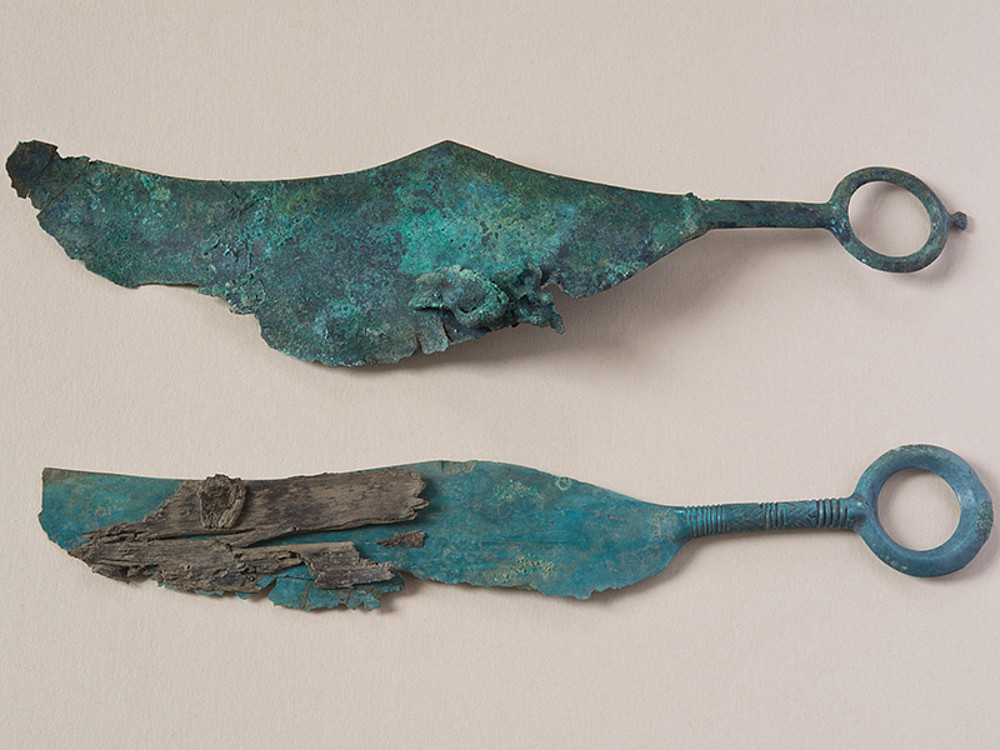
Bronzemesser aus dem urnenfelderzeitlichen Grab 42 bei Wildon. An einem haften noch Reste der hölzernen Scheide an. Foto: Kulturpark Hengist

Bronzemesser aus dem urnenfelderzeitlichen Grab 42 bei Wildon. An einem haften noch Reste der hölzernen Scheide an. Foto: Kulturpark Hengist

Wanderausstellung zeigt beeindruckende Funde aus Gräberfeld bei Wildon

2004 wurde in Kainach bei Wildon eine mehr als 3000 Jahre alte Begräbnisstätte entdeckt, die sich als eine der bedeutendsten jener Zeit im Südostalpenraum entpuppte. An der Universität Graz sind derzeit im Rahmen einer kleinen Wanderausstellung einige beeindruckende Funde aus diesem Gräberfeld zu sehen. „Das Bestattungsareal steht mit großer Wahrscheinlichkeit in Zusammenhang mit der Höhensiedlung am Wildoner Schlossberg“, sagt der Archäologe Christoph Gutjahr vom Kulturpark Hengist, der die Schau zusammengestellt hat und den spektakulären Fundort seit vielen Jahren erforscht.

Über 230 Gräber aus dem Zeitraum von etwa 1300 bis 600 v. Chr. wurden bislang geborgen. Die aktuelle Ausstellung zeigt vor allem das Inventar von Grab 42 aus dem 10. Jahrhundert v. Chr., das besonders reich ausgestattet war. Zu sehen sind unter anderem Keramikgefäße, Bronzeobjekte, wie Messer, Ringe und Gewandnadeln, ein Rasiermesser und eine Feinmeißelklinge. „Der hier in einer Urne bestattete Tote war ein kräftiger Mann im Alter zwischen 31 und 50 Jahren, der – zu schließen nach den Objekten, die ihm auf seine letzte Reise mitgegeben wurden – aus Oberitalien stammte oder enge Kontakte in diese Region pflegte“, weiß Gutjahr.

Gegenstände auch aus anderen urnenfelderzeitlichen Gräbern, die bei Wildon entdeckt wurden, lassen auf weitreichende Handels- und Kulturbeziehungen der lokalen Bevölkerung schließen. So zeigen sich Verbindungen zur Laugener Kultur in der Ostschweiz, in Liechtenstein, Vorarlberg, Nord- und Südtirol und im Trentino, zur Schlesischen Gruppe der Lausitzer Kultur in Südwestpolen und zum nördlichen Balkan.

Die Wanderausstellung ist noch bis 25. April 2022 in den Archäologischen Sammlungen an der Uni Graz zu sehen.
Universitätsplatz 3/2. Stock, 8010 Graz
Öffnungszeiten:
Montag bis Donnerstag 9 bis 14 Uhr, Freitag 9 bis 13 Uhr
ab 28. April 2022:
Montag bis Donnerstag 9 bis 17 Uhr, Freitag 9 bis 15 Uhr
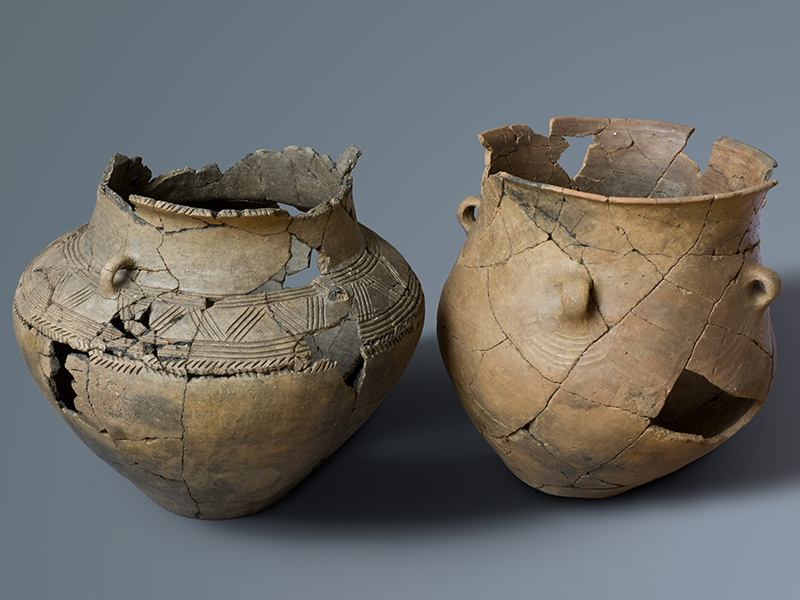
 

Links die Urne und rechts ein Zylinderhalsgefäß aus Grab 42. Foto: Kulturpark Hengist
created by Gudrun Pichler

Related news

Greenery on the rise: over 500 new flowers, perennials and shrubs on campus

Bright blooms and fresh greenery make our hearts beat faster in spring. But it is not just us humans who delight in this colourful growth. For many animals, this splendour provides, above all, food and habitat. There has recently been an increase in this on the University of Graz campus. More than 500 native flowers, perennials and shrubs have been planted on strips of fallow land around Universitätsplatz 2.

Around the world in eight stops: the Long Night of Research at the University of Graz

On 24 April from 5 pm, you can take a short trip around the globe at the University of Graz, discovering pecularities of foreign countries or new local features in the entrance hall of the University Library. The itinerary takes you through introduced animal species, political attitudes and the omnipotence of algorithms. There will also be a programme in the historic reading hall, as well as at the UniGraz@Museum and the University Archive.

Building biological bridges: Chemist discovers an ecological tool for the pharmaceutical industry

Building a relationship on a solid foundation is also important in chemistry. To produce medicines, disinfectants or plant protection products, stable bonds between carbon atoms must be formed. Conventional chemical methods rely on environmentally harmful reagents and solvents to carry out the desired reaction. This process also produces unusable by-products. Chemist Lilla Gal has discovered an enzyme that enables the same process to take place efficiently and sustainably. The results of her research were recently published in the prestigious journal Angewandte Chemie.

Higher Education Strategy 2040: Austria’s universities on course for the future

Austria has 77 higher education institutions, which is above the EU average – but does this really make sense? The new Higher Education Strategy 2040 focuses on cooperation rather than mergers. As one of the six largest universities in Austria, the University of Graz plays a central role in this.

Begin of page section:
Additional information:

University of Graz
Universitaetsplatz 3
8010 Graz
Austria
  • Contact
  • Web Editors
  • Moodle
  • UNIGRAZonline
  • Imprint
  • Data Protection Declaration
  • Accessibility Declaration
Weatherstation
Uni Graz

End of this page section. Go to overview of page sections

End of this page section. Go to overview of page sections

Begin of page section:

End of this page section. Go to overview of page sections


