Begin of page section:
Page sections:

  • Go to contents (Accesskey 1)
  • Go to position marker (Accesskey 2)
  • Go to main navigation (Accesskey 3)
  • Go to sub navigation (Accesskey 4)
  • Go to additional information (Accesskey 5)
  • Go to page settings (user/language) (Accesskey 8)
  • Go to search (Accesskey 9)

End of this page section. Go to overview of page sections

Begin of page section:
Page settings:

English en
Deutsch de
Search
Login

End of this page section. Go to overview of page sections

Begin of page section:
Search:

Search for details about Uni Graz
Close

End of this page section. Go to overview of page sections


Search

Begin of page section:
Main navigation:

Page navigation:

  • University

    University
    • About the University
    • Organisation
    • Faculties
    • Library
    • Working at University of Graz
    • Campus
    Developing solutions for the world of tomorrow - that is our mission. Our students and our researchers take on the great challenges of society and carry the knowledge out.
  • Research Profile

    Research Profile
    • Our Expertise
    • Research Questions
    • Research Portal
    • Promoting Research
    • Research Transfer
    • Ethics in Research
    Scientific excellence and the courage to break new ground. Research at the University of Graz creates the foundations for making the future worth living.
  • Studies

    Studies
    • Prospective Students
    • Students
  • Community

    Community
    • International
    • Location
    • Research and Business
    • Alumni
    The University of Graz is a hub for international research and brings together scientists and business experts. Moreover, it fosters the exchange and cooperation in study and teaching.
  • Spotlight
Topics
  • Sustainable University
  • Researchers answer
  • Work for us
Close menu

End of this page section. Go to overview of page sections

Begin of page section:
You are here:

University of Graz News Weg mit dem Fett

End of this page section. Go to overview of page sections

Monday, 18 June 2018

Weg mit dem Fett

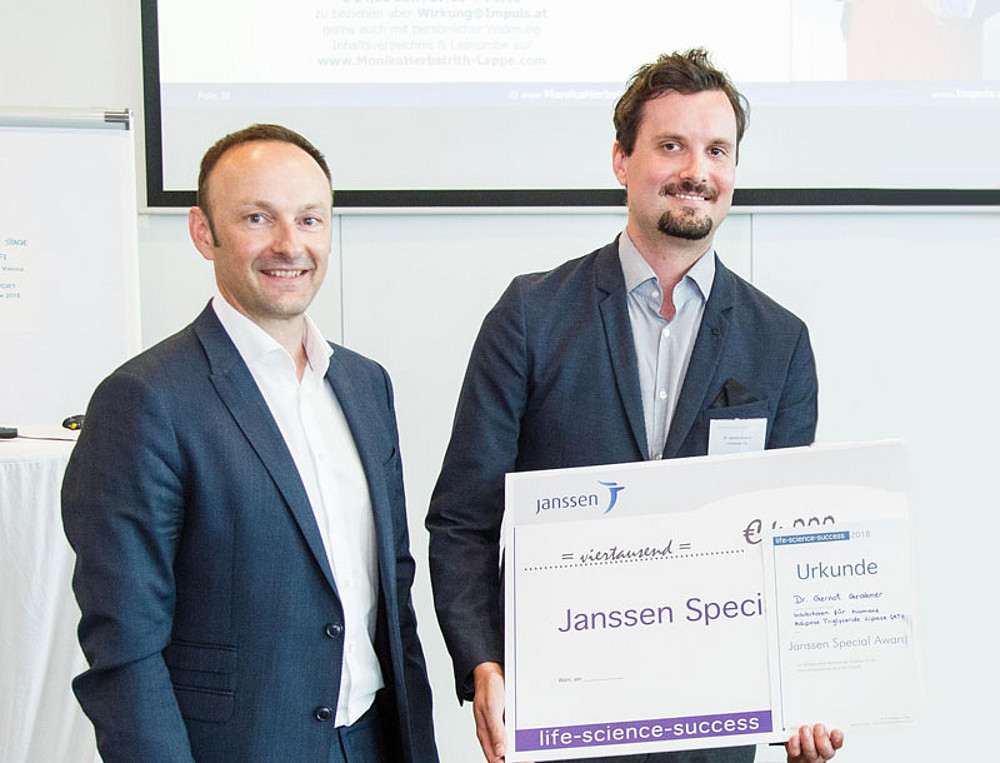
Wolfgang Tüchler, Geschäftsführer Janssen Österreich, mit dem Preisträger des Janssen Special Awards 2018 Gernot Grabner. Foto: Arman Rastegar

Wolfgang Tüchler, Geschäftsführer Janssen Österreich, mit dem Preisträger des Janssen Special Awards 2018 Gernot Grabner. Foto: Arman Rastegar

Universität Graz forscht an Medikament gegen Insulinresistenz und Fettleber

Diabetes, Fettleber und Fettleibigkeit sind Zivilisationskrankheiten des 21. Jahrhunderts. Hervorgerufen durch falsche Ernährung, Bewegungsmangel und Stress schaden sie enorm dem menschlichen Organismus und führen häufig zu einem verfrühten Tod. Ein wesentliches Problem dabei ist die Überlastung der Speicherkapazitäten des Fettgewebes, welche zu einer Fett-Überflutung von Leber und Muskel führt. Dieser Vorgang fördert auch die Entstehung von Typ II-Diabetes.

ForscherInnen rund um den Biochemiker Rudolf Zechner am Institut für Molekulare Biowissenschaften der Universität Graz arbeiten intensiv am Enzym Adipose Triglyceride Lipase – kurz ATGL –, das bei Stoffwechselerkrankungen eine bedeutende Rolle spielt. Forschung an Mäusen hat gezeigt, dass die ATGL eine hohe Relevanz bei metabolischen Krankheiten wie Adipositas und Diabetes hat, erklärt der Molekularbiologie Gernot Grabner. Er ist nun dabei ein Medikament zu entwickeln, das diese Erkrankungen verhindern oder sogar rückgängig machen soll.

„Stellen Sie sich vor, Sie wären Diabetiker und könnten durch ein wirkungsvolles Medikament die Insulinresistenz lindern oder sogar heilen“, nennt Grabner ein Exempel. „Das würde nicht nur die Lebensqualität für PatientInnen steigern, sondern auch die Kosten im Gesundheitssystem reduzieren.“ Das Enzym ATGL baut die Fettspeicher im Fettgewebe ab und setzt sie als Fettsäuren im Blut frei. Diese wiederum sind maßgeblich an der Entstehung von Fettleber und Diabetes beteiligt. So genannte ATGL Inhibitoren können diesen Vorgang blockieren. „Die ATGL von Mensch und Maus unterscheiden sich minimal, bisher entwickelte Inhibitoren stoppen den Vorgang bei der Maus, nicht aber beim Menschen“, erklärt der Molekularbiologe. Grabner versucht daher gemeinsam mit ChemikerInnen der TU Graz so genannte Inhibitoren, das sind Hemmer, für humane ATGL zu entwickeln. Das Projekt wird dabei im Rahmen eines „Research Studio Austria“ als Zusammenarbeit der Arbeitsgruppen von Robert Zimmermann (Universität Graz) und Rolf Breinbauer (TU Graz) durchgeführt.

„Nach erfolgtem Abschluss des präklinischen Wirkstoffprogrammes ist die Ausgründung eines Spin-Off-Unternehmens geplant, das sich auf die Entwicklung der synthetisierten Substanzen bis zur ersten klinischen Phase fokussieren wird“, beschreibt Peter Amersdorfer, Projektmanager im Research Studio Austria Programm. Für seine Arbeit wurde der Nachwuchswissenschafter Grabner kürzlich mit dem Janssen Special Award ausgezeichnet; der Preis wird vom Unternehmen Janssen-Austria vergeben und würdigt Forschungsleistungen, die besondere Relevanz für die Gesundheitsversorgung in der Zukunft hat. 


created by Konstantinos Tzivanopoulos

Related news

AI in schools: Maria Bertel drafts legal guidelines for teachers

The legal expert and her team analysed the legal situation regarding the use of artificial intelligence in education as part of an EU project and answered open questions from practice.

Cosmetics in the environment: University of Graz proves danger to ants

Titanium dioxide, which is found in cosmetics, for example, is increasingly entering the environment in the form of nanoparticles. This could also put insects at risk. If ants ingest the substance in combination with the pesticide glyphosate, it disturbs the development of their offspring. Scientists at the University of Graz are drawing attention to the negative consequences of this toxic cocktail.

Varied and healthy: studies move

Exercise is the ideal way to balance out everyday stress, prevent illness and keep fit. Why this is the case, how to do it properly and what role human bodily functions and psychology play can be studied at the University of Graz.

Religious scholar Theresia Heimerl: Fasting as a spiritual boost

Fasting is not just a strategy for losing weight – it is a ritual dating back thousands of years with spiritual and evolutionary roots that has positive effects on the body. At the University of Graz, religious scholar Theresia Heimerl is investigating why fasting is a "spiritual boost".

Begin of page section:
Additional information:

University of Graz
Universitaetsplatz 3
8010 Graz
Austria
  • Contact
  • Web Editors
  • Moodle
  • UNIGRAZonline
  • Imprint
  • Data Protection Declaration
  • Accessibility Declaration
Weatherstation
Uni Graz

End of this page section. Go to overview of page sections

End of this page section. Go to overview of page sections

Begin of page section:

End of this page section. Go to overview of page sections