Begin of page section:
Page sections:

  • Go to contents (Accesskey 1)
  • Go to position marker (Accesskey 2)
  • Go to main navigation (Accesskey 3)
  • Go to sub navigation (Accesskey 4)
  • Go to additional information (Accesskey 5)
  • Go to page settings (user/language) (Accesskey 8)
  • Go to search (Accesskey 9)

End of this page section. Go to overview of page sections

Begin of page section:
Page settings:

English en
Deutsch de
Search
Login

End of this page section. Go to overview of page sections

Begin of page section:
Search:

Search for details about Uni Graz
Close

End of this page section. Go to overview of page sections


Search

Begin of page section:
Main navigation:

Page navigation:

  • University

    University
    • About the University
    • Organisation
    • Faculties
    • Library
    • Working at University of Graz
    • Campus
    Developing solutions for the world of tomorrow - that is our mission. Our students and our researchers take on the great challenges of society and carry the knowledge out.
  • Research Profile

    Research Profile
    • Our Expertise
    • Research Questions
    • Research Portal
    • Promoting Research
    • Research Transfer
    • Ethics in Research
    Scientific excellence and the courage to break new ground. Research at the University of Graz creates the foundations for making the future worth living.
  • Studies

    Studies
    • Prospective Students
    • Students
  • Community

    Community
    • International
    • Location
    • Research and Business
    • Alumni
    The University of Graz is a hub for international research and brings together scientists and business experts. Moreover, it fosters the exchange and cooperation in study and teaching.
  • Spotlight
Topics
  • Our digital Advent calendar
  • Sustainable University
  • Researchers answer
  • Work for us
Close menu

End of this page section. Go to overview of page sections

Begin of page section:
You are here:

University of Graz Spotlight Study and research more beautifully: How the Campus 2025 is evolving

End of this page section. Go to overview of page sections

Study and research more beautifully: How the Campus 2025 is evolving

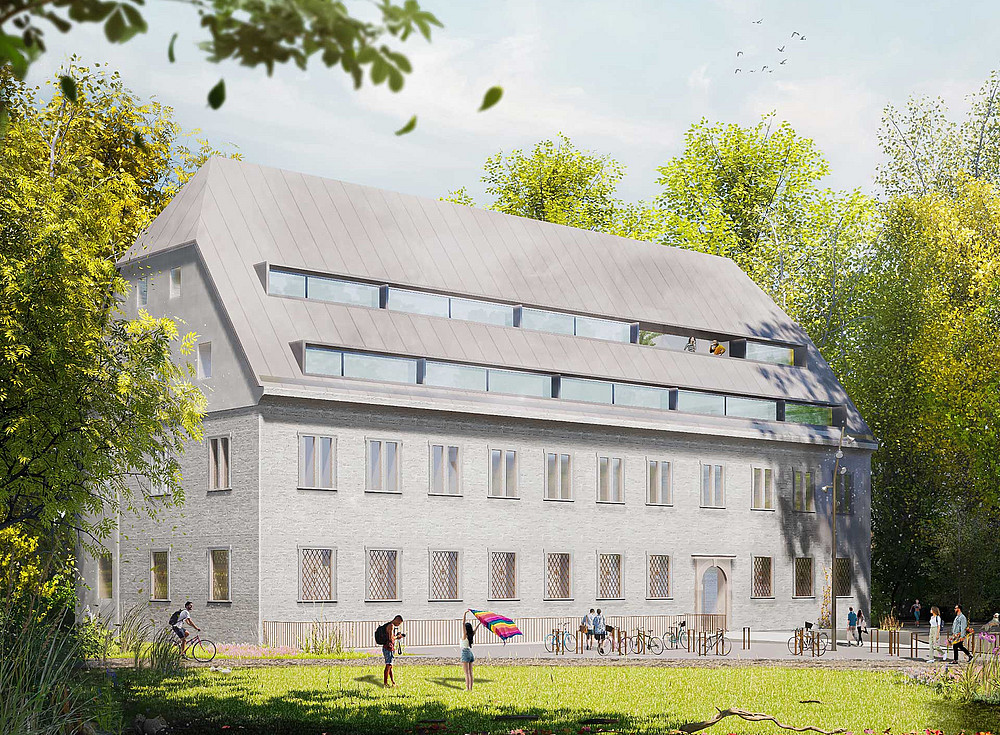
Rendering of the Jesuit refectory

This is what the refurbished Jesuit refectory will look like. The Institute of Human Movement Sciences, Sport and Health will be researching and teaching there in autumn 2025. Photo: lebidris-Daniel Neubauer

It is a research centre, place of study, workplace and living space all in one. The green, inner-city campus of the University of Graz fulfils numerous requirements. And it is constantly evolving. Currently with striking new buildings and renovations: the Graz Centre of Physics, the House of Educational Sciences and the refurbished Jesuit Refectory. "Sustainability aspects are incorporated into all planning and implementation phases in order to achieve the goal of climate neutrality," emphasises Rector Peter Riedler.

They have characterised the campus for exactly 150 years: the institute buildings for Chemistry at Universitätsplatz 1 and for Physics at Universitätsplatz 5 are celebrating their birthdays in 2025. In the 1870s, the Physics Building was considered to be one of the most advanced of its time: Observation louvres made it possible to direct sunlight for optical experiments. Experiment tables could be mechanically decoupled from the building by insulated columns in the floor. Iron-free laboratories for galvanometric measurements and specially insulated rooms for thermal investigations were set up.

The story continues right next door. Just a few metres away from the historic building, the Graz Center of Physics is one of the most modern research centres in Austria. Following the spectacular demolition of the former pre-clinic, the architecturally impressive complex will begin to rise in the spring.

Construction workers are also at work directly opposite: the former medical institute building for hygiene and forensic medicine is being converted into the House of Educational Sciences. Completion is planned for 2027.

However, the opening is already planned for this year. The Institute of Human Movement Sciences, Sport and Health will take up work in the former, completely renovated Jesuit refectory on Rosenhain from the 2025/26 winter semester. With 50 workstations, a lecture theatre and seminar rooms for almost 300 people as well as event rooms with modern equipment on a total of five floors, the Jesuit Refectory will expand the infrastructure of the University of Graz.

created by Andreas Schweiger

Related news

Semester abroad without barriers: University of Graz wins award for promoting inclusion

The University of Graz has been awarded the Internationalization Award for its new inclusion initiative. Students with fewer opportunities now also receive financial support for their semester abroad outside Europe.

Fair distribution: Researchers determine just greenhouse gas budgets for all EU regions

Ten years ago, on 12 December 2015, the Paris Climate Agreement was signed at the UN Climate Conference. In order to limit global warming to well below two degrees, only a certain amount of CO2 may be emitted worldwide. While the focus was originally on national emission targets, more than 200 subnational regions and almost 300 cities have now adopted their own targets. But how many emissions are they fairly entitled to? Researchers at the University of Graz have now developed transparent criteria for fair distribution at the subnational level for the first time and determined corresponding greenhouse gas budgets for all European regions. The paper was published today in the scientific journal Nature Communications.

Chemical Christmas show at the University of Graz: An explosive evening at the Schauspielh

At the beginning of December, the University of Graz transformed the theater into a laboratory: as part of “Chemical Life,” teacher training students staged a chemical Christmas show for Styrian school classes—complete with ethanol rockets, nitrogen snow, and glowing effects. An evening designed to inspire interest in studying chemistry.

Train by train: Koralm railway accelerates exchange between the Universities

Lectures at the University of Klagenfurt in the morning, seminars at the University of Graz in the afternoon: Austria's longest tunnel and a journey time of around 45 minutes make it easy. The Koralm railway increases the speed of networking between the two university locations. The collaboration builds on existing cooperation - for example in the areas of teacher training, Slavic studies and as employers, the universities are well coordinated.

Begin of page section:
Additional information:

University of Graz
Universitaetsplatz 3
8010 Graz
Austria
  • Contact
  • Web Editors
  • Moodle
  • UNIGRAZonline
  • Imprint
  • Data Protection Declaration
  • Accessibility Declaration
Weatherstation
Uni Graz

End of this page section. Go to overview of page sections

End of this page section. Go to overview of page sections

Begin of page section:

End of this page section. Go to overview of page sections