Begin of page section:
Page sections:

  • Go to contents (Accesskey 1)
  • Go to position marker (Accesskey 2)
  • Go to main navigation (Accesskey 3)
  • Go to sub navigation (Accesskey 4)
  • Go to additional information (Accesskey 5)
  • Go to page settings (user/language) (Accesskey 8)
  • Go to search (Accesskey 9)

End of this page section. Go to overview of page sections

Begin of page section:
Page settings:

English en
Deutsch de
Search
Login

End of this page section. Go to overview of page sections

Begin of page section:
Search:

Search for details about Uni Graz
Close

End of this page section. Go to overview of page sections


Search

Begin of page section:
Main navigation:

Page navigation:

  • University

    University
    • About the University
    • Organisation
    • Faculties
    • Library
    • Working at University of Graz
    • Campus
    Developing solutions for the world of tomorrow - that is our mission. Our students and our researchers take on the great challenges of society and carry the knowledge out.
  • Research Profile

    Research Profile
    • Our Expertise
    • Research Questions
    • Research Portal
    • Promoting Research
    • Research Transfer
    • Ethics in Research
    • Commission for Scientific Integrity
    Scientific excellence and the courage to break new ground. Research at the University of Graz creates the foundations for making the future worth living.
  • Studies

    Studies
    • Prospective Students
    • Students
  • Community

    Community
    • International
    • Location
    • Research and Business
    • Alumni
    The University of Graz is a hub for international research and brings together scientists and business experts. Moreover, it fosters the exchange and cooperation in study and teaching.
  • Spotlight
Topics
  • Sustainable University
  • Researchers answer
  • Work for us
Close menu

End of this page section. Go to overview of page sections

Begin of page section:
You are here:

University of Graz Spotlight Greenery under the sun: how plants protect themselves from too much UV light

End of this page section. Go to overview of page sections

Greenery under the sun: how plants protect themselves from too much UV light

Ulli Grube

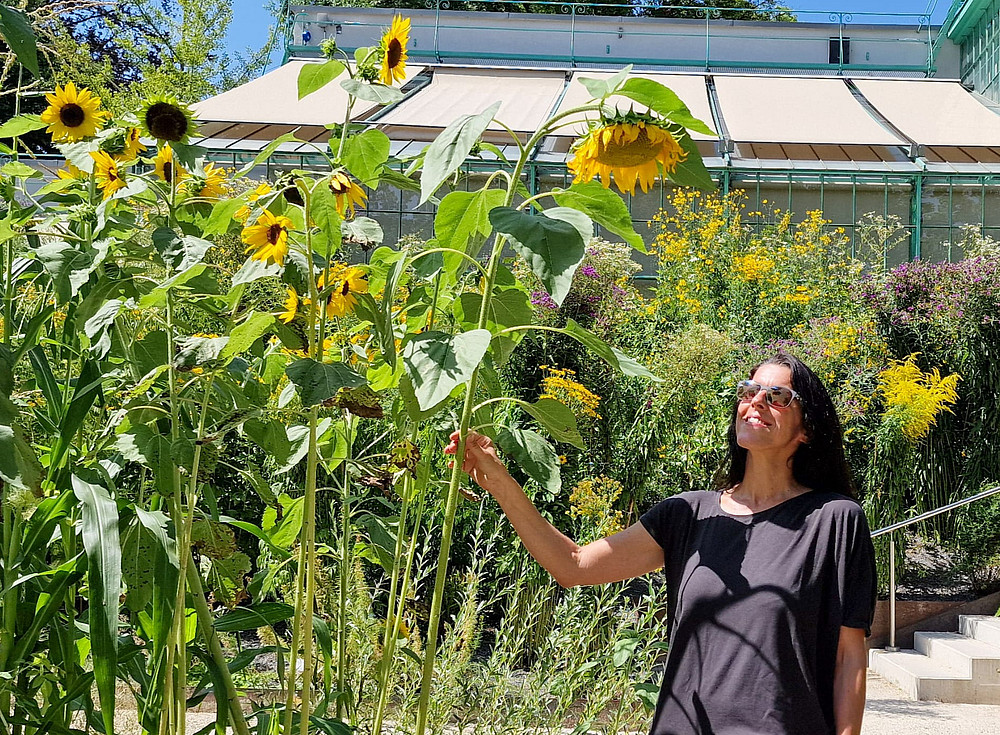
"Only young sunflowers orient themselves towards the sun in order to use the maximum amount of light for their growth," explains Ulli Grube. Photo: University of Graz/Elisabeth Helmberger

Plants can't grow without sun. But too much of it is not good either. This is why some flowers and trees have developed strategies to protect themselves from too much light. The Botanical Garden of the University of Graz invites you to do some research on site.

We put up a parasol. The silver lime tree (Tilia platyphyllos), on the other hand, turns the silvery hairs on the underside of its leaves upwards as soon as the sunlight becomes too strong for the tree. In addition, a strong "hairiness" can reflect light and thus protect the sensitive cells, says Ulli Grube from the Botanical Garden at the University of Graz: "This is clearly visible on the mullein (Verbascum sp.), which is considered a typical sun plant."
Hairs can also help to reduce evaporation and thus the plant's water loss, as numerous alpine plants prove. It also helps if the silverroot (Dryas octopetala), for example, reduces leaf areas. Succulent plants, i.e. those with water storage tissues, are particularly good at this strategy and are masters at adapting to drought.

Sunburn in plants

"Even plants can get sunburnt," says Grube. This can be seen, for example, in brown spots on the leaves. Grube reports on another green phenomenon: "If too much photosynthesis is carried out, reactive oxygen compounds are produced that can damage the light systems of the leaf cells. The plant can very quickly dissipate excess energy in the form of heat."
Other plants, on the other hand, turn towards the sun in a daily rhythm: the best-known example is the sunflower (Helianthus annuus). "However, only young plants do this in order to use the maximum amount of light for their growth," explains Ulli Grube.

Flora from the Mediterranean region

Jonathan Wilfling, Technical Manager at the Botanic Garden, confirms that the current heat and climate change are causing the plants problems. The trees have been watered for three years now. "Beech trees in particular are suffering from the high temperatures," explains Wilfling. The greenhouses are also becoming increasingly hot. In response to the climate change, attempts are currently being made to introduce more flora from south-eastern Europe and the Mediterranean in the open air. Wilfling: "The Botanic Garden's arboretum will certainly look different in 50 years' time than it does today, as the life expectancy of trees in the city is decreasing."

►Botanical Garden of the University of Graz

created by Andreas Schweiger

Related news

Climate at the cliffs: Researchers unravel the evolution of the Greenland ice margin

Vertical ice walls, up to 40 metres high: in "Game of Thrones" they were dramatised as fortifications; during the Cold War, they were studied with great interest. How these imposing walls along Greenland’s 80,000-kilometre-long ice margin formed, how they are evolving, and what impact they have on the climate is not yet fully understood. Researchers from the Universities of Graz and Innsbruck have come one step closer to solving the mystery. The results of their latest study have been published in the journal The Cryosphere.

Achieving climate goals: Researchers highlight need for fair country shares in CO2

As the war in the Middle East is currently reminding us once again, many countries around the world are heavily reliant on oil and gas. Lax climate policy and limited options for removing CO₂ from the atmosphere could cement this dependence for future generations. Scientists at the University of Graz highlight this danger in a new study published in the journal Global Environmental Change. They find that rights to carbon dioxide removal should be distributed across countries just as fairly as emission budgets in order to halt global warming.

Electrons and AI: New approaches to the search for new medicines

Researchers at the University of Graz are revolutionising the development of new medicines by combining electrochemistry and artificial intelligence. Thanks to smart optimisation, the search for new active ingredients will in future be faster, more sustainable and safer.

Universities call for sustained investment in the Southern Education Region

University rectors are calling for an adequately funded budget for the Southern Education Region

Begin of page section:
Additional information:

University of Graz
Universitaetsplatz 3
8010 Graz
Austria
  • Contact
  • Web Editors
  • Moodle
  • UNIGRAZonline
  • Imprint
  • Data Protection Declaration
  • Accessibility Declaration
Weatherstation
Uni Graz

End of this page section. Go to overview of page sections

End of this page section. Go to overview of page sections

Begin of page section:

End of this page section. Go to overview of page sections