Begin of page section:
Page sections:

  • Go to contents (Accesskey 1)
  • Go to position marker (Accesskey 2)
  • Go to main navigation (Accesskey 3)
  • Go to sub navigation (Accesskey 4)
  • Go to additional information (Accesskey 5)
  • Go to page settings (user/language) (Accesskey 8)
  • Go to search (Accesskey 9)

End of this page section. Go to overview of page sections

Begin of page section:
Page settings:

English en
Deutsch de
Search
Login

End of this page section. Go to overview of page sections

Begin of page section:
Search:

Search for details about Uni Graz
Close

End of this page section. Go to overview of page sections


Search

Begin of page section:
Main navigation:

Page navigation:

  • University

    University
    • About the University
    • Organisation
    • Faculties
    • Library
    • Working at University of Graz
    • Campus
    Developing solutions for the world of tomorrow - that is our mission. Our students and our researchers take on the great challenges of society and carry the knowledge out.
  • Research Profile

    Research Profile
    • Our Expertise
    • Research Questions
    • Research Portal
    • Promoting Research
    • Research Transfer
    • Ethics in Research
    • Commission for Scientific Integrity
    Scientific excellence and the courage to break new ground. Research at the University of Graz creates the foundations for making the future worth living.
  • Studies

    Studies
    • Prospective Students
    • Students
  • Community

    Community
    • International
    • Location
    • Research and Business
    • Alumni
    The University of Graz is a hub for international research and brings together scientists and business experts. Moreover, it fosters the exchange and cooperation in study and teaching.
  • Spotlight
Topics
  • Sustainable University
  • Researchers answer
  • Work for us
Close menu

End of this page section. Go to overview of page sections

Begin of page section:
You are here:

University of Graz Spotlight A success story: 20 years of the Wegener Centre at the University of Graz

End of this page section. Go to overview of page sections

A success story: 20 years of the Wegener Centre at the University of Graz

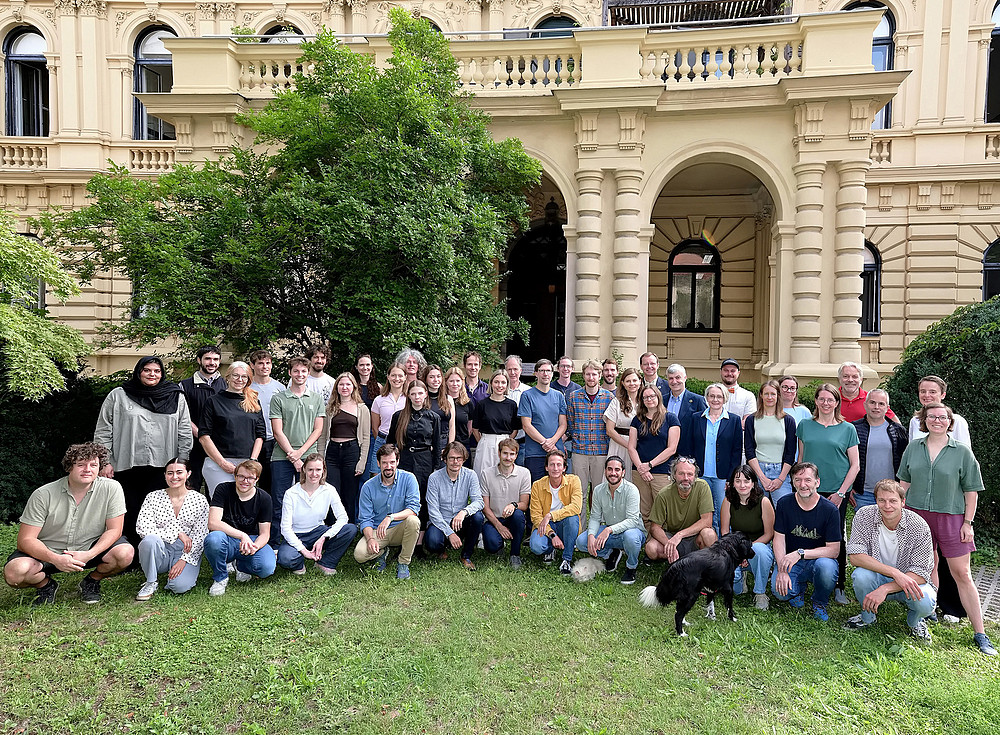
Group photo of the Wegener Center team in front of the villa on Brandhofgasse, where the facility is located. ©CP-PICTURES Graz

The team of the Wegener Center at the University of Graz: Working together to find solutions to the challenges of the future. Photo: University of Graz / cp-pictures

Paths emerge in that we walk them. In line with this motto, more than 70 scientists from the fields of geophysics, climate physics, meteorology, economics, transition research, geography and regional studies are conducting research at the Wegener Center of the University of Graz. What unites them is their expertise and commitment to slowing down climate change, developing strategies for adapting to changing environmental conditions and successfully managing the transition to a low-carbon future. On 3 October 2025, the Wegener Center celebrated its 20th anniversary.


Founded in 2005 on the initiative of geophysicist Gottfried Kirchengast as an interdisciplinary, internationally oriented research centre, the Wegener Center for Climate and Global Change at the University of Graz has an excellent network. Its numerous cooperation partners include institutions such as ESA and NASA, the World Bank and the WHO. Researchers from the Wegener Center are also among the authors of the Assessment Report of the IPCC, the Intergovernmental Panel on Climate Change.

The institution, since 2023 under the direction of founding member economist Karl Steininger, is also an inspiring place for postdocs and doctoral students. Together with internationally renowned scientists, they gain new insights and work on solutions to the challenges of the future. To mark its 20th anniversary, 20 researchers from the Wegener Center provide an insight into the diversity of their socially relevant topics.

On 3 October 2025, celebrations were held in the auditorium of the University of Graz: in the afternoon with presentations of current research – to listen to, ask questions and join in the discussion – and in the evening with a festive event. Among those offering their congratulations was Federal President Alexander Van der Bellen, who sent a video message.
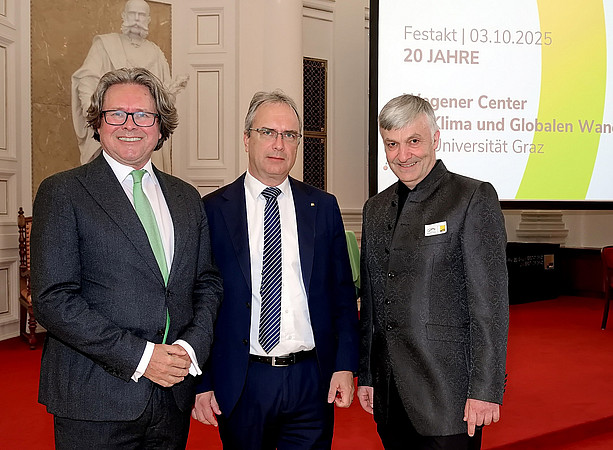
Martin Polaschek, Peter Riedler, Karl Steininger in the auditorium ©cp-pictures.at
©cp-pictures.at
Rector Peter Riedler (center) and Martin Polaschek (left), former Minister of Science, offered their congratulations on the anniversary. Karl Steininger (right) was a founding member of the Wegener Center and has headed the institution since 2023.
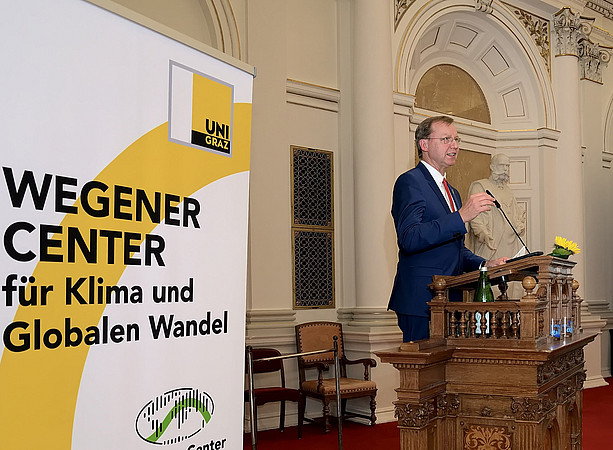
Gottfried Kirchengast at the lectern in the auditorium ©cp-pictures.at
©cp-pictures.at
With a personal touch and humor, Gottfried Kirchengast outlined the history of the Wegener Center – from his own initial ideas for its founding in the 1990s to the present day, with an outlook for the future.
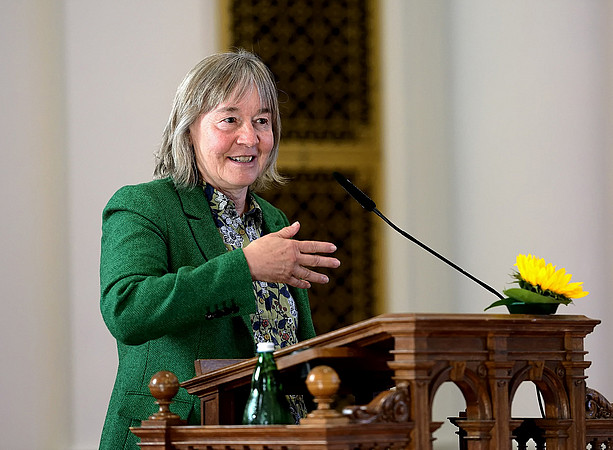
Gabi Hegerl at the lectern in the auditorium ©CP-PICTURES
©CP-PICTURES
Gabi Hegerl, climate researcher at the University of Edinburgh, showed in her keynote speech that man-made climate change can be scientifically proven beyond doubt, emphasising the importance of research at the Wegener Center.
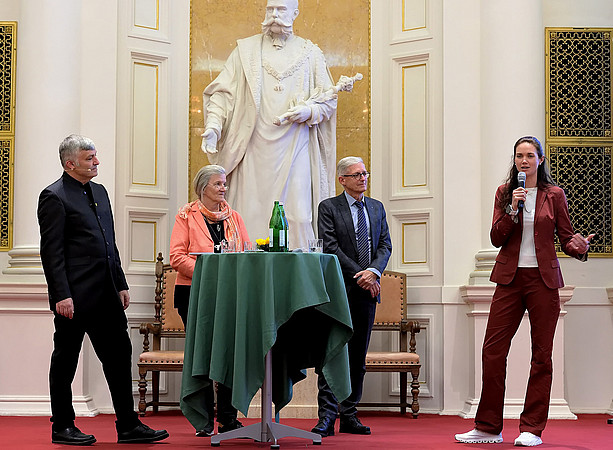
Karl Steininger, Daniela Jacob, Thomas Hlatky, Nina Knittel around a bar table on the podium in the auditorium, behind them the statue of the emperor. ©CP-PICTURES
©CP-PICTURES
Praise for the research and social commitment of the Wegener Center: German climate researcher Daniela Jacob, Thomas Hlatky from GRAWE Insurance, and postdoc Nina Knittel.
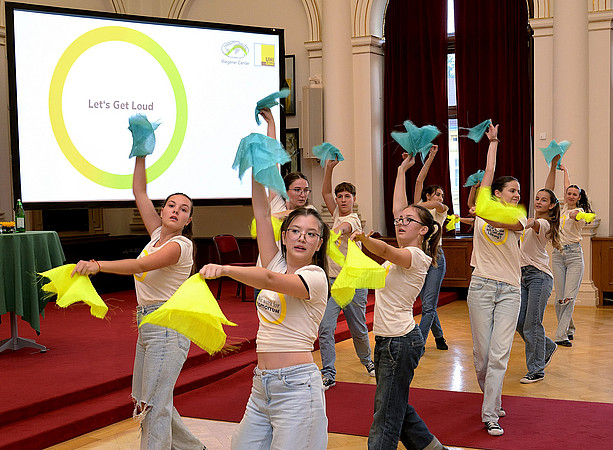
Dancing high school students with yellow and blue scarves in their hands in the auditorium ©cp-pictures.at
©cp-pictures.at
Let's get loud for climate protection: The dance ensemble of the Graz Music High School Dreihackengasse, directed by Pamina Plauder, set the mood with their performance.
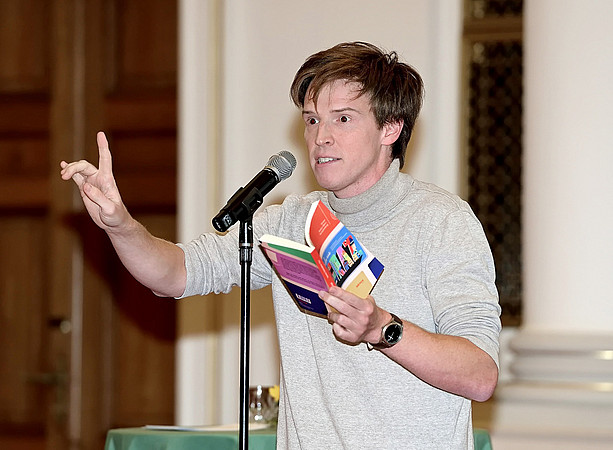
Christoph Steiner in front of the microphone, a book in his hand, his right index finger raised ©CP-PICTURES
©CP-PICTURES
The art of language as an appeal: In his poetry slam “Fisch verliebt” (Fish in Love), Christoph Steiner addressed the issue of plastic in the sea.
created by Gudrun Pichler

Related news

Long Night of Research: How many languages are there in the world?

From a linguistic perspective, there are worlds of difference between Bern, Berlin and Vienna. A dialect impersonator will demonstrate live just how varied German can sound. How many languages are there in the world? What are their distinctive features? Which of these are spoken in Austria? These and other questions will be answered during the Long Night of Research at the University of Graz: on Friday, 24 April 2025, from 5 pm to 11 pm, in the University Library. Visitors can immerse themselves in the diversity of languages without travelling far by taking part in a quiz at the station.

Dual role: Researchers show that platelets can worsen disease

Platelets are best known as rapid responders in the event of injury. They stop bleeding and are indispensable for wound healing. “However, thrombocytes can also aggravate diseases, especially when inflammatory processes are involved,” explains Marion Mußbacher, a pharmacist at the University of Graz. She investigated the “dual role” of platelets in relation to fatty liver disease, a condition closely linked to obesity and type 2 diabetes.

Forscher:innen entdecken natürlichen Wirkstoff zum Schutz vor Lebererkrankungen

Die Leber leidet still. „Fetteinlagerungen, strukturelle Zerstörung des Gewebes oder mutierende Tumorzellen – all das fliegt eine Weile unter dem Radar. Begleitet werden diese Veränderungen oft von leichten, jedoch chronischen Entzündungen“, erklärt Andreas Koeberle, Pharmazeut an der Universität Graz. Er hat mit seinem Team und Kolleg:innen der Universität Innsbruck den Wirkstoff Mitrephoron B untersucht, der neue Behandlungsansätze ermöglicht. Die Ergebnisse der Studie wurden kürzlich in der Open-Access-Fachzeitschrift „Theranostics“ veröffentlicht.

Climate at the cliffs: Researchers unravel the evolution of the Greenland ice margin

Vertical ice walls, up to 40 metres high: in "Game of Thrones" they were dramatised as fortifications; during the Cold War, they were studied with great interest. How these imposing walls along Greenland’s 80,000-kilometre-long ice margin formed, how they are evolving, and what impact they have on the climate is not yet fully understood. Researchers from the Universities of Graz and Innsbruck have come one step closer to solving the mystery. The results of their latest study have been published in the journal The Cryosphere.

Begin of page section:
Additional information:

University of Graz
Universitaetsplatz 3
8010 Graz
Austria
  • Contact
  • Web Editors
  • Moodle
  • UNIGRAZonline
  • Imprint
  • Data Protection Declaration
  • Accessibility Declaration
Weatherstation
Uni Graz

End of this page section. Go to overview of page sections

End of this page section. Go to overview of page sections

Begin of page section:

End of this page section. Go to overview of page sections