Begin of page section:
Page sections:

  • Go to contents (Accesskey 1)
  • Go to position marker (Accesskey 2)
  • Go to main navigation (Accesskey 3)
  • Go to sub navigation (Accesskey 4)
  • Go to additional information (Accesskey 5)
  • Go to page settings (user/language) (Accesskey 8)
  • Go to search (Accesskey 9)

End of this page section. Go to overview of page sections

Begin of page section:
Page settings:

English en
Deutsch de
Search
Login

End of this page section. Go to overview of page sections

Begin of page section:
Search:

Search for details about Uni Graz
Close

End of this page section. Go to overview of page sections


Search

Begin of page section:
Main navigation:

Page navigation:

  • University

    University
    • About the University
    • Organisation
    • Faculties
    • Library
    • Working at University of Graz
    • Campus
    Developing solutions for the world of tomorrow - that is our mission. Our students and our researchers take on the great challenges of society and carry the knowledge out.
  • Research Profile

    Research Profile
    • Our Expertise
    • Research Questions
    • Research Portal
    • Promoting Research
    • Research Transfer
    • Ethics in Research
    Scientific excellence and the courage to break new ground. Research at the University of Graz creates the foundations for making the future worth living.
  • Studies

    Studies
    • Prospective Students
    • Students
  • Community

    Community
    • International
    • Location
    • Research and Business
    • Alumni
    The University of Graz is a hub for international research and brings together scientists and business experts. Moreover, it fosters the exchange and cooperation in study and teaching.
  • Spotlight
Topics
  • Our digital Advent calendar
  • Sustainable University
  • Researchers answer
  • Work for us
Close menu

End of this page section. Go to overview of page sections

Begin of page section:
You are here:

University of Graz Spotlight A sign of freedom and democracy: University of Graz awards human rights prize to IAPB

End of this page section. Go to overview of page sections

A sign of freedom and democracy: University of Graz awards human rights prize to IAPB

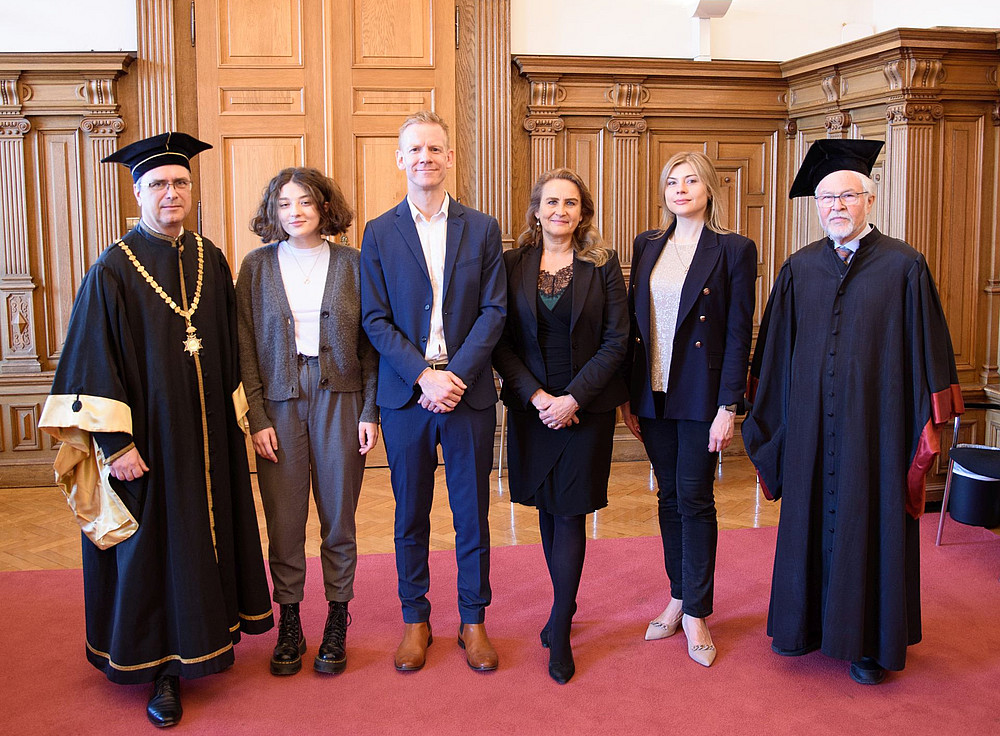
Rektor Peter Riedler, Univ.Prof Wolfang Benedek und die Preisträger:innen

Rektor Peter Riedler (Universität Graz); Paulina K. (Human Rights Center Viasna, Belarus); Rasmus Grue Christensen (CEO of DIGNITY - Danish Institute Against Tortoure, IAPB lead); Therese Rytter (Director of Prevention and Accountability, DIGNITY, IAPB); Victoria Fedorova (International Committee for the Investigation of Torture, Belarus, IAPB); Univ.-Prof. i.R. Wolfgang Benedek (Europäisches Trainings- und Forschungszentrum für Menschenrechte und Demokratie der Universität Graz, UNI-ETC) Foto: Uni Graz/Vilgut

The University of Graz awards its Human Rights Prize to the International Accountability Platform for Belarus for its crucial work in documenting serious human rights violations in Belarus. A clear signal for justice and a democratic Europe.

Even 70 years after the Universal Declaration of Human Rights, these fundamental social norms are still being violated. There is no need to look far. A ten-hour drive from Graz takes you to the border with Belarus, where political imprisonment and torture are part of everyday life. The International Accountability Platform for Belarus (IAPB) was founded to document these crimes and bring the perpetrators to justice at a later date. Since its foundation in 2021, it has documented around 2,500 reports from victims and witnesses and identified numerous perpetrators.

For this outstanding achievement, the University of Graz is awarding the organization the Human Rights Prize on 22 March 2024, sending a strong signal for a free and democratic Europe. “For a university, freedom of teaching and research is of highest importance. Inseparably linked to this are values such as freedom from unlawful persecution, freedom of expression and the freedom to shape one's life according to one's own ideas,” says Peter Riedler, Rector of the University of Graz. “The IAPB's award is an expression of this commitment and underlines the importance of human rights for our university.”

Several human rights NGOs pool their activities via the platform. Representatives from a wide range of organizations, including DIGNITY - Danish Institute Against Torture, Human Rights Center Viasna, Belarus, International Committee for the Investigation of Torture, Belarus, European Committee for the Prevention of Torture, Bellingcat, Truth Hounds, Human Rights Watch and the OSCE, attended the ceremony and the subsequent symposium.

Wolfgang Benedek, whose recommendations as OSCE rapporteur on elections and human rights violations in 2020 contributed to the founding of the IAPB, recalled in his laudatory speech numerous reports of atrocities committed in the course of the suppression of the large and peaceful demonstrations against the obvious election manipulation. Criminal prosecution of these incidents seemed unthinkable at the time. The IAPB's documentation will make this possible in the future.

“Unfortunately, the human rights situation in Belarus continues to deteriorate,” laments Benedek. “But it is important not to give up and to continue documenting the serious human rights violations committed by Lukashenko's regime. The International Accountability Platform for Belarus has set a standard for how this task can be fulfilled, and its work must therefore be continued for as long as necessary.” The award of the Human Rights Prize by the University of Graz should serve as motivation.

“The award is also an significant recognition of the unique and innovative features of the IAPB, which was founded to document human rights violations and hold the perpetrators accountable,” says Rasmus Grue Christensen, head of the NGO DIGNITY, which leads the IAPB. “There are currently around 1500 political prisoners in prison,” says the activist, describing the situation in Belarus. “Those who have been released from prison continue to report that they were tortured in prison and subjected to other forms of ill-treatment. Belarusians who flee the country risk the expropriation of the property they left behind and the loss of their citizenship.”

In her acceptance speech, Victoria Federova from the International Committee for the Investigation of Torture, Belarus, emphasized the high quality of the documentation that is now possible thanks to the platform. “Many of my colleagues are political prisoners and have to endure abuse in prison,” says Federova. “And there is currently no authority to hold the perpetrators accountable. That's why documenting these crimes is so important. The award encourages us to continue this work.”

Paulina K. (surname withheld for security reasons) accepted the award on behalf of the Belarusian NGO Viasna, whose founder, Nobel Peace Prize winner Ales Bialatski, was sentenced to ten years in prison. “The conditions in the prisons are terrible. There is abuse, no medical care, no hygiene, sleep deprivation and a ban on contact with the outside world,” says the human rights activist, describing the situation in Belarus. “We know of 1411 people who are locked up in these conditions.” And even those like her who were able to flee are suffering from repression. The regime is taking action against the activists' relatives. “For me, this prize is also important because it draws attention back to the situation in Belarus.”

For Rector Peter Riedler, honouring the IAPB is also an obligation for the university and its members to uphold the principles of human rights, criminal accountability and the pursuit of justice. “The work of the IAPB is a powerful reminder of what dedicated individuals and organizations can accomplish in the face of seemingly insurmountable challenges.” They can serve as an inspiration to work across disciplines, borders, and cultures to create a world where human rights are respected, protected and fulfilled for all.

Interview with Rasmus Grue Christensen: Holding Lukashenko Accountable

created by Roman Vilgut

Related news

Semester abroad without barriers: University of Graz wins award for promoting inclusion

The University of Graz has been awarded the Internationalization Award for its new inclusion initiative. Students with fewer opportunities now also receive financial support for their semester abroad outside Europe.

Fair distribution: Researchers determine just greenhouse gas budgets for all EU regions

Ten years ago, on 12 December 2015, the Paris Climate Agreement was signed at the UN Climate Conference. In order to limit global warming to well below two degrees, only a certain amount of CO2 may be emitted worldwide. While the focus was originally on national emission targets, more than 200 subnational regions and almost 300 cities have now adopted their own targets. But how many emissions are they fairly entitled to? Researchers at the University of Graz have now developed transparent criteria for fair distribution at the subnational level for the first time and determined corresponding greenhouse gas budgets for all European regions. The paper was published today in the scientific journal Nature Communications.

Chemical Christmas show at the University of Graz: An explosive evening at the Schauspielh

At the beginning of December, the University of Graz transformed the theater into a laboratory: as part of “Chemical Life,” teacher training students staged a chemical Christmas show for Styrian school classes—complete with ethanol rockets, nitrogen snow, and glowing effects. An evening designed to inspire interest in studying chemistry.

Train by train: Koralm railway accelerates exchange between the Universities

Lectures at the University of Klagenfurt in the morning, seminars at the University of Graz in the afternoon: Austria's longest tunnel and a journey time of around 45 minutes make it easy. The Koralm railway increases the speed of networking between the two university locations. The collaboration builds on existing cooperation - for example in the areas of teacher training, Slavic studies and as employers, the universities are well coordinated.

Begin of page section:
Additional information:

University of Graz
Universitaetsplatz 3
8010 Graz
Austria
  • Contact
  • Web Editors
  • Moodle
  • UNIGRAZonline
  • Imprint
  • Data Protection Declaration
  • Accessibility Declaration
Weatherstation
Uni Graz

End of this page section. Go to overview of page sections

End of this page section. Go to overview of page sections

Begin of page section:

End of this page section. Go to overview of page sections