Begin of page section:
Page sections:

  • Go to contents (Accesskey 1)
  • Go to position marker (Accesskey 2)
  • Go to main navigation (Accesskey 3)
  • Go to sub navigation (Accesskey 4)
  • Go to additional information (Accesskey 5)
  • Go to page settings (user/language) (Accesskey 8)
  • Go to search (Accesskey 9)

End of this page section. Go to overview of page sections

Begin of page section:
Page settings:

English en
Deutsch de
Search
Login

End of this page section. Go to overview of page sections

Begin of page section:
Search:

Search for details about Uni Graz
Close

End of this page section. Go to overview of page sections


Search

Begin of page section:
Main navigation:

Page navigation:

  • University

    University
    • About the University
    • Organisation
    • Faculties
    • Library
    • Working at University of Graz
    • Campus
    Developing solutions for the world of tomorrow - that is our mission. Our students and our researchers take on the great challenges of society and carry the knowledge out.
  • Research Profile

    Research Profile
    • Our Expertise
    • Research Questions
    • Research Portal
    • Promoting Research
    • Research Transfer
    • Ethics in Research
    • Commission for Scientific Integrity
    Scientific excellence and the courage to break new ground. Research at the University of Graz creates the foundations for making the future worth living.
  • Studies

    Studies
    • Prospective Students
    • Students
  • Community

    Community
    • International
    • Location
    • Research and Business
    • Alumni
    The University of Graz is a hub for international research and brings together scientists and business experts. Moreover, it fosters the exchange and cooperation in study and teaching.
  • Spotlight
Topics
  • Sustainable University
  • Researchers answer
  • Work for us
Close menu

End of this page section. Go to overview of page sections

Begin of page section:
You are here:

University of Graz News Zum Leben erweckt

End of this page section. Go to overview of page sections

Wednesday, 05 October 2016

Zum Leben erweckt
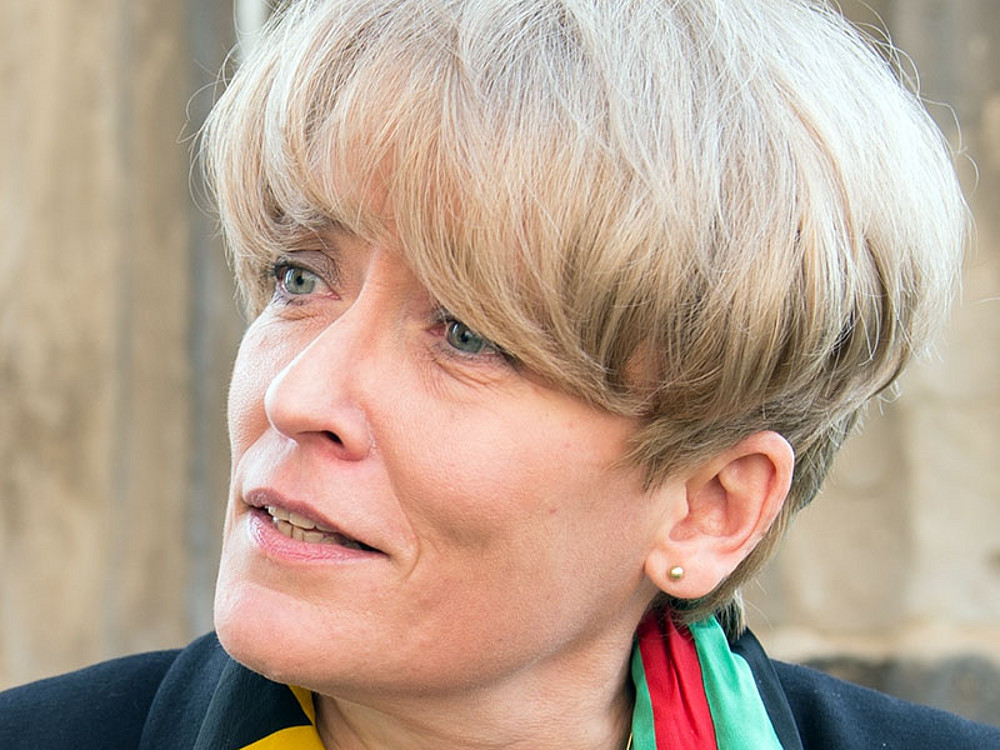
Ursula Gärtner erforscht aktuelle Bezüge in lateinischen Texten. Foto: KK

Ursula Gärtner erforscht aktuelle Bezüge in lateinischen Texten. Foto: KK

Ursula Gärtner ist seit 1. März neue Professorin für Klassische Philologie an der Uni Graz

Diskussionen über die Sinnhaftigkeit ihres Faches ist Ursula Gärtner gewohnt. Dennoch freut sich die neue Professorin für Latinistik, dass sie sich in Graz viel seltener die Bedeutung ihres Fachs erklären muss als in Potsdam, wo sie über zehn Jahre tätig war. „Das Schulfach Latein wurde in DDR-Zeiten nahezu völlig abgeschafft“, erzählt sie. Für den Wechsel nach Österreich war unter anderem die breit aufgestellte Altertumswissenschaft ausschlaggebend. „Das war für mich sehr reizvoll, es hat sich in den wenigen Monaten auch schon eine fruchtbare Zusammenarbeit ergeben“, berichtet Gärtner. Ein Schwerpunkt ihrer Arbeit ist die LehrerInnenausbildung, hier hat sie auch schon neue Initiativen gestartet. Am 18. Oktober findet der erste Lateintag an der Uni Graz statt: SchülerInnen erhalten Einblick in die Wissenschaft und die wissenschaftliche Herangehensweise an Texte in eigens auf sie zugeschnittenen Schnuppervorlesungen und -seminaren. Parallel dazu gibt es Weiterbildungsmöglichkeiten für LehrerInnen. „Wir wollen auch von den PädagogInnen Rückmeldungen zu unserer Ausbildung bekommen, um diese kontinuierlich zu verbessern“, betont Gärtner.

In ihrer Forschung beschäftigt sich die Latinistin unter anderem mit Bildsprache und der Bedeutung von Gleichnissen – vor allem in Epen. Sie versucht zu rekonstruieren, welche Vorstellung sich LeserInnen machen, wenn sie die Texte rezipieren. Besonders intensiv setzt sie sich mit den antiken Versfabeln des Phaedrus auseinander. Der Autor aus dem ersten Jahrhundert nach Christus wurde in der Wissenschaft lange Zeit stiefmütterlich behandelt, da er als Schriftsteller für die unteren Schichten galt. „Er schreibt aber sehr witzige, anspielungsreiche Gedichte“, hat Gärtner festgestellt. Phaedrus kennt die Werke seiner berühmteren Kollegen und macht sich über die hohen Ansprüche der Dichtung lustig. „In gewisser Weise handeln seinen Fabeln auch von der Dichtung selbst“, erklärt die neue Professorin. Anhand seiner Arbeit möchte sie auch SchülerInnen die Vielschichtigkeit von Literatur näherbringen, die im regulären Unterricht im Regelfall nicht vermittelt wird. „Latein ist nicht tot, sondern die Sprache von lebendigen Texten, die nach wie vor aktuell sind und an denen es immer noch Neues zu entdecken gibt“, resümiert Gärtner.

created by Dagmar Eklaude

Related news

Studying at the University of Graz: How to enrol

Ready for a new chapter in your life with the start of your studies at the University of Graz in the winter semester 2026/27? Here you will find information on deadlines, admission procedures, registration, and everything else you need to successfully start your studies in the fall.

Interpreting data: Why studies sometimes get it wrong

Hilmar Brohmer and Ziva Korda from the Institute of Psychology, together with 500 international colleagues, have re-evaluated a hundred scientific publications and have often come to different conclusions.

Crystal-clear: AI method revolutionises solar observation

The Sun makes life on Earth possible. However, its magnetic fields can also cause massive disruption. This makes it all the more important to gain a better understanding of the processes taking place on our nearest star. A research team from the University of Graz and the High Altitude Observatory in Boulder (USA) has succeeded in doing just that. The astrophysicists have developed an AI-supported method that makes even the smallest structures on the Sun visible. The scientists are convinced that this will bring about a lasting change in solar observation and that the new method can be used for the planned European Solar Telescope.

Long Night of Research: How many languages are there in the world?

From a linguistic perspective, there are worlds of difference between Bern, Berlin and Vienna. A dialect impersonator will demonstrate live just how varied German can sound. How many languages are there in the world? What are their distinctive features? Which of these are spoken in Austria? These and other questions will be answered during the Long Night of Research at the University of Graz: on Friday, 24 April 2025, from 5 pm to 11 pm, in the University Library. Visitors can immerse themselves in the diversity of languages without travelling far by taking part in a quiz at the station.

Begin of page section:
Additional information:

University of Graz
Universitaetsplatz 3
8010 Graz
Austria
  • Contact
  • Web Editors
  • Moodle
  • UNIGRAZonline
  • Imprint
  • Data Protection Declaration
  • Accessibility Declaration
Weatherstation
Uni Graz

End of this page section. Go to overview of page sections

End of this page section. Go to overview of page sections

Begin of page section:

End of this page section. Go to overview of page sections