Begin of page section:
Page sections:

  • Go to contents (Accesskey 1)
  • Go to position marker (Accesskey 2)
  • Go to main navigation (Accesskey 3)
  • Go to sub navigation (Accesskey 4)
  • Go to additional information (Accesskey 5)
  • Go to page settings (user/language) (Accesskey 8)
  • Go to search (Accesskey 9)

End of this page section. Go to overview of page sections

Begin of page section:
Page settings:

English en
Deutsch de
Search
Login

End of this page section. Go to overview of page sections

Begin of page section:
Search:

Search for details about Uni Graz
Close

End of this page section. Go to overview of page sections


Search

Begin of page section:
Main navigation:

Page navigation:

  • University

    University
    • About the University
    • Organisation
    • Faculties
    • Library
    • Working at University of Graz
    • Campus
    Developing solutions for the world of tomorrow - that is our mission. Our students and our researchers take on the great challenges of society and carry the knowledge out.
  • Research Profile

    Research Profile
    • Our Expertise
    • Research Questions
    • Research Portal
    • Promoting Research
    • Research Transfer
    • Ethics in Research
    Scientific excellence and the courage to break new ground. Research at the University of Graz creates the foundations for making the future worth living.
  • Studies

    Studies
    • Prospective Students
    • Students
  • Community

    Community
    • International
    • Location
    • Research and Business
    • Alumni
    The University of Graz is a hub for international research and brings together scientists and business experts. Moreover, it fosters the exchange and cooperation in study and teaching.
  • Spotlight
Topics
  • Our digital Advent calendar
  • Sustainable University
  • Researchers answer
  • Work for us
Close menu

End of this page section. Go to overview of page sections

Begin of page section:
You are here:

University of Graz News Zeit und Körper

End of this page section. Go to overview of page sections

Monday, 26 May 2014

Zeit und Körper

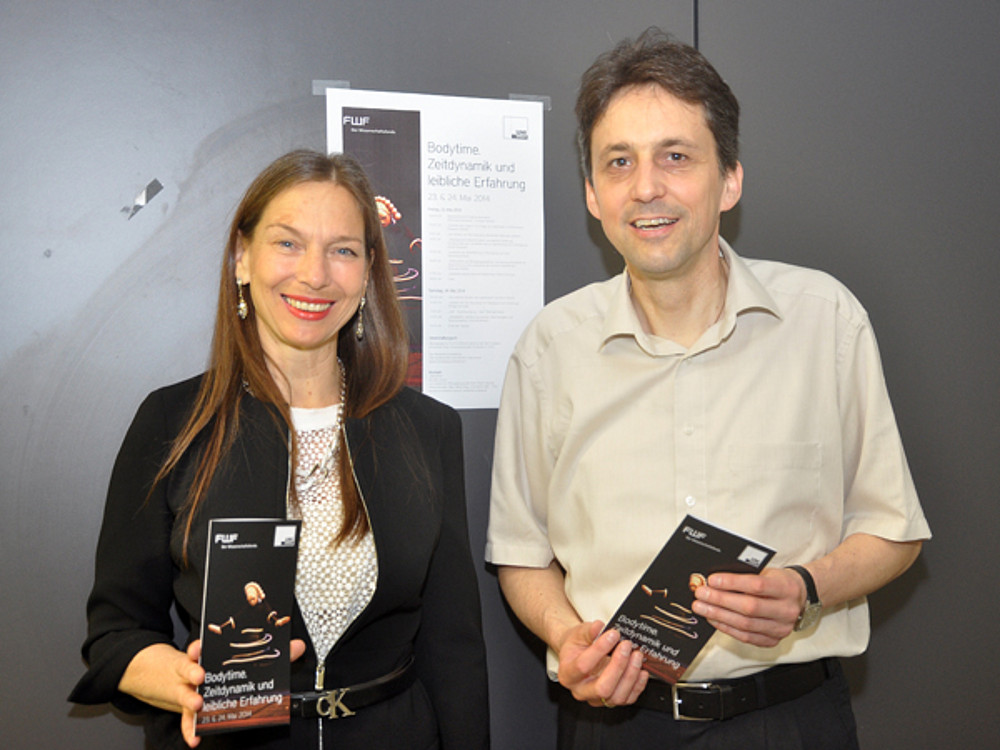
Andrea Paletta und Reinhold Esterbauer eröffneten die Tagung BODYTIME am vergangenen Freitag.

Andrea Paletta und Reinhold Esterbauer eröffneten die Tagung BODYTIME am vergangenen Freitag.

Fächerübgreifende Tagung untersucht Zusammenhänge bei Burn-Out-PatientInnen

Sie haben jegliches Gefühl für Zeit verloren, schenken ihrem Körper keine Aufmerksamkeit und glauben, nur mehr funktionieren zu müssen: Burn-Out-PatientInnen im fortgeschrittenen Stadium der Krankheit gleichen oft fremdbestimmten Wesen. Wie wirken sich der Verlust des eigenen Rhythmus und das bruchstückhafte Zeitbewusstsein auf den Körper aus?


Diese Frage untersuchte am vergangenen Wochenende die zweitägige Tagung "Bodytime", die gleichzeitig auch Auftaktveranstaltung eines vom österreichischen Wissenschaftsfonds FWF geförderten Prokjekt war. Besonders interessant ist dabei die Zusammenarbeit des Instituts fürs Philosophie an der Katholisch-Theologischen Fakultät mit dem Institut für Sportwissenschaft der Uni Graz. Die Verbindung dieser unterschiedlichen Disziplinen erlaubt einen ganzheitlichen Blick auf den Konnex zwischen individueller Zeitwahrnehmung und persönlichem Körpergefühl, erläuterten die OrganisatorInnen, und Univ.-Prof. Dr. Reinhold Esterbauer und Ao.Univ.-Prof. Dr. Andrea Paletta.


Neben spannenden Vorträgen wurden im Rahmen der Tagung auch schon erste Ergebnisse des für drei Jahre anberaumten Projekts präsentiert: So korrelieren körperliche Antriebslosigkeit mit einer völlig auf die Arbeit fokussierten Zeitwahrnehmung eindeutig miteinander. Die WissenschafterInnen stehen nun vor der Frage, ob sich durch spezielle Bewegungstherapien, in der die PatientInnen wieder lernen, auf Signale des Körpers zu achten, eine Umstellung ihrer Wahrnehmung des eigenen Ich im zeitlichen Gefüge des Lebens bewirken lässt.


>> Mehr über "Bodytime" lesen Sie hier!

created by Gerhild Kastrun

Related news

Chemical Christmas show at the University of Graz: An explosive evening at the Schauspielh

At the beginning of December, the University of Graz transformed the theater into a laboratory: as part of “Chemical Life,” teacher training students staged a chemical Christmas show for Styrian school classes—complete with ethanol rockets, nitrogen snow, and glowing effects. An evening designed to inspire interest in studying chemistry.

Train by train: Koralm railway accelerates exchange between the Universities

Lectures at the University of Klagenfurt in the morning, seminars at the University of Graz in the afternoon: Austria's longest tunnel and a journey time of around 45 minutes make it easy. The Koralm railway increases the speed of networking between the two university locations. The collaboration builds on existing cooperation - for example in the areas of teacher training, Slavic studies and as employers, the universities are well coordinated.

On the trail of the Big Bang: University of Graz receives 1.5 million euros for doctoral programmes

The Austrian Science Fund FWF has selected the Doctoral Programme in Theoretical Particle Physics at the University of Graz for funding from the Doc.funds. Six young scientists will be funded for 3.5 years. They will gain fundamentally new insights into the origins of the world.

From trans women and knee prostheses: sports science prizes awarded

Walking better with a prosthesis, successfully getting rid of excess weight, training more effectively, more fairness for trans people in sport: these were the topics addressed by the students at the University of Graz who were awarded the sports science prizes for their Master's theses on 3 December 2025.

Begin of page section:
Additional information:

University of Graz
Universitaetsplatz 3
8010 Graz
Austria
  • Contact
  • Web Editors
  • Moodle
  • UNIGRAZonline
  • Imprint
  • Data Protection Declaration
  • Accessibility Declaration
Weatherstation
Uni Graz

End of this page section. Go to overview of page sections

End of this page section. Go to overview of page sections

Begin of page section:

End of this page section. Go to overview of page sections