Begin of page section:
Page sections:

  • Go to contents (Accesskey 1)
  • Go to position marker (Accesskey 2)
  • Go to main navigation (Accesskey 3)
  • Go to sub navigation (Accesskey 4)
  • Go to additional information (Accesskey 5)
  • Go to page settings (user/language) (Accesskey 8)
  • Go to search (Accesskey 9)

End of this page section. Go to overview of page sections

Begin of page section:
Page settings:

English en
Deutsch de
Search
Login

End of this page section. Go to overview of page sections

Begin of page section:
Search:

Search for details about Uni Graz
Close

End of this page section. Go to overview of page sections


Search

Begin of page section:
Main navigation:

Page navigation:

  • University

    University
    • About the University
    • Organisation
    • Faculties
    • Library
    • Working at University of Graz
    • Campus
    Developing solutions for the world of tomorrow - that is our mission. Our students and our researchers take on the great challenges of society and carry the knowledge out.
  • Research Profile

    Research Profile
    • Our Expertise
    • Research Questions
    • Research Portal
    • Promoting Research
    • Research Transfer
    • Ethics in Research
    • Commission for Scientific Integrity
    Scientific excellence and the courage to break new ground. Research at the University of Graz creates the foundations for making the future worth living.
  • Studies

    Studies
    • Prospective Students
    • Students
  • Community

    Community
    • International
    • Location
    • Research and Business
    • Alumni
    The University of Graz is a hub for international research and brings together scientists and business experts. Moreover, it fosters the exchange and cooperation in study and teaching.
  • Spotlight
Topics
  • Sustainable University
  • Researchers answer
  • Work for us
Close menu

End of this page section. Go to overview of page sections

Begin of page section:
You are here:

University of Graz News Wo Wissen wächst

End of this page section. Go to overview of page sections

Wednesday, 29 May 2019

Wo Wissen wächst

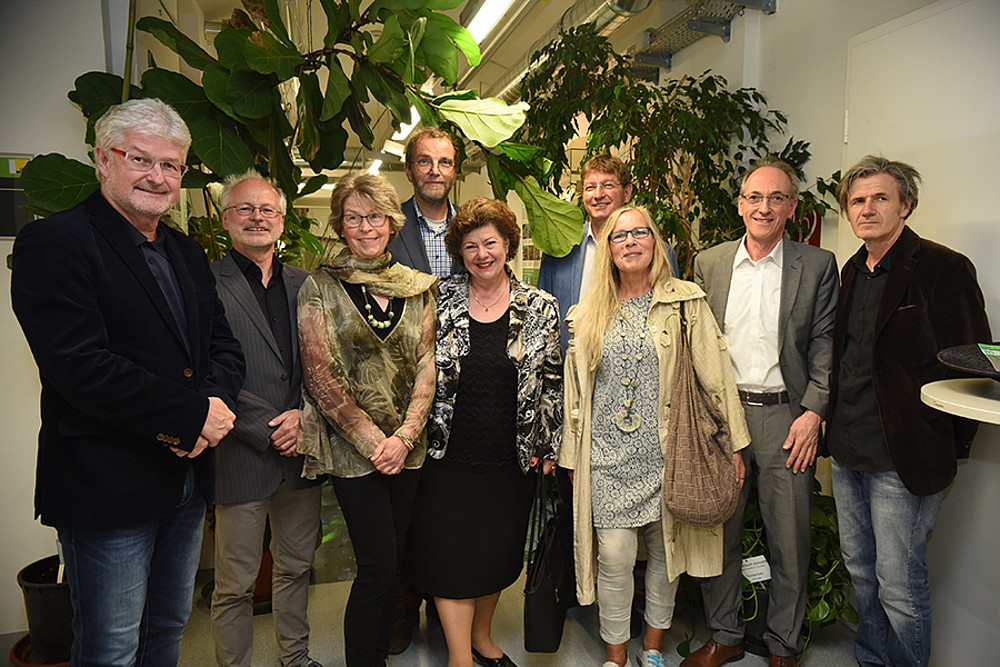
Gäste der Ausstellungseröffnung: Museumsleiter Nikolaus Reisinger, die BiologInnen Martin Grube, Ursula Brosch und Christian Berg, Gemeinderätin Sissy Potzinger, Vizerektor Peter Scherrer, Künstlerin Barbara Raić, Kustos Franz Stangl und Künstler Božo Raić (v. l.) Fotos: Uni Graz/Schweiger

Gäste der Ausstellungseröffnung: Museumsleiter Nikolaus Reisinger, die BiologInnen Martin Grube, Ursula Brosch und Christian Berg, Gemeinderätin Sissy Potzinger, Vizerektor Peter Scherrer, Künstlerin Barbara Raić, Kustos Franz Stangl und Künstler Božo Raić (v. l.) Fotos: Uni Graz/Schweiger

Universität Graz entführt mit neuer Sonderausstellung in die Welt von Flora und Forschung

Warum können Moose das Stadtklima regulieren? Sind Pilze in Zukunft ein umweltfreundliches Baumaterial? BiologInnen der Universität Graz widmen sich spannenden und innovativen Projekten. Der Botanische Garten dient dazu als Ideengeber und als Labor. Wie das vor genau 130 Jahren in der Schubertstraße begonnen und sich weiterentwickelt hat, ist Thema einer neuen Sonderausstellung im UniGraz@Museum im Hauptgebäude. Die Schau „Wo Wissen wächst“ wurde am 28. Mai 2019 eröffnet und läuft bis April 2020. 

„Unser Museum bildet eine wichtige Schnittstelle zur Gesellschaft“, erläuterte Vizerektor Peter Scherrer im Rahmen der Vernissage. Nikolaus Reisinger, Leiter der Universitätsmuseen, freute sich über die bereits 24. Sonderausstellung im Hauptgebäude: „Das Museum ist ein lebendiger Ort der angewandten Forschung.“ 
Für die wissenschaftliche Konzeption zeichnen Christian Berg, Leiter des Botanischen Gartens, und Martin Grube, Professor am Institut für Biologie, verantwortlich. Sie haben eine spannende und abwechslungsreiche Expedition durch die Pflanzenwelt gestaltet. BesucherInnen erfahren zum Beispiel, dass von fast 400.000 Pflanzenarten nur ein Bruchteil vom Menschen genutzt werden. Dass Gewächse für das Funktionieren des Ökosystems lebensnotwendig sind. Und dass die Universität Graz eine der weltgrößten Sammlungen getrockneter Pflanzen besitzt.

Die Sonderausstellung „Wo Wissen wächst“ ist montags von 10 bis 15 Uhr, mittwochs und freitags, jeweils von 10 bis 13 Uhr, bis zum 30. April 2020 zu sehen. Eintritt: 4 Euro, ermäßigt 2 Euro >> Mehr übers UniGraz@Museum erfahren

Wissenswertes aus der Pflanzenwelt verrät auch der nächste Botanik Brunch über Heilpflanzen am Sonntag, 16. Juni 2019. Was ist dran an der Heilkraft von Pflanzen? Ist tatsächlich gegen jede Krankheit ein Kraut gewachsen? >> Mehr erfahren 
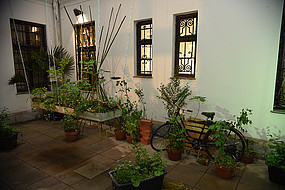
Es grünt im Innenhof des Uni-Museums.
Mit mehr als 100 Ländern tauscht der Botanische Garten Pflanzen aus.
created by Andreas Schweiger

Related news

Studying at the University of Graz: How to enrol

Ready for a new chapter in your life with the start of your studies at the University of Graz in the winter semester 2026/27? Here you will find information on deadlines, admission procedures, registration, and everything else you need to successfully start your studies in the fall.

Interpreting data: Why studies sometimes get it wrong

Hilmar Brohmer and Ziva Korda from the Institute of Psychology, together with 500 international colleagues, have re-evaluated a hundred scientific publications and have often come to different conclusions.

Crystal-clear: AI method revolutionises solar observation

The Sun makes life on Earth possible. However, its magnetic fields can also cause massive disruption. This makes it all the more important to gain a better understanding of the processes taking place on our nearest star. A research team from the University of Graz and the High Altitude Observatory in Boulder (USA) has succeeded in doing just that. The astrophysicists have developed an AI-supported method that makes even the smallest structures on the Sun visible. The scientists are convinced that this will bring about a lasting change in solar observation and that the new method can be used for the planned European Solar Telescope.

Long Night of Research: How many languages are there in the world?

From a linguistic perspective, there are worlds of difference between Bern, Berlin and Vienna. A dialect impersonator will demonstrate live just how varied German can sound. How many languages are there in the world? What are their distinctive features? Which of these are spoken in Austria? These and other questions will be answered during the Long Night of Research at the University of Graz: on Friday, 24 April 2025, from 5 pm to 11 pm, in the University Library. Visitors can immerse themselves in the diversity of languages without travelling far by taking part in a quiz at the station.

Begin of page section:
Additional information:

University of Graz
Universitaetsplatz 3
8010 Graz
Austria
  • Contact
  • Web Editors
  • Moodle
  • UNIGRAZonline
  • Imprint
  • Data Protection Declaration
  • Accessibility Declaration
Weatherstation
Uni Graz

End of this page section. Go to overview of page sections

End of this page section. Go to overview of page sections

Begin of page section:

End of this page section. Go to overview of page sections