Begin of page section:
Page sections:

  • Go to contents (Accesskey 1)
  • Go to position marker (Accesskey 2)
  • Go to main navigation (Accesskey 3)
  • Go to sub navigation (Accesskey 4)
  • Go to additional information (Accesskey 5)
  • Go to page settings (user/language) (Accesskey 8)
  • Go to search (Accesskey 9)

End of this page section. Go to overview of page sections

Begin of page section:
Page settings:

English en
Deutsch de
Search
Login

End of this page section. Go to overview of page sections

Begin of page section:
Search:

Search for details about Uni Graz
Close

End of this page section. Go to overview of page sections


Search

Begin of page section:
Main navigation:

Page navigation:

  • University

    University
    • About the University
    • Organisation
    • Faculties
    • Library
    • Working at University of Graz
    • Campus
    Developing solutions for the world of tomorrow - that is our mission. Our students and our researchers take on the great challenges of society and carry the knowledge out.
  • Research Profile

    Research Profile
    • Our Expertise
    • Research Questions
    • Research Portal
    • Promoting Research
    • Research Transfer
    • Ethics in Research
    • Commission for Scientific Integrity
    Scientific excellence and the courage to break new ground. Research at the University of Graz creates the foundations for making the future worth living.
  • Studies

    Studies
    • Prospective Students
    • Students
  • Community

    Community
    • International
    • Location
    • Research and Business
    • Alumni
    The University of Graz is a hub for international research and brings together scientists and business experts. Moreover, it fosters the exchange and cooperation in study and teaching.
  • Spotlight
Topics
  • Sustainable University
  • Researchers answer
  • Work for us
Close menu

End of this page section. Go to overview of page sections

Begin of page section:
You are here:

University of Graz News Wissenschaft unterstützt Politik

End of this page section. Go to overview of page sections

Thursday, 14 July 2016

Wissenschaft unterstützt Politik

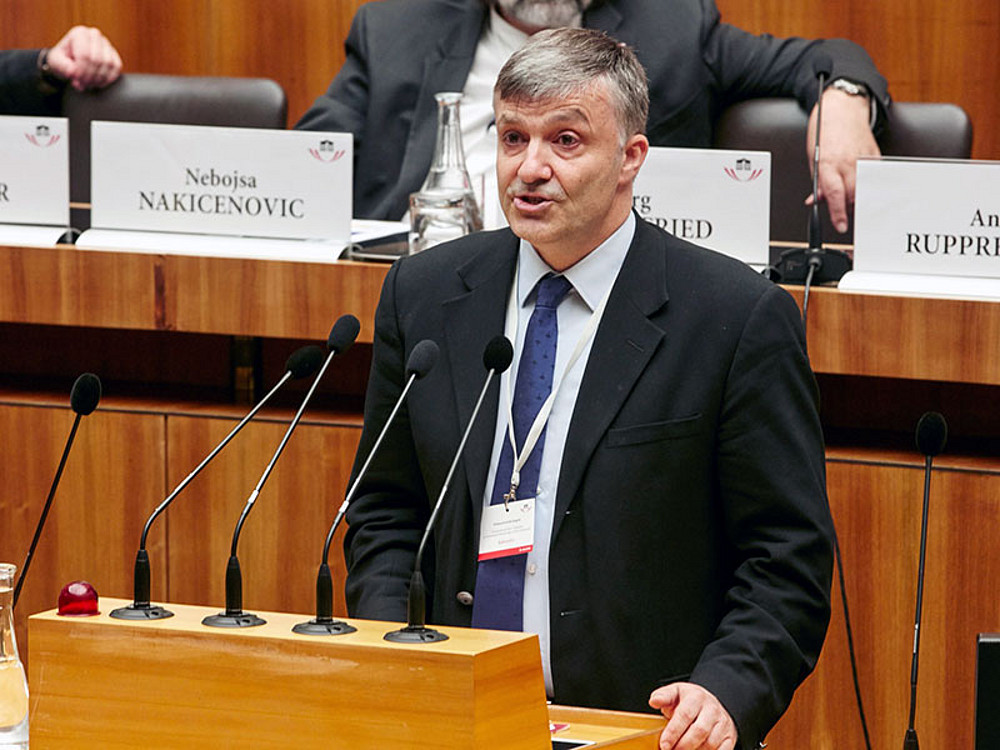
Karl Steininger legte im Parlament Handlungsmöglichkeiten zur Emissionsreduktion dar. Foto: © Parlamentsdirektion / Thomas Topf ©Parlamentsdirektion/Thomas Top

Karl Steininger legte im Parlament Handlungsmöglichkeiten zur Emissionsreduktion dar. Foto: © Parlamentsdirektion / Thomas Topf

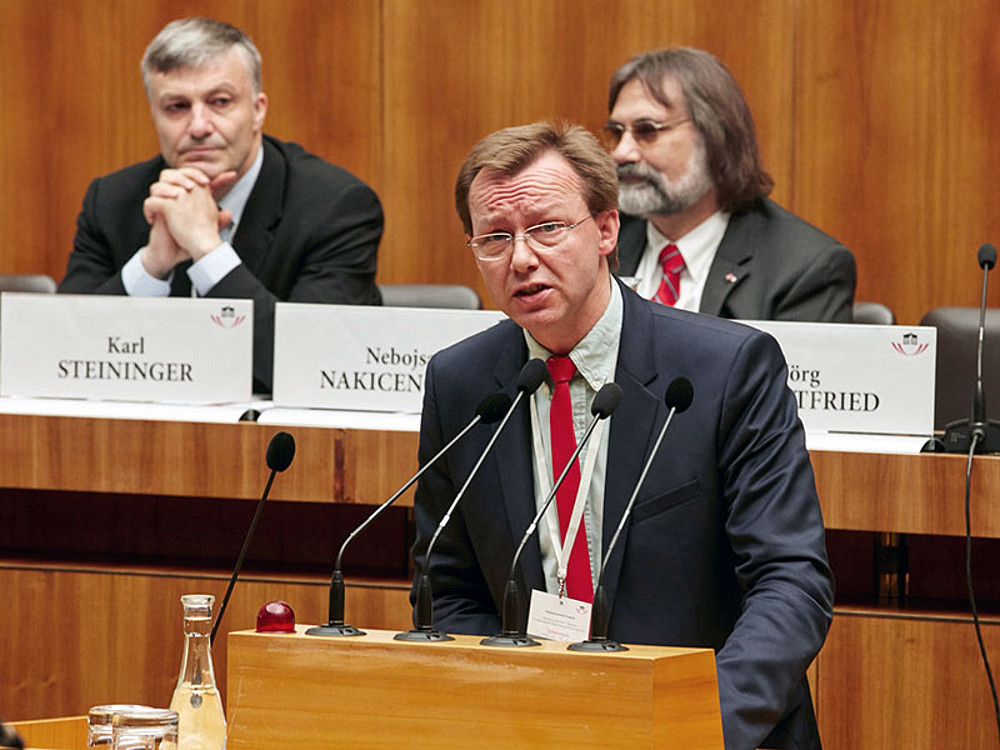
Gottfried Kirchengast berichtete, dass als Folge des Grazer Umweltrechtstages nun die Möglichkeiten der Klimapolitik aus zivil-, öffentlich-, verfassungs- und haftungsrechtlicher Perspektive erarbeitet werden. Foto: © Parlamentsdirektion / Thomas Topf ©Parlamentsdirektion/Thomas Top

Gottfried Kirchengast berichtete, dass als Folge des Grazer Umweltrechtstages nun die Möglichkeiten der Klimapolitik aus zivil-, öffentlich-, verfassungs- und haftungsrechtlicher Perspektive erarbeitet werden. Foto: © Parlamentsdirektion / Thomas Topf

Forscher der Uni Graz präsentierten im Parlament Handlungsmöglichkeiten zur Umsetzung des Pariser Klimaschutzabkommens

Am 8. Juli 2016 wurde das Pariser Klimaschutzabkommen, das 195 Staaten bei der UN-Klimakonferenz im Dezember 2015 beschlossen haben, im Österreichischen Nationalrat ratifiziert. Die zentrale Vereinbarung ist, den globalen Temperaturanstieg durch eine Reduktion von Treibhausgasemissionen auf deutlich unter zwei Grad zu begrenzen. Nun sind die einzelnen Länder gefordert, effektive Maßnahmen zur Erreichung dieses Ziels zu setzen. Dabei kommt der Wissenschaft die bedeutende Rolle zu, durch neueste Forschungsergebnisse eine verlässliche Grundlage für politische Entscheidungen zu schaffen.

Auch im Vorfeld der Ratifzierung des Pariser Abkommens bat der Nationalrat die Wissenschaft um ihre Expertise. Im Juni 2016 lud er Ao.Univ.-Prof. Dr. Karl Steininger vom Institut für Volkswirtschaftslehre und dem Wegener Center der Universität Graz, als Vertreter der österreichischen Universitäten, zur parlamentarischen Enquete „Was kommt nach Paris?“. Diskutiert wurde die Umsetzung des Klimavertrages von Paris in Österreich. Steininger, Mitherausgeber des Österreichischen Sachstandsberichts Klimawandel legte die neuesten Studienergebnisse zur Ausgangslage sowie Handlungsmöglichkeiten zur Emissionsreduktion dar, wie etwa neue Technologien oder Siedlungsstrukturen mit geringem Transportbedarf. „Wir müssen einen sozial verträglichen, wirtschaftlich tragfähigen und ökologisch angepassten Lebensstil erreichen“, so Steininger. „Es wird deutlich ungemütlicher, wenn wir nichts tun.“

Univ.-Prof. Dr. Gottfried Kirchengast, Leiter des Wegener Center, informierte in einer persönlichen Stellungnahme die Nationalratsabgeordneten, dass in der Folge des jüngsten Grazer Umweltrechtstages derzeit die Möglichkeiten der Klimapolitik aus zivil-, öffentlich-, verfassungs- und haftungsrechtlicher Perspektive erarbeitet werden. Auch mehrere AbsolventInnen der Uni Graz brachten ihre Expertise ein, unter ihnen der Volkswirt Mag. Mario Matzer für die Arbeiterkammer.

Neben Norwegen und den Malediven zählt Österreich zu den ersten Ländern, die das Pariser Klimaschutzabkommen ratifiziert haben.

created by Karl Steininger & Gudrun Pichler

Related news

Around the world in eight stops: the Long Night of Research at the University of Graz

On 24 April from 5 pm, you can take a short trip around the globe at the University of Graz, discovering pecularities of foreign countries or new local features in the entrance hall of the University Library. The itinerary takes you through introduced animal species, political attitudes and the omnipotence of algorithms. There will also be a programme in the historic reading hall, as well as at the UniGraz@Museum and the University Archive.

Studying at the University of Graz: How to enrol

Ready for a new chapter in your life with the start of your studies at the University of Graz in the winter semester 2026/27? Here you will find information on deadlines, admission procedures, registration, and everything else you need to successfully start your studies in the fall.

Interpreting data: Why studies sometimes get it wrong

Hilmar Brohmer and Ziva Korda from the Institute of Psychology, together with 500 international colleagues, have re-evaluated a hundred scientific publications and have often come to different conclusions.

Crystal-clear: AI method revolutionises solar observation

The Sun makes life on Earth possible. However, its magnetic fields can also cause massive disruption. This makes it all the more important to gain a better understanding of the processes taking place on our nearest star. A research team from the University of Graz and the High Altitude Observatory in Boulder (USA) has succeeded in doing just that. The astrophysicists have developed an AI-supported method that makes even the smallest structures on the Sun visible. The scientists are convinced that this will bring about a lasting change in solar observation and that the new method can be used for the planned European Solar Telescope.

Begin of page section:
Additional information:

University of Graz
Universitaetsplatz 3
8010 Graz
Austria
  • Contact
  • Web Editors
  • Moodle
  • UNIGRAZonline
  • Imprint
  • Data Protection Declaration
  • Accessibility Declaration
Weatherstation
Uni Graz

End of this page section. Go to overview of page sections

End of this page section. Go to overview of page sections

Begin of page section:

End of this page section. Go to overview of page sections