Begin of page section:
Page sections:

  • Go to contents (Accesskey 1)
  • Go to position marker (Accesskey 2)
  • Go to main navigation (Accesskey 3)
  • Go to sub navigation (Accesskey 4)
  • Go to additional information (Accesskey 5)
  • Go to page settings (user/language) (Accesskey 8)
  • Go to search (Accesskey 9)

End of this page section. Go to overview of page sections

Begin of page section:
Page settings:

English en
Deutsch de
Search
Login

End of this page section. Go to overview of page sections

Begin of page section:
Search:

Search for details about Uni Graz
Close

End of this page section. Go to overview of page sections


Search

Begin of page section:
Main navigation:

Page navigation:

  • University

    University
    • About the University
    • Organisation
    • Faculties
    • Library
    • Working at University of Graz
    • Campus
    Developing solutions for the world of tomorrow - that is our mission. Our students and our researchers take on the great challenges of society and carry the knowledge out.
  • Research Profile

    Research Profile
    • Our Expertise
    • Research Questions
    • Research Portal
    • Promoting Research
    • Research Transfer
    • Ethics in Research
    Scientific excellence and the courage to break new ground. Research at the University of Graz creates the foundations for making the future worth living.
  • Studies

    Studies
    • Prospective Students
    • Students
  • Community

    Community
    • International
    • Location
    • Research and Business
    • Alumni
    The University of Graz is a hub for international research and brings together scientists and business experts. Moreover, it fosters the exchange and cooperation in study and teaching.
  • Spotlight
Topics
  • Sustainable University
  • Researchers answer
  • Work for us
Close menu

End of this page section. Go to overview of page sections

Begin of page section:
You are here:

University of Graz News Wenn die Chemie stimmt

End of this page section. Go to overview of page sections

Monday, 09 April 2018

Wenn die Chemie stimmt

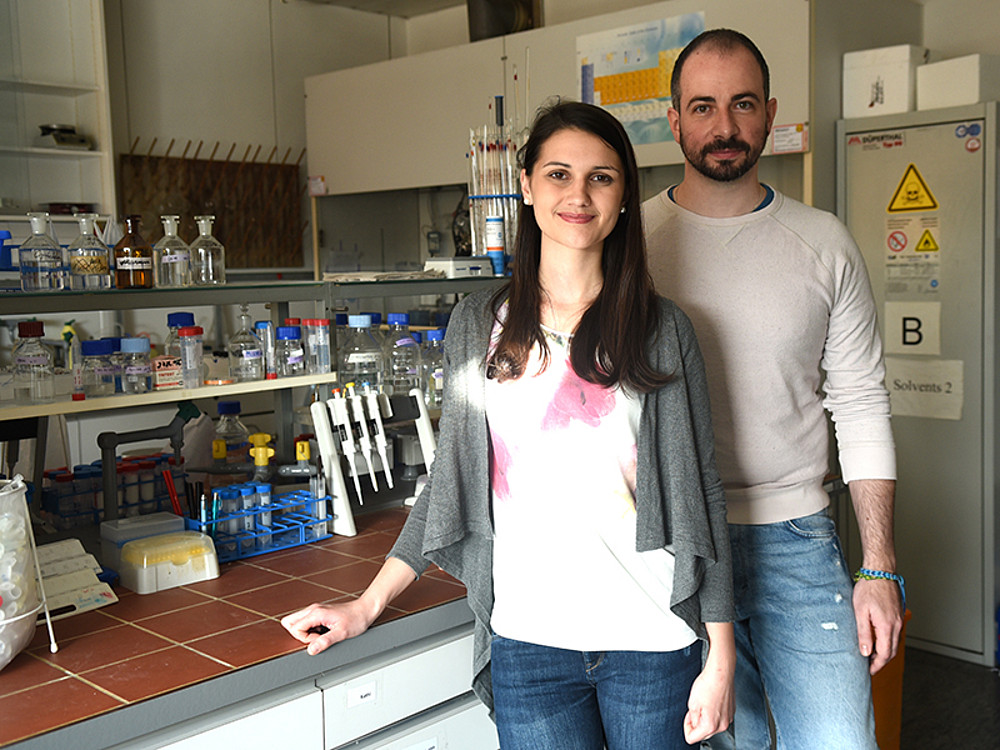
Julia Blesl und Stefan Velikogne forschen in der Doktoratsschule Chemie von NAWI Graz. Foto: Uni Graz/Schweiger

Julia Blesl und Stefan Velikogne forschen in der Doktoratsschule Chemie von NAWI Graz. Foto: Uni Graz/Schweiger

Die PhD-Studierenden Julia Blesl und Stefan Velikogne forschen in der Doktoratsschule von NAWI Graz

Es stimmt buchstäblich die Chemie – unter den NachwuchswissenschafterInnen der Doktoratsschule Chemie von NAWI Graz, der Kooperation von Universität Graz und Technischer Universität Graz. Und es gibt erfolgreiche Kettenreaktionen – wie bei den DocDays Chemistry, an denen sich PhD-Studierende mit Industrie-VertreterInnen, erfahrenen WissenschafterInnen und erfolgreichen AbsolventInnen austauschen. Seit bereits zehn Jahren. Anlässlich des Jubiläums der Veranstaltung am 4. und 5. April 2018 an der Uni Graz schildern Julia Blesl (26) und Stefan Velikogne (29), welche Vorteile die gemeinsame Doktoratsausbildung hat, warum sie sich für die Wissenschaft begeistern und wie sie die Zukunft für ihre Forschungsarbeit sehen.

Zukunft hat Julia Blesls Forschung unbestritten. Könnten doch einmal neue Therapiemöglichkeiten von Krankheiten daraus resultieren. Die Grazerin beschäftigt sich in ihrer Dissertation unter der Betreuung von Rolf Breinbauer an der TU Graz mit sogenannten Protein-Protein-Interaktionen. Derartige biologische Prozesse spielen im gesamten Körper eine große Rolle – von der Tumorbildung über Asthma bis hin zu Bluthochdruck. „Ich beschäftige mich insbesondere mit der Synthese hemmender Verbindungen und bemühe mich, die Bausteine schnell herzustellen“, schildert Blesl, die gerade das dritte Jahr ihres PhD-Studiums begonnen hat.
Ebenso wie Stefan Velikogne. Der Villacher geht in der Arbeitsgruppe rund um Wolfgang Kroutil von der Uni Graz der Frage nach, wie man Enzyme biotechnologisch bzw. biokatalytisch nutzen kann, um Arzneien oder auch Feinchemikalien herzustellen. „Wir suchen nach neuen Enzymen oder nutzen die Vielseitigkeit schon bekannter Enzyme noch weiter aus. Zudem arbeiten wir in wässriger Lösung, dadurch entsteht kaum Abfall, und auch die Enzyme sind nicht schädlich für die Umwelt“, nennt der Doktorand Vorteile der Biokatalyse.
Er kann sich durchaus vorstellen, nach seinem PhD-Studium in der Wissenschaft zu bleiben. „Ich habe schon einige Laborübungen betreut und festgestellt, dass mir auch die Lehre viel Freude macht“, so der 29-Jährige. Ein Auslandaufenthalt wäre eine weitere Option. „Renommierte Forschungsgruppen zur Biokatalyse finden sich in Deutschland, in Großbritannien oder in den USA.“ Internationalität ist auch in der 2006 initiierten Doktoratsschule Chemie ein entscheidender Aspekt, dem die DocDays – selbstständig von PhD-Studierenden organisiert – im Programm Rechnung tragen.

Und welche Vorteile ergeben sich sonst durch den Schulterschluss im Rahmen von NAWI Graz? Blesl: „Durch die Chance, Lehrveranstaltungen an beiden Universitäten zu besuchen und andere Fächer und Forschungsgruppen kennenzulernen, bekommt man unterschiedliche Einblicke.“

Julia Blesl und Stefan Velikogne verbindet nicht nur die Doktoratsschule. Bei beiden wurde schon im Gymnasium das Interesse für Chemie geweckt und damit das Fundament für die wissenschaftliche Tätigkeit gelegt. „Das Fragen hört nie auf, die Abwechslung ist groß“, begründet Blesl. Durchhaltevermögen, gesteht die Chemikerin, sei wichtig, denn natürlich können langwierige Forschungen hin und wieder frustrierend sein: „Umso mehr motiviert dann aber ein Durchbruch.“


>> Mehr zur Doktoratsschule

created by Andreas Schweiger

Related news

AI in schools: Maria Bertel drafts legal guidelines for teachers

The legal expert and her team analysed the legal situation regarding the use of artificial intelligence in education as part of an EU project and answered open questions from practice.

Cosmetics in the environment: University of Graz proves danger to ants

Titanium dioxide, which is found in cosmetics, for example, is increasingly entering the environment in the form of nanoparticles. This could also put insects at risk. If ants ingest the substance in combination with the pesticide glyphosate, it disturbs the development of their offspring. Scientists at the University of Graz are drawing attention to the negative consequences of this toxic cocktail.

Varied and healthy: studies move

Exercise is the ideal way to balance out everyday stress, prevent illness and keep fit. Why this is the case, how to do it properly and what role human bodily functions and psychology play can be studied at the University of Graz.

Religious scholar Theresia Heimerl: Fasting as a spiritual boost

Fasting is not just a strategy for losing weight – it is a ritual dating back thousands of years with spiritual and evolutionary roots that has positive effects on the body. At the University of Graz, religious scholar Theresia Heimerl is investigating why fasting is a "spiritual boost".

Begin of page section:
Additional information:

University of Graz
Universitaetsplatz 3
8010 Graz
Austria
  • Contact
  • Web Editors
  • Moodle
  • UNIGRAZonline
  • Imprint
  • Data Protection Declaration
  • Accessibility Declaration
Weatherstation
Uni Graz

End of this page section. Go to overview of page sections

End of this page section. Go to overview of page sections

Begin of page section:

End of this page section. Go to overview of page sections