Begin of page section:
Page sections:

  • Go to contents (Accesskey 1)
  • Go to position marker (Accesskey 2)
  • Go to main navigation (Accesskey 3)
  • Go to sub navigation (Accesskey 4)
  • Go to additional information (Accesskey 5)
  • Go to page settings (user/language) (Accesskey 8)
  • Go to search (Accesskey 9)

End of this page section. Go to overview of page sections

Begin of page section:
Page settings:

English en
Deutsch de
Search
Login

End of this page section. Go to overview of page sections

Begin of page section:
Search:

Search for details about Uni Graz
Close

End of this page section. Go to overview of page sections


Search

Begin of page section:
Main navigation:

Page navigation:

  • University

    University
    • About the University
    • Organisation
    • Faculties
    • Library
    • Working at University of Graz
    • Campus
    Developing solutions for the world of tomorrow - that is our mission. Our students and our researchers take on the great challenges of society and carry the knowledge out.
  • Research Profile

    Research Profile
    • Our Expertise
    • Research Questions
    • Research Portal
    • Promoting Research
    • Research Transfer
    • Ethics in Research
    Scientific excellence and the courage to break new ground. Research at the University of Graz creates the foundations for making the future worth living.
  • Studies

    Studies
    • Prospective Students
    • Students
  • Community

    Community
    • International
    • Location
    • Research and Business
    • Alumni
    The University of Graz is a hub for international research and brings together scientists and business experts. Moreover, it fosters the exchange and cooperation in study and teaching.
  • Spotlight
Topics
  • Our digital Advent calendar
  • Sustainable University
  • Researchers answer
  • Work for us
Close menu

End of this page section. Go to overview of page sections

Begin of page section:
You are here:

University of Graz News Why different things are good for us: psychologist Katja Corcoran on the benefits of diver

End of this page section. Go to overview of page sections

Tuesday, 15 April 2025

Why different things are good for us: psychologist Katja Corcoran on the benefits of diver

Katja Corcoran

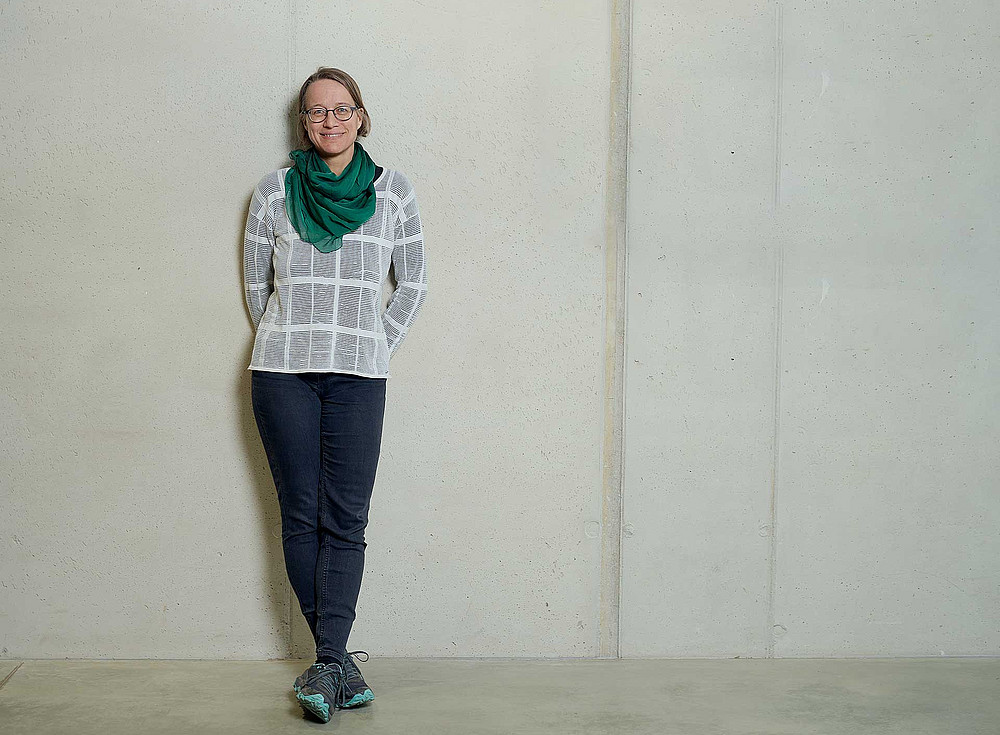
Social psychologist Katja Corcoran: ‘People outside my own circle report different things to me than my friends do. This input helps us expand our self-image.’ Photo: Uni Graz/wildundwunderbar

Bright, colourful and exotic: especially now in May, we enjoy variety in nature. Not always in human society. Psychologist Katja Corcoran explains why diversity can be overwhelming for some and why it is always an enrichment.

Humans are creatures of habit. Familiarity creates security, similarity gives us a sense of well-being. Moving out of your comfort zone? Not necessarily. But breaking out of our own bubble is good for us: "It's the only way to get accurate information about ourselves. People outside my own circle tell me different things than my friends. This input allows us to expand our self-image," explains social psychologist Katja Corcoran. 
She confirms that this approach is also important in the professional world. The more diverse teams are, the more perspectives flow into decisions. This makes them more comprehensible for a wider group of people. However, Corcoran confirms that it can be challenging to get there because familiar things are easier to assess. "We usually only overcome this form of inertia when we see a purpose behind the effort. For example, pursuing a common goal," explains the scientist.

Living diversity

Diversity should therefore not just be a buzzword that is attached to flags. It should be an attitude that is incorporated everywhere - in work, leisure and everyday life. "We must consciously promote this attitude because it is contrary to our preferred reaction pattern. If we also have a world view that is based on a constant competitive situation, then I find it even more difficult to accept and positively value difference," summarises the researcher.

Out of the box

People who don't (or don't want to) fit into preconceived categories also enrich our perspective. This is because they open up scope for all of us, the researcher explains: "When we discard traditional categorisations of 'male' and 'female', it gives us freedom. Boundaries become more permeable and are no longer so strongly tied to seemingly immovable biological 'facts'." 
Behind the superficial rejection of "different" people may lie the fear of behaving incorrectly towards them, Corcoran considers: "Clear rules make it easier to deal with each other. If nothing has to be 'right' but everything can be 'wrong', some people perceive this as stress and react with defence." It's better to enter into dialogue in a non-judgemental way than with embarrassed silence or open aggression. And not to reduce the other person to what makes him or her different, but to look for common ground.

created by Gerhild Leljak

Related news

Chemical Christmas show at the University of Graz: An explosive evening at the Schauspielh

At the beginning of December, the University of Graz transformed the theater into a laboratory: as part of “Chemical Life,” teacher training students staged a chemical Christmas show for Styrian school classes—complete with ethanol rockets, nitrogen snow, and glowing effects. An evening designed to inspire interest in studying chemistry.

Train by train: Koralm railway accelerates exchange between the Universities

Lectures at the University of Klagenfurt in the morning, seminars at the University of Graz in the afternoon: Austria's longest tunnel and a journey time of around 45 minutes make it easy. The Koralm railway increases the speed of networking between the two university locations. The collaboration builds on existing cooperation - for example in the areas of teacher training, Slavic studies and as employers, the universities are well coordinated.

On the trail of the Big Bang: University of Graz receives 1.5 million euros for doctoral programmes

The Austrian Science Fund FWF has selected the Doctoral Programme in Theoretical Particle Physics at the University of Graz for funding from the Doc.funds. Six young scientists will be funded for 3.5 years. They will gain fundamentally new insights into the origins of the world.

From trans women and knee prostheses: sports science prizes awarded

Walking better with a prosthesis, successfully getting rid of excess weight, training more effectively, more fairness for trans people in sport: these were the topics addressed by the students at the University of Graz who were awarded the sports science prizes for their Master's theses on 3 December 2025.

Begin of page section:
Additional information:

University of Graz
Universitaetsplatz 3
8010 Graz
Austria
  • Contact
  • Web Editors
  • Moodle
  • UNIGRAZonline
  • Imprint
  • Data Protection Declaration
  • Accessibility Declaration
Weatherstation
Uni Graz

End of this page section. Go to overview of page sections

End of this page section. Go to overview of page sections

Begin of page section:

End of this page section. Go to overview of page sections