Begin of page section:
Page sections:

  • Go to contents (Accesskey 1)
  • Go to position marker (Accesskey 2)
  • Go to main navigation (Accesskey 3)
  • Go to sub navigation (Accesskey 4)
  • Go to additional information (Accesskey 5)
  • Go to page settings (user/language) (Accesskey 8)
  • Go to search (Accesskey 9)

End of this page section. Go to overview of page sections

Begin of page section:
Page settings:

English en
Deutsch de
Search
Login

End of this page section. Go to overview of page sections

Begin of page section:
Search:

Search for details about Uni Graz
Close

End of this page section. Go to overview of page sections


Search

Begin of page section:
Main navigation:

Page navigation:

  • University

    University
    • About the University
    • Organisation
    • Faculties
    • Library
    • Working at University of Graz
    • Campus
    Developing solutions for the world of tomorrow - that is our mission. Our students and our researchers take on the great challenges of society and carry the knowledge out.
  • Research Profile

    Research Profile
    • Our Expertise
    • Research Questions
    • Research Portal
    • Promoting Research
    • Research Transfer
    • Ethics in Research
    • Commission for Scientific Integrity
    Scientific excellence and the courage to break new ground. Research at the University of Graz creates the foundations for making the future worth living.
  • Studies

    Studies
    • Prospective Students
    • Students
    • Registration for Study Programme (Winter semester 2026/27)
  • Community

    Community
    • International
    • Location
    • Research and Business
    • Alumni
    The University of Graz is a hub for international research and brings together scientists and business experts. Moreover, it fosters the exchange and cooperation in study and teaching.
Topics
  • Sustainable University
  • Researchers answer
  • Work for us
Close menu

End of this page section. Go to overview of page sections

Begin of page section:
You are here:

University of Graz News When will we run out of water? Geologists analyse springs in the Alps

End of this page section. Go to overview of page sections

Monday, 21 July 2025

When will we run out of water? Geologists analyse springs in the Alps

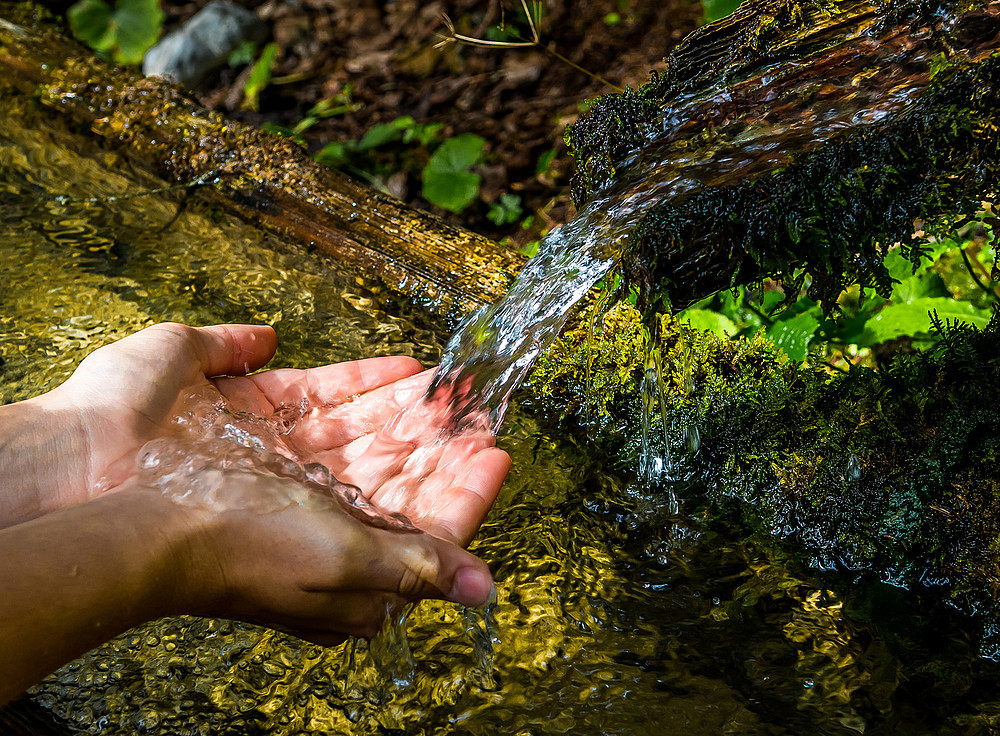
Hands formed into a bowl catch fresh mountain spring water ©grafxart/Adobe Stock

Fresh spring water becomes rarer in karst regions in summer. In the long term, this could jeopardise the drinking water supply. Photo: Adobe Stock/grafxart

More water in winter, a drastic drop in summer: Austria's springs are still abundant enough throughout the year. In the long term, however, climate change could jeopardise the supply. This is the result of a recently published study.

Prolonged drought has already led to crop failures this year, particularly in eastern Austria. Higher fees for filling private pools were only recently discussed. However, the demand for drinking water is still covered. "Calculated over the year, high alpine sources guarantee a sufficient supply. However, climate change is clearly noticeable," says Gerfried Winkler, summarising the results of the latest study. The hydrogeologist at the University of Graz and his team have analysed the discharge volumes of 27 selected springs in the Austrian Alps for the period 1997-2022 and compared them with weather data. 
Warmer winters have led to water reservoirs in the mountains also being filled at this time of year. However, due to the earlier onset of snowmelt in spring, they empty more quickly over the summer. "Autumn then becomes drier and drier," Winkler sums up. "In general, there is more frequent low water, especially in karst regions." The increased runoff in the winter months is likely to benefit electricity generation, while the decline in summer could become a problem for drinking water supplies and the ecological balance in the long term.

Important reservoirs
Alpine springs are particularly important for Austria's water supply during dry periods. How climate change affects their discharge was largely unknown before the study. However, some of the results of the study raise questions: "The developments in some high-altitude reservoirs influenced by snow do not consistently match the observed weather trends. This means that we have not yet captured all the relevant processes," concludes Winkler. We therefore need long-term data series from springs and good knowledge of their catchment areas in order to better predict future water availability.

Publication:
Matevz Vremec, Magdalena Seelig, Simon Seelig, Raoul Collenteur, Klaus Haslinger, Thomas Wagner, Jutta Eybl, Gerfried Winkler: Trend analysis of Alpine spring discharge: Interplay between climate and discharge characteristics, Science of the Total Environment 993 (2025)

created by Dagmar Eklaude

Related news

Complying with the norm: Why Do Standards Shape Our Lives, Elisabeth Staudegger?

Standards determine whether a sheet of paper fits in a printer or whether a charging plug can power multiple devices. These standards shape our everyday lives. But who actually sets these standards? Where are the weaknesses, and how could science help to improve them? Elisabeth Staudegger, Head of the ‘Law and IT’ Department at the Institute for Legal Foundations at the University of Graz, host the Academic Standards Day on 16 June. Here she relays how sciences can contribute to the topic of standardisation and reveals her personal favourite standard.

More body awareness than a culture war

In Italy, sex education lessons will in future only be permitted with parental consent, and will be banned entirely in nurseries and primary schools. At the same time, Pride Month highlights why knowledge about the body, relationships, boundaries and diversity is important for young people. A study by the University of Graz shows how important knowledge about the body, contraception, relationship skills and protection against violence is

Will Austria win the World Cup? Mathematician reveals calculation method

Michael Fischer uses the football tournament as a practical example for highschool lessons.

Survival strategies: How plants respond to drought

According to Geosphere Austria, this spring was the driest in Austria since records began around 170 years ago. The low rainfall put particular pressure on the agricultural sector. And climate change is set to make the situation even worse in the coming decades. We asked Johannes Liesche, a professor at the Department of Biology at the University of Graz, how plants react to water shortages and how they survive periods of drought.

Begin of page section:
Additional information:

University of Graz
Universitaetsplatz 3
8010 Graz
Austria
  • Contact
  • Web Editors
  • Moodle
  • UNIGRAZonline
  • Imprint
  • Data Protection Declaration
  • Accessibility Declaration
Weatherstation
Uni Graz

End of this page section. Go to overview of page sections

End of this page section. Go to overview of page sections

Begin of page section:

End of this page section. Go to overview of page sections