Begin of page section:
Page sections:

  • Go to contents (Accesskey 1)
  • Go to position marker (Accesskey 2)
  • Go to main navigation (Accesskey 3)
  • Go to sub navigation (Accesskey 4)
  • Go to additional information (Accesskey 5)
  • Go to page settings (user/language) (Accesskey 8)
  • Go to search (Accesskey 9)

End of this page section. Go to overview of page sections

Begin of page section:
Page settings:

English en
Deutsch de
Search
Login

End of this page section. Go to overview of page sections

Begin of page section:
Search:

Search for details about Uni Graz
Close

End of this page section. Go to overview of page sections


Search

Begin of page section:
Main navigation:

Page navigation:

  • University

    University
    • About the University
    • Organisation
    • Faculties
    • Library
    • Working at University of Graz
    • Campus
    Developing solutions for the world of tomorrow - that is our mission. Our students and our researchers take on the great challenges of society and carry the knowledge out.
  • Research Profile

    Research Profile
    • Our Expertise
    • Research Questions
    • Research Portal
    • Promoting Research
    • Research Transfer
    • Ethics in Research
    Scientific excellence and the courage to break new ground. Research at the University of Graz creates the foundations for making the future worth living.
  • Studies

    Studies
    • Prospective Students
    • Students
  • Community

    Community
    • International
    • Location
    • Research and Business
    • Alumni
    The University of Graz is a hub for international research and brings together scientists and business experts. Moreover, it fosters the exchange and cooperation in study and teaching.
  • Spotlight
Topics
  • Our digital Advent calendar
  • Sustainable University
  • Researchers answer
  • Work for us
Close menu

End of this page section. Go to overview of page sections

Begin of page section:
You are here:

University of Graz News Heated Honeycomb

End of this page section. Go to overview of page sections

Thursday, 23 March 2023

Heated Honeycomb

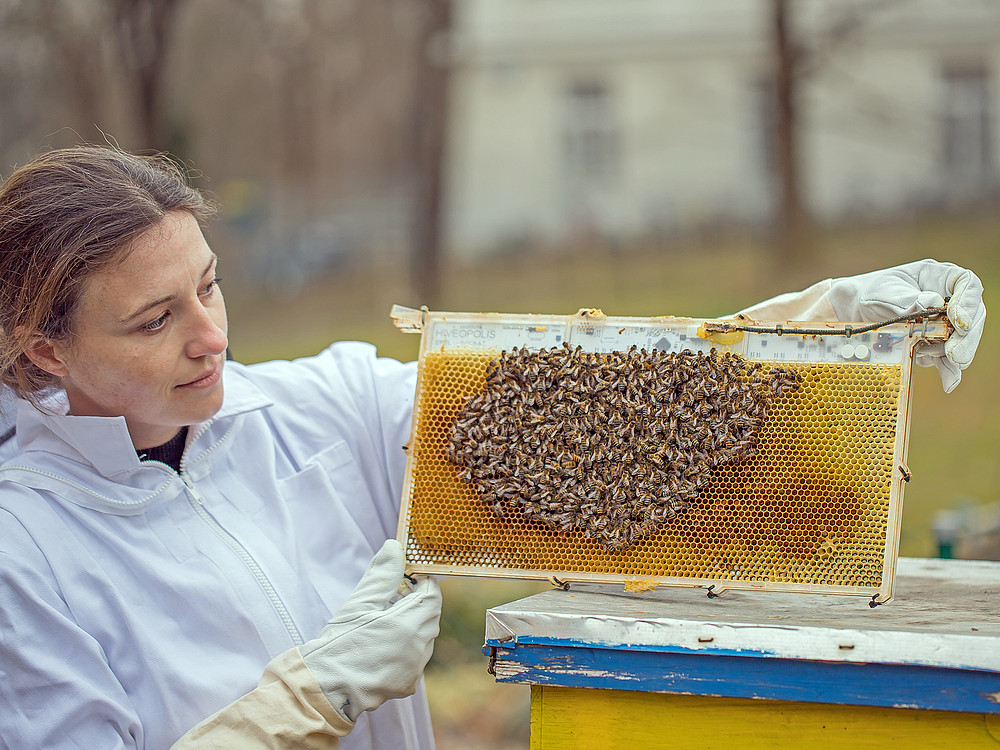
Female bee researcher from the University of Graz shows robot honeycomb with bees on it.

High-tech in the beehive: The smart honeycomb with robotic elements can control the temperature and monitor the health of the insects. Photo: Uni Graz/Artificial Life Lab/Project Hiveopolis

Newly developed robotic system can protect bees from death and offers hidden window into collective behaviour.

One third of bee colonies tend to die during the winter months, often because they lack the necessary warmth to survive. A new joint development by the team of the Artificial Life Lab at the University of Graz and the Swiss École Polytechnique Fédérale de Lausanne (EPFL) has created a unique honeycomb: It is equipped with innovative technical know-how to monitor the bee colony in the cold season, to actively guide it from the outside and to support it in overwintering through additional heat supply. In addition, this high-tech honeycomb provides insights into the behavioural and social unknowns of the bee world that were previously inaccessible to us humans.

The novel honeycomb not only enables protecting colonies from winter death, especially at a time when it is almost impossible for the beekeeper(s) to open the hive because of the threat of a detrimental heat loss for the colony. It also provides first-time insights into the interior of the so-called "winter cluster" of honeybees, as the formation of the bees in the hive is called during the cold months. This enables basic biological research that can provide important insights into the behaviour of social insects during the overwintering phase.

Hightech with remote control
A new type of honeycomb was jointly developed, which is equipped with a comprehensive sensor and actuator field, a technology derived from robotics. This robotic device can monitor the health of the bees on a 24/7 regime. If the bees are detected to be in danger, they can be redirected to honey-rich areas, for example, or supported by targeted additional heat supply. This is done without disturbing the bees in the hive; even in the depths of winter, hives that are snowed in can be remotely monitored and even remotely controlled by mobile phone or computer. The robotic field in the honeycomb makes it possible to "remotely" supply heat to the hive in a targeted and precise manner, thereby guiding the bees on the honeycomb, as they need places with specific temperatures in order to survive and therefore stay or move there. This makes it possible to supply heat to weak colonies during cold spells, thus saving them from winter death. An imminent temperature collapse can be automatically detected by the sensors and the beekeeper can be warned by text message in order to initiate countermeasures remotely and in due time.

About Hiveopolis
Within the framework of the project Hiveopolis, directed by Thomas Schmickl, the researchers of the Artificial Life Lab at the University of Graz and the Mobile Robotic Systems Group at EPFL have joined forces to support the western honeybee throug technology in such a way that it can face a safer future in times of global species extinction. The project is funded by the EU with seven million Euros for five years and runs till 31 März 2024. Further partners are Université Libre de Bruxelles, Freie Universität Berlin, Bee Smart Technologies Sofia, Latvijas Biozinatnu un Tehnologiju Universitate as well as Humboldt-Universität Berlin.

Publication:
Rafael Barmak und Martin Stefanec, Daniel N. Hofstadler, Louis Piotet, Stefan Schönwetter-Fuchs-Schistek, Francesco Mondada, Thomas Schmickl, Rob Mills: A robotic honeycomb for interaction with a honeybee colony, Science Robotics

created by Dagmar Eklaude

Related news

Chemical Christmas show at the University of Graz: An explosive evening at the Schauspielh

At the beginning of December, the University of Graz transformed the theater into a laboratory: as part of “Chemical Life,” teacher training students staged a chemical Christmas show for Styrian school classes—complete with ethanol rockets, nitrogen snow, and glowing effects. An evening designed to inspire interest in studying chemistry.

Train by train: Koralm railway accelerates exchange between the Universities

Lectures at the University of Klagenfurt in the morning, seminars at the University of Graz in the afternoon: Austria's longest tunnel and a journey time of around 45 minutes make it easy. The Koralm railway increases the speed of networking between the two university locations. The collaboration builds on existing cooperation - for example in the areas of teacher training, Slavic studies and as employers, the universities are well coordinated.

On the trail of the Big Bang: University of Graz receives 1.5 million euros for doctoral programmes

The Austrian Science Fund FWF has selected the Doctoral Programme in Theoretical Particle Physics at the University of Graz for funding from the Doc.funds. Six young scientists will be funded for 3.5 years. They will gain fundamentally new insights into the origins of the world.

From trans women and knee prostheses: sports science prizes awarded

Walking better with a prosthesis, successfully getting rid of excess weight, training more effectively, more fairness for trans people in sport: these were the topics addressed by the students at the University of Graz who were awarded the sports science prizes for their Master's theses on 3 December 2025.

Begin of page section:
Additional information:

University of Graz
Universitaetsplatz 3
8010 Graz
Austria
  • Contact
  • Web Editors
  • Moodle
  • UNIGRAZonline
  • Imprint
  • Data Protection Declaration
  • Accessibility Declaration
Weatherstation
Uni Graz

End of this page section. Go to overview of page sections

End of this page section. Go to overview of page sections

Begin of page section:

End of this page section. Go to overview of page sections