Begin of page section:
Page sections:

  • Go to contents (Accesskey 1)
  • Go to position marker (Accesskey 2)
  • Go to main navigation (Accesskey 3)
  • Go to sub navigation (Accesskey 4)
  • Go to additional information (Accesskey 5)
  • Go to page settings (user/language) (Accesskey 8)
  • Go to search (Accesskey 9)

End of this page section. Go to overview of page sections

Begin of page section:
Page settings:

English en
Deutsch de
Search
Login

End of this page section. Go to overview of page sections

Begin of page section:
Search:

Search for details about Uni Graz
Close

End of this page section. Go to overview of page sections


Search

Begin of page section:
Main navigation:

Page navigation:

  • University

    University
    • About the University
    • Organisation
    • Faculties
    • Library
    • Working at University of Graz
    • Campus
    Developing solutions for the world of tomorrow - that is our mission. Our students and our researchers take on the great challenges of society and carry the knowledge out.
  • Research Profile

    Research Profile
    • Our Expertise
    • Research Questions
    • Research Portal
    • Promoting Research
    • Research Transfer
    • Ethics in Research
    • Commission for Scientific Integrity
    Scientific excellence and the courage to break new ground. Research at the University of Graz creates the foundations for making the future worth living.
  • Studies

    Studies
    • Prospective Students
    • Students
    • Registration for Study Programme (Winter semester 2026/27)
    • Welcome Weeks for First Year Students
  • Community

    Community
    • International
    • Location
    • Research and Business
    • Alumni
    The University of Graz is a hub for international research and brings together scientists and business experts. Moreover, it fosters the exchange and cooperation in study and teaching.
Topics
  • Sustainable University
  • Researchers answer
  • Work for us
Close menu

End of this page section. Go to overview of page sections

Begin of page section:
You are here:

University of Graz News Vom Krieg bis zur Demokratie

End of this page section. Go to overview of page sections

Thursday, 21 March 2013

Vom Krieg bis zur Demokratie

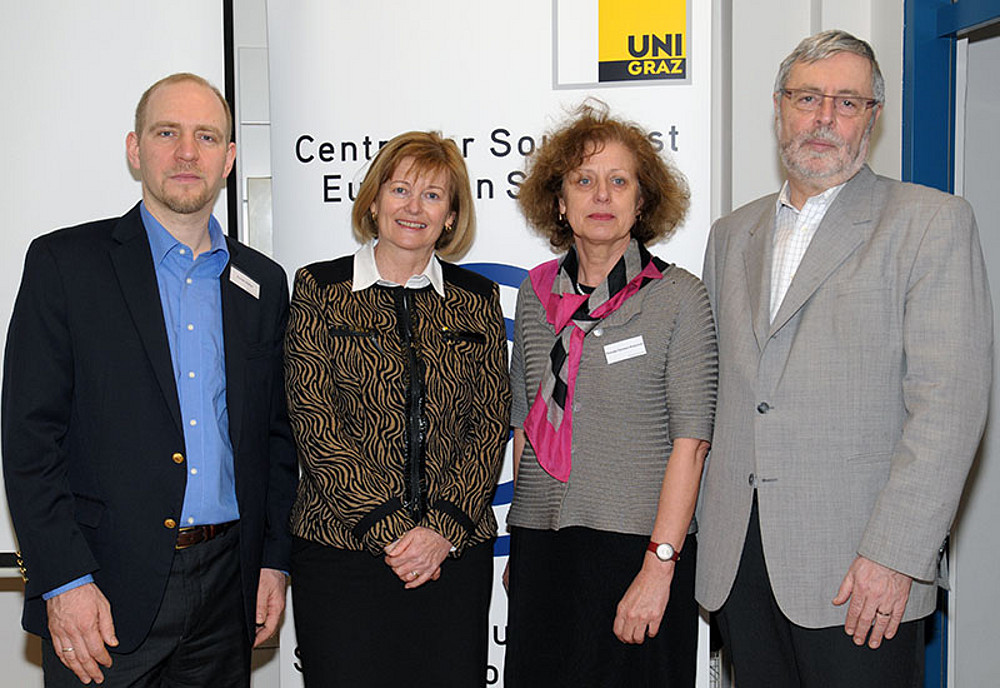
Florian Bieber, Leiter des Zentrums für Südosteuropastudien, Rektorin Christa Neuper, Renate Hansen-Kokorus, Leiterin des Instituts für Slawistik, und Helmut Konrad, Dekan der Geisteswissenschaftlichen Fakultät (v.l.)

Florian Bieber, Leiter des Zentrums für Südosteuropastudien, Rektorin Christa Neuper, Renate Hansen-Kokorus, Leiterin des Instituts für Slawistik, und Helmut Konrad, Dekan der Geisteswissenschaftlichen Fakultät (v.l.)

Tagung mit Literaturlesungen und Filmvorführungen über die Veränderungen in den Nachfolgestaaten Jugoslawiens

Am Institut für Slawistik wurde heute die internationale Tagung "Facing the Present - Transition in Post-Yugoslavia: The Artists' View" eröffnet. Im Mittelpunkt der zweitägigen Konferenz stehen die Veränderungen, welche die Nachfolgestaaten Jugoslawiens - von den Kriegen bis zur Demokratisierung - durchlaufen. Der Fokus liegt dabei auf der Verarbeitung in Film und Literatur.


Rektorin Christa Neuper begrüßte die TeilnehmerInnen der Konferenz, die vom Institut für Slawistik gemeinsam mit dem Zentrum für Südosteuropastudien veranstaltet wird. „Ich freue mich, dass die Universität Graz Gastgeberin dieser Tagung ist, insbesondere als die wissenschaftliche Beschäftigung und der akademische Austausch mit Südosteuropa seit Jahrzehnten einen interdisziplinären Schwerpunkt unserer Universität darstellen“, betonte Christa Neuper. Auch Dekan Helmut Konrad unterstrich das Ziel und Bemühen der Uni Graz, „eine Brücke nach Südosteuropa“ zu sein. Im Anschluss führte Univ.-Prof. Dr. Renate Hansen-Kokorus, Leiterin des Instituts für Slawistik, ins Thema der Tagung ein.


Neben der wissenschaftlichen Auseinandersetzung stehen Lesungen und Filmpräsentationen auf dem Programm. Den Auftakt machte am 20. März 2013 eine Literaturlesung mit Adisa Bašić (Sarajevo), Goran Vojnović (Ljubljana) und Bekim Sejranović (Oslo), moderiert vom Autor Nenad Veličković (Sarajevo).

Heute liest Dubravka Ugrešić (Amsterdam) im Literaturhaus aus ihrer Essaysammlung „Karaokekultur“. Sie wurde im vergangenen Jahr für den „National Book Critics Award“ in der Kategorie „Kritische Prosa“ nominiert. Am 22. März werden die Autoren Goran Vojnović, Andrej Nikolaidis (Podgorica) und Igor Štiks (Edinburg) ein Round-table-Gespräch zum Thema „Transition and the Artists' Role in the Public“ führen, moderiert von Adelheid Wölfl (der Standard).


Den Abschluss der Tagung bildet schließlich die Österreich-Premiere des preisgekrönten Films „Circles“ mit einer anschließenden Diskussion, an der neben dem Regisseur Srdan Golubović (Belgrad) auch Elma Tataragić (Sarajevo Film Festival) und Markus Mörth (Diagonale, Graz) teilnehmen werden.
 

>> Programm

created by Gudrun Pichler

Related news

Commissioned by NATO: University of Graz tests high-tech textiles

As part of an international project, antimicrobial and fire-resistant fabrics with UV protection are being developed in Zagreb. Pharmacists from the University of Graz are ensuring that these fabrics are skin-friendly.

The Arctic up close: ORF special feature on the University of Graz’s research station in S

Students from the University of Graz are spending two weeks conducting research at the Univerisity of Graz research station at the Sermilik Fjord in Greenland, which has been operational for three years. They are measuring glacial runoff, tracking ice melt in real time and installing weather stations. ORF is following the expedition and will be reporting on the special feature ‘Arctic Adventure’ across its various channels from 20 July.

Medicine for ants: Caffeine prolongs the life of infected insects

Black coffee stimulates us and acts against bacteria. So, can caffeine also be good for insects? Yes, confirm biologists of the University of Graz. When ants suffer from a fungal disease, they consume more caffeine and remain active for longer.

How formulas are making medicine more personalised

When Federica Caforio talks about the heart, it doesn’t sound like an operating theatre, but rather like equations, parameters and simulations. Yet this is precisely where the medical promise of her research lies: one day, clinical data will be used to create a digital twin of the heart – a virtual model that will enable a better understanding of diseases and allow for more personalised treatment plans. She will be presenting her research at the ‘ECMTB 2026’ mathematics conference.

Begin of page section:
Additional information:

University of Graz
Universitaetsplatz 3
8010 Graz
Austria
  • Contact
  • Web Editors
  • Moodle
  • UNIGRAZonline
  • Imprint
  • Data Protection Declaration
  • Accessibility Declaration
Weatherstation
Uni Graz

End of this page section. Go to overview of page sections

End of this page section. Go to overview of page sections

Begin of page section:

End of this page section. Go to overview of page sections