Begin of page section:
Page sections:

  • Go to contents (Accesskey 1)
  • Go to position marker (Accesskey 2)
  • Go to main navigation (Accesskey 3)
  • Go to sub navigation (Accesskey 4)
  • Go to additional information (Accesskey 5)
  • Go to page settings (user/language) (Accesskey 8)
  • Go to search (Accesskey 9)

End of this page section. Go to overview of page sections

Begin of page section:
Page settings:

English en
Deutsch de
Search
Login

End of this page section. Go to overview of page sections

Begin of page section:
Search:

Search for details about Uni Graz
Close

End of this page section. Go to overview of page sections


Search

Begin of page section:
Main navigation:

Page navigation:

  • University

    University
    • About the University
    • Organisation
    • Faculties
    • Library
    • Working at University of Graz
    • Campus
    Developing solutions for the world of tomorrow - that is our mission. Our students and our researchers take on the great challenges of society and carry the knowledge out.
  • Research Profile

    Research Profile
    • Our Expertise
    • Research Questions
    • Research Portal
    • Promoting Research
    • Research Transfer
    • Ethics in Research
    • Commission for Scientific Integrity
    Scientific excellence and the courage to break new ground. Research at the University of Graz creates the foundations for making the future worth living.
  • Studies

    Studies
    • Prospective Students
    • Students
    • Registration for Study Programme (Winter semester 2026/27)
    • Welcome Weeks for First Year Students
  • Community

    Community
    • International
    • Location
    • Research and Business
    • Alumni
    The University of Graz is a hub for international research and brings together scientists and business experts. Moreover, it fosters the exchange and cooperation in study and teaching.
Topics
  • Sustainable University
  • Researchers answer
  • Work for us
Close menu

End of this page section. Go to overview of page sections

Begin of page section:
You are here:

University of Graz News Economist explains: How innovation secures our prosperity

End of this page section. Go to overview of page sections

Monday, 20 October 2025

Economist explains: How innovation secures our prosperity

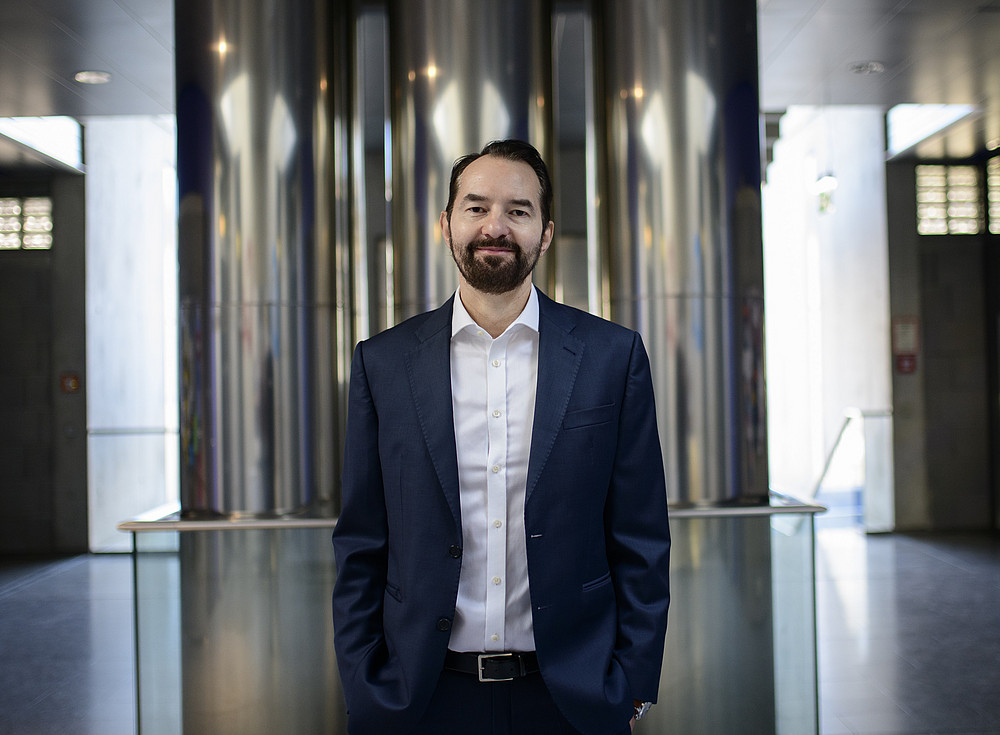
a portrait of a man in business attire, standing confidently inside an office building with stainless steel columns and glass walls, exuding professional elegance. he has dark hair and a beard, wearing a blue suit, white shirt, and black shoes. he is smiling at the camera ©Uni Graz/Tzivanopoulos
©Uni Graz/Tzivanopoulos

Economist Maik Schneider sees innovation as the key to prosperity. Photo: University of Graz/Tzivanopoulos

Why has going to the supermarket become more expensive, and is Austria really in crisis? Economist Maik Schneider from the University of Graz explains the country's economic challenges and shows why innovation is the key to future prosperity.

Whether it's the weekly shopping or a coffee to go, many of us notice every day that life has become more expensive. News websites and social media outlets repeatedly claim that Austria is in a “crisis.” But what does that actually mean? Maik Schneider from the Institute of Economics at the University of Graz has an answer: “The country is in a difficult phase of upheaval, a transformation.” Specifically, gross domestic product (GDP) has not grown for two years in a row, but has actually fallen slightly, the number of unemployed is rising, and inflation is consistently higher than in the rest of the eurozone.

What this means can be seen in the supermarket. Whether it's bread, meat, chocolate, or fruit, everything is more expensive in Austria than in neighbouring Germany, for example. “This price difference can hardly be explained by geographical factors such as transport costs and tax differences alone,” emphasizes the expert. Should the state now intervene and introduce fixed prices? “That is not the right approach,” says Schneider. “Rather, it is a matter of looking at the causes of the high prices. How can competition be strengthened and territorial delivery restrictions be removed, for example?” This is because large food manufacturers are currently preventing Austrian retailers, for example, from buying at the same low prices as German companies. This is then also reflected on supermarket shelves. “However, this issue must be resolved at EU level,” says Schneider.

Price cap

Intervening in prices, such as imposing a price cap, would not really combat inflation, but only postpone it. This phenomenon is particularly evident in Austria. The electricity price cap only helped in the short term to cope with high energy costs. “The extreme prices on the electricity market were always there, they were just hidden,” explains the economist. The effect: with the end of the price cap, inflation rose sharply again.

Although major economic challenges lie ahead, Schneider warns against taking a pessimistic view of the situation: “Recently, for example, growth forecasts have brightened slightly, and despite the difficult situation, many people are no worse off than before.” The economist emphasizes that GDP is not the only measure of prosperity. “Of course, you could say that if people work more hours, that means more growth in the short term,” says Schneider. “But it's also about quality of life. If we want more of that, we need innovation above all else.”

Innovation ensures prosperity

Europe faces the major challenge of getting fit for the future, the economist emphasizes. “In the US, top universities work together with financially strong investors. This biotope is missing here.” As a result, the research environment for top scientists in the EU is often not attractive enough. It is important to take appropriate measures here, especially for technologies that will shape the future, such as artificial intelligence or renewable energies.

"Innovations are the real drivers of prosperity. In Europe, we must ensure that we actively shape and drive technological change. Without this progress, long-term growth is hardly possible," explains Schneider. And this is where universities play a central role. Through intensive basic research, they form the foundation from which new technology can emerge in the first place.

At the University of Graz, your studies will lay the foundation for tomorrow's innovations. Work with us for the future – for example, with a degree in economics.

created by Roman Vilgut

Related news

Surprise, spectacle, science: Astrophysicists observed a partial solar eclipse

The star of the show was the sun, and the programme featured a natural spectacle: the partial solar eclipse on the evening of 12 August 2026 drew crowds to Graz’s Schloßberg. The ‘sun-downer’ was accompanied by a dash of science from astrophysicists at the University of Graz.

Discussions on Europe’s digital future are taking place in Graz

Exactly three months before the event, the Technology Impact Summit (TIS) team is unveiling the programme for this year’s think tank event.

Preserving cultural heritage: Graz researchers make Roman inscriptions legible again

Researchers from the University of Graz and Graz University of Technology are working to save inscriptions carved in stone in Styria during Roman times from disappearing. They have developed a simple and cost-effective method to make inscriptions on tombs and votive altars – which have been weathered or damaged – legible again. They are currently testing the method on Roman stones at several sites across Styria. The aim is to provide other historians with a tool to preserve cultural heritage when expensive research equipment is not available. The method was recently published in the research journal Heritage Science.

When the sun goes dark: Enlightening for science and the people of Graz

When the moon partially passes in front of the sun in Graz on 12 August 2026, the event will once again captivate many people. This includes Manuela Temmer, an astrophysicist at the University of Graz. The scientist confirms that this celestial phenomenon offers significant value for research: “During a solar eclipse, the corona can be observed more clearly than with any instrument.”

Begin of page section:
Additional information:

University of Graz
Universitaetsplatz 3
8010 Graz
Austria
  • Contact
  • Web Editors
  • Moodle
  • UNIGRAZonline
  • Imprint
  • Data Protection Declaration
  • Accessibility Declaration
Weatherstation
Uni Graz

End of this page section. Go to overview of page sections

End of this page section. Go to overview of page sections

Begin of page section:

End of this page section. Go to overview of page sections