Begin of page section:
Page sections:

  • Go to contents (Accesskey 1)
  • Go to position marker (Accesskey 2)
  • Go to main navigation (Accesskey 3)
  • Go to sub navigation (Accesskey 4)
  • Go to additional information (Accesskey 5)
  • Go to page settings (user/language) (Accesskey 8)
  • Go to search (Accesskey 9)

End of this page section. Go to overview of page sections

Begin of page section:
Page settings:

English en
Deutsch de
Search
Login

End of this page section. Go to overview of page sections

Begin of page section:
Search:

Search for details about Uni Graz
Close

End of this page section. Go to overview of page sections


Search

Begin of page section:
Main navigation:

Page navigation:

  • University

    University
    • About the University
    • Organisation
    • Faculties
    • Library
    • Working at University of Graz
    • Campus
    Developing solutions for the world of tomorrow - that is our mission. Our students and our researchers take on the great challenges of society and carry the knowledge out.
  • Research Profile

    Research Profile
    • Our Expertise
    • Research Questions
    • Research Portal
    • Promoting Research
    • Research Transfer
    • Ethics in Research
    • Commission for Scientific Integrity
    Scientific excellence and the courage to break new ground. Research at the University of Graz creates the foundations for making the future worth living.
  • Studies

    Studies
    • Prospective Students
    • Students
  • Community

    Community
    • International
    • Location
    • Research and Business
    • Alumni
    The University of Graz is a hub for international research and brings together scientists and business experts. Moreover, it fosters the exchange and cooperation in study and teaching.
  • Spotlight
Topics
  • Sustainable University
  • Researchers answer
  • Work for us
Close menu

End of this page section. Go to overview of page sections

Begin of page section:
You are here:

University of Graz News Vernetzung von Klimadaten

End of this page section. Go to overview of page sections

Monday, 13 March 2017

Vernetzung von Klimadaten

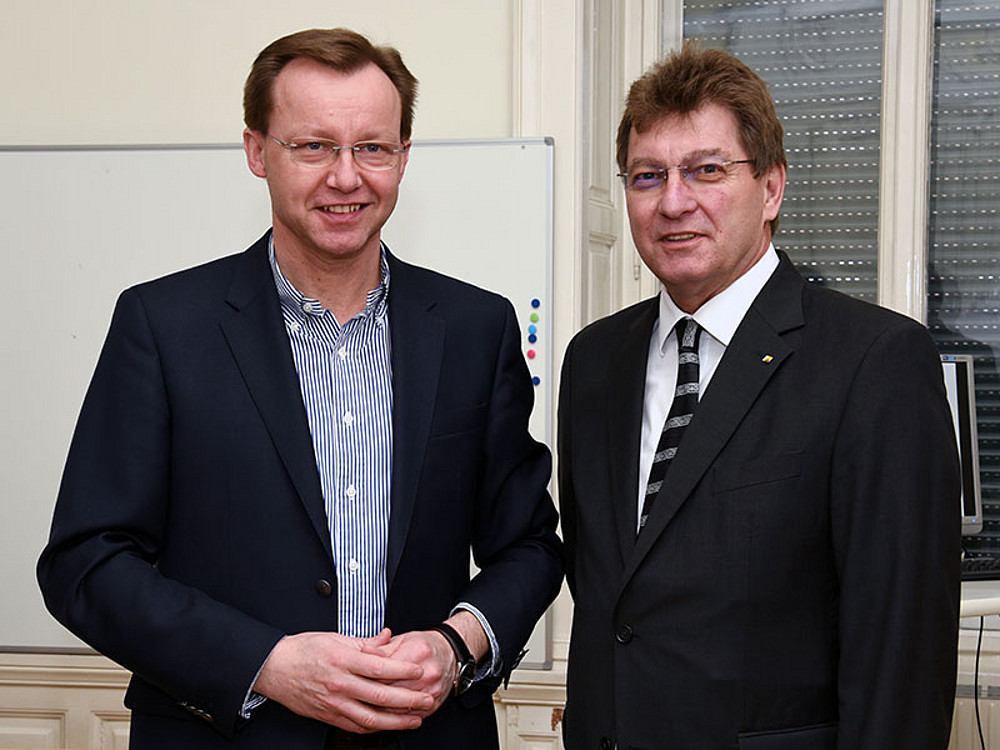
Freuen sich über die Förderung des Projekts GEOCLIM: Wegener-Center-Leiter Gottfried Kirchengast (l.) und Vizerektor Peter Scherrer. Fotos: Uni Graz/Pichler

Freuen sich über die Förderung des Projekts GEOCLIM: Wegener-Center-Leiter Gottfried Kirchengast (l.) und Vizerektor Peter Scherrer. Fotos: Uni Graz/Pichler

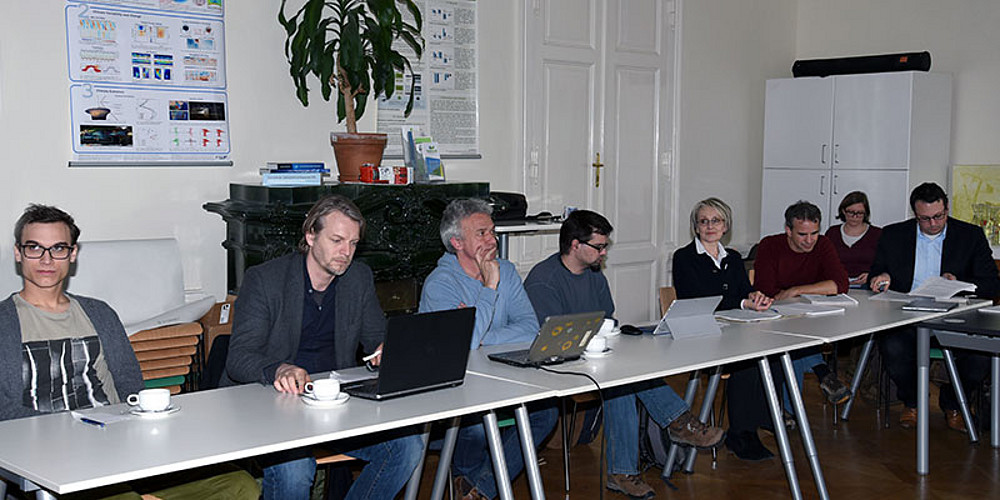
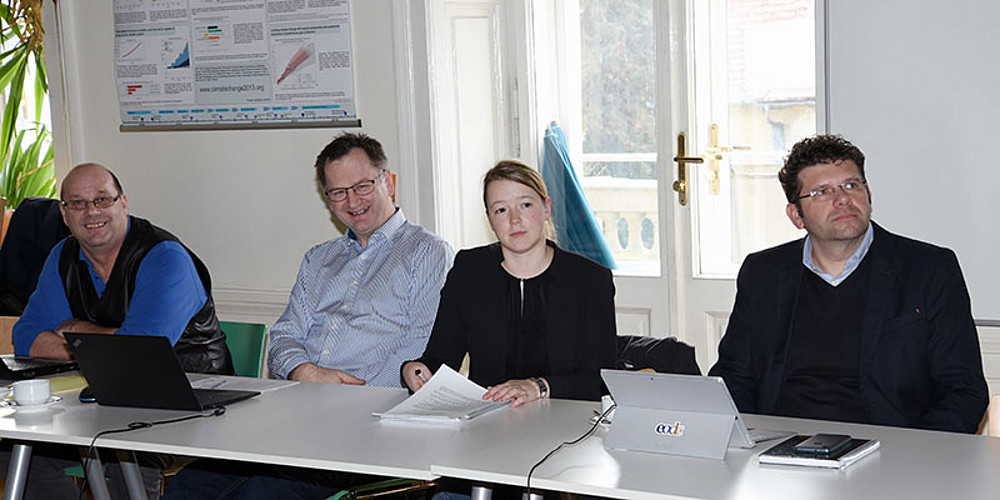
Kick-off-Meeting im Wegener Center

Kick-off-Meeting im Wegener Center

Bei GEOCLIM arbeiten ForscherInnen der Uni Graz, der BOKU, der Technischen Universitäten Graz und Wien, der Uni Wien, der ZAMG, des Earth Observation Data Centre und des Datenzentrums des Climate Change Center Austria zusammen.

Bei GEOCLIM arbeiten ForscherInnen der Uni Graz, der BOKU, der Technischen Universitäten Graz und Wien, der Uni Wien, der ZAMG, des Earth Observation Data Centre und des Datenzentrums des Climate Change Center Austria zusammen.

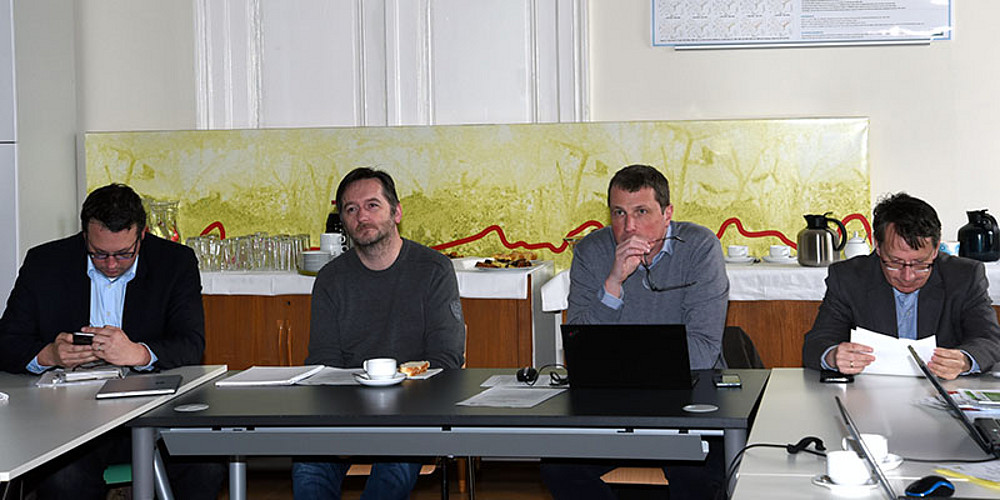
Die Vernetzung fördert die Auseinandersetzung mit wichtigen Zukunftsthemen in Österreich.

Die Vernetzung fördert die Auseinandersetzung mit wichtigen Zukunftsthemen in Österreich.

KooperationspartnerInnen des Projekts GEOCLIM trafen sich zum Kick-off-Meeting

1,5 Millionen Euro stellt das Wissenschaftsministerium aus Hochschulraumstrukturmitteln für das Kooperationsprojekt GEOCLIM zur Verfügung. Ziel des von Univ.-Prof. Dr. Gottfried Kirchengast, Leiter des Wegener Center der Uni Graz, koordinierten Vorhabens ist die Vernetzung von Klimadaten, die an verschiedenen Zentren Österreichs gesammelt werden. Am 10. März 2017 trafen sich die ProjektpartnerInnen zum Kick-off-Meeting.

Vizerektor Peter Scherrer begrüßte die TeilnehmerInnen im Wegener Center. „Dass die Koordination von GEOCLIM bei der Karl-Franzens-Universität liegt, unterstreicht, dass Graz neben Wien ein zweiter anerkannter Standort im Bereich der Umweltforschung ist“, freut sich Scherrer. Der interdisziplinäre Forschungsschwerpunkt „Umwelt und Globaler Wandel“ der Uni Graz bündelt seit Jahren Kompetenzen der Natur-, System-, Regional- und Wirtschaftswissenschaften sowie der Philosophie von internationalem Renommee.

Im Rahmen von GEOCLIM werden die bestehende Datenzentren des EODC (Earth Observation Data Centre) am Standort Arsenal in Wien und des Climate Change Center Austria (CCCA-DZ) bei der ZAMG Hohe Warte weiter ausgebaut, integriert und mit den Hochleistungscomputern des Vienna Scientific Cluster (VSC) verbunden. Dies schafft international konkurrenzfähige Rechen- und Speicher-Kapazität für Monitoring und Modellierungen unter anderem von Ökosystemen, Klima, Atmosphäre, Wasserhaushalt und Landoberfläche. „GEOCLIM unterstützt damit nachhaltig die Etablierung und den weiteren Ausbau wichtiger Zukunftsthemen in Österreich, wie Erdbeobachtung – auch satelliten-gestützt, Klimamodellierung und Klimaforschung sowie Risikomanagement und Ökosystemsimulation“, betont Kirchengast die Bedeutung der Projekts. KooperationspartnerInnen sind die Universität für Bodenkultur (BOKU) Wien, die TU Wien, die TU Graz, die Universität Wien, die Zentralanstalt für Meteorologie und Geodynamik (ZAMG), das EODC und das CCCA-DZ.

created by Gudrun Pichler

Related news

Studying at the University of Graz: How to enrol

Ready for a new chapter in your life with the start of your studies at the University of Graz in the winter semester 2026/27? Here you will find information on deadlines, admission procedures, registration, and everything else you need to successfully start your studies in the fall.

Interpreting data: Why studies sometimes get it wrong

Hilmar Brohmer and Ziva Korda from the Institute of Psychology, together with 500 international colleagues, have re-evaluated a hundred scientific publications and have often come to different conclusions.

Crystal-clear: AI method revolutionises solar observation

The Sun makes life on Earth possible. However, its magnetic fields can also cause massive disruption. This makes it all the more important to gain a better understanding of the processes taking place on our nearest star. A research team from the University of Graz and the High Altitude Observatory in Boulder (USA) has succeeded in doing just that. The astrophysicists have developed an AI-supported method that makes even the smallest structures on the Sun visible. The scientists are convinced that this will bring about a lasting change in solar observation and that the new method can be used for the planned European Solar Telescope.

Long Night of Research: How many languages are there in the world?

From a linguistic perspective, there are worlds of difference between Bern, Berlin and Vienna. A dialect impersonator will demonstrate live just how varied German can sound. How many languages are there in the world? What are their distinctive features? Which of these are spoken in Austria? These and other questions will be answered during the Long Night of Research at the University of Graz: on Friday, 24 April 2025, from 5 pm to 11 pm, in the University Library. Visitors can immerse themselves in the diversity of languages without travelling far by taking part in a quiz at the station.

Begin of page section:
Additional information:

University of Graz
Universitaetsplatz 3
8010 Graz
Austria
  • Contact
  • Web Editors
  • Moodle
  • UNIGRAZonline
  • Imprint
  • Data Protection Declaration
  • Accessibility Declaration
Weatherstation
Uni Graz

End of this page section. Go to overview of page sections

End of this page section. Go to overview of page sections

Begin of page section:

End of this page section. Go to overview of page sections