Begin of page section:
Page sections:

  • Go to contents (Accesskey 1)
  • Go to position marker (Accesskey 2)
  • Go to main navigation (Accesskey 3)
  • Go to sub navigation (Accesskey 4)
  • Go to additional information (Accesskey 5)
  • Go to page settings (user/language) (Accesskey 8)
  • Go to search (Accesskey 9)

End of this page section. Go to overview of page sections

Begin of page section:
Page settings:

English en
Deutsch de
Search
Login

End of this page section. Go to overview of page sections

Begin of page section:
Search:

Search for details about Uni Graz
Close

End of this page section. Go to overview of page sections


Search

Begin of page section:
Main navigation:

Page navigation:

  • University

    University
    • About the University
    • Organisation
    • Faculties
    • Library
    • Working at University of Graz
    • Campus
    Developing solutions for the world of tomorrow - that is our mission. Our students and our researchers take on the great challenges of society and carry the knowledge out.
  • Research Profile

    Research Profile
    • Our Expertise
    • Research Questions
    • Research Portal
    • Promoting Research
    • Research Transfer
    • Ethics in Research
    Scientific excellence and the courage to break new ground. Research at the University of Graz creates the foundations for making the future worth living.
  • Studies

    Studies
    • Prospective Students
    • Students
  • Community

    Community
    • International
    • Location
    • Research and Business
    • Alumni
    The University of Graz is a hub for international research and brings together scientists and business experts. Moreover, it fosters the exchange and cooperation in study and teaching.
  • Spotlight
Topics
  • Our digital Advent calendar
  • Sustainable University
  • Researchers answer
  • Work for us
Close menu

End of this page section. Go to overview of page sections

Begin of page section:
You are here:

University of Graz News Vegetation under stress: climate change increases the risk of forest fires in Austria

End of this page section. Go to overview of page sections

Friday, 27 June 2025

Vegetation under stress: climate change increases the risk of forest fires in Austria

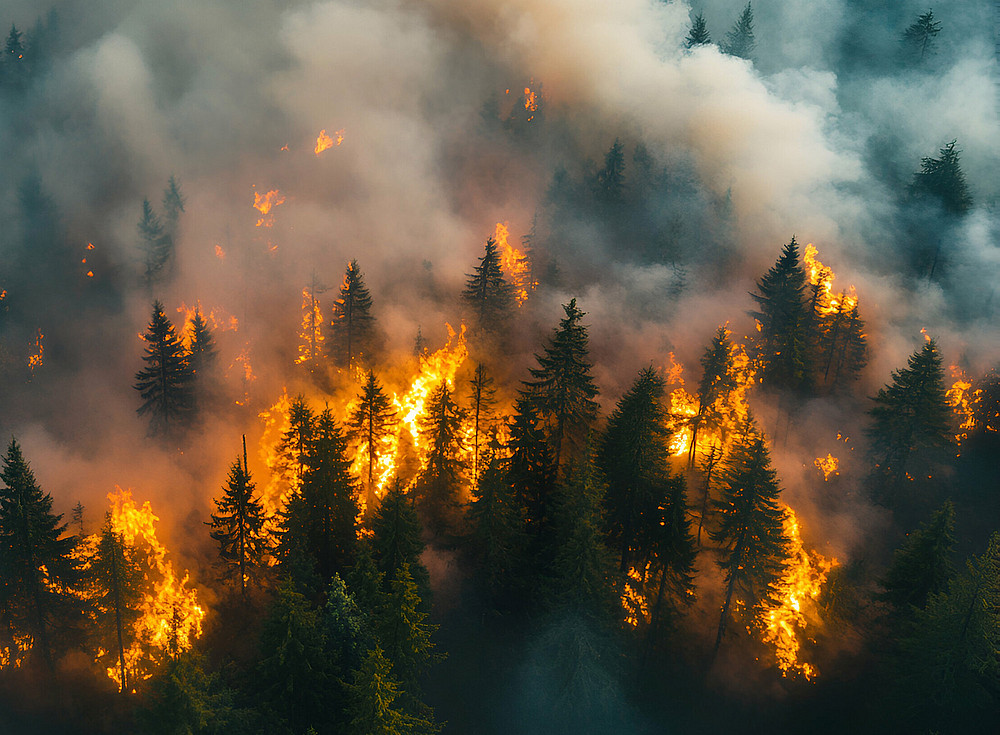
burning spruce forest from above, flames and smoke ©Gustav - stock.adobe.com

In Austria, protective forests on steep slopes are often affected by fires. Without the forest, the risk of landslides, debris and snow avalanches increases. Photo: Gustav - stock.adobe.com

Large-scale forest fires have just been extinguished on the Croatian coast. The Greek island of Chios is still battling the flames. Here in Austria, fire brigades are currently tackling blazes in the Leoben and the Rax area. In our region, the risk of fire is actually highest in spring due to dry conditions. However, in recent years there have also been more forest fires in summer due to very high temperatures. Researchers at the University of Graz are investigating the links between this increase and climate change in the European Alpine region, as well as the consequences for affected areas.


“When climate change causes a dry spring to be followed by a hot summer, the risk of forest fires increases,” says Dagmar Henner from the Wegener Center for Climate and Global Change at the University of Graz. In her latest publication, she investigates how the risk and occurrence of such events has changed in Austria, Slovenia, and Slovakia since the 1990s. “Data from the European Forest Fire Information System (EFFIS) show an increase in the frequency and severity of fires. Between 1993 and 2023, a total of over 4,600 forest fires were recorded in Austria. According to EFFIS data, the most dangerous year was 2022, with five such events resulting in around 1,000 hectares of land being burned. We have already reached an affected area of around 430 hectares with two fires in 2025,” reports the lead author of the study. Heavy rainfall, which is becoming more frequent as a result of climate change, cannot effectively reduce the risk. “If the forest soil is very dry, the water does not seep deep enough,” explains the researcher. 

In Austria, protective forests on steep slopes are often affected by fires. “This makes it difficult to fight the fires, so they often spread over large areas,” reports Henner. The remaining burnt areas, in turn, increase the risk of landslides and are no longer able to stop debris and snow avalanches. “This study underscores the need for climate action and adaptation measures to safeguard Austria's forests,” says Gottfried Kirchengast, head of the research group and co-author of the publication. “Other risk analyses conducted at the Wegener Center at the University of Graz also confirm that extreme weather events, which are becoming more frequent and intense as a result of climate change, pose an increasing major threat,” Kirchengast continues.

The extent of the damage also depends on the climate zone
In regions of the world accustomed to drought, vegetation is adapted to regular fires. In the Alpine region, however, it cannot recover so quickly. In addition, the forest is already stressed by climate change and therefore more susceptible to pests, which in turn benefit from the higher temperatures. “The bark beetle, which attacks spruce trees, for example, is really benefiting from the warmer winters. The populations are emerging earlier, and there are increasingly two to three generations per year. At the same time, weakened trees are more susceptible to dying from beetle infestation,” explains the researcher. Moreover, their dry condition promotes the ignition and spread of fires.

The comparison with Slovenia in the study showed that Mediterranean vegetation copes better with the changing climatic conditions, which reduces the risk of damage. In Austria, reforestation efforts are already focusing on planting tree species that are better suited to the changing climatic conditions. However, it will take a long time for the protective forest function to be restored. “On the one hand, young trees are more susceptible to dying in dry conditions. On the other hand, the newly planted species often grow more slowly than the spruce that was previously common,” says Henner.

Most forest fires are started by humans, whether through careless use of open fires, discarded cigarettes, car exhaust fumes, or arson. The next most common cause is lightning and storms that cause electricity lines to break down. Clearly, there is still a need to raise awareness among the population about the importance of protecting forests.

Publication
Forest Fire Risk Under Climate Change in Austria and Comparable European Regions
Dagmar N. Henner and Gottfried Kirchengast
https://doi.org/10.1016/j.tfp.2025.100889

The research was co-funded by grants from the Austrian Science Fund FWF and conducted as part of the “Climate Change Graz” field of excellence at the University of Graz.

created by Gudrun Pichler

Related news

Chemical Christmas show at the University of Graz: An explosive evening at the Schauspielh

At the beginning of December, the University of Graz transformed the theater into a laboratory: as part of “Chemical Life,” teacher training students staged a chemical Christmas show for Styrian school classes—complete with ethanol rockets, nitrogen snow, and glowing effects. An evening designed to inspire interest in studying chemistry.

Train by train: Koralm railway accelerates exchange between the Universities

Lectures at the University of Klagenfurt in the morning, seminars at the University of Graz in the afternoon: Austria's longest tunnel and a journey time of around 45 minutes make it easy. The Koralm railway increases the speed of networking between the two university locations. The collaboration builds on existing cooperation - for example in the areas of teacher training, Slavic studies and as employers, the universities are well coordinated.

On the trail of the Big Bang: University of Graz receives 1.5 million euros for doctoral programmes

The Austrian Science Fund FWF has selected the Doctoral Programme in Theoretical Particle Physics at the University of Graz for funding from the Doc.funds. Six young scientists will be funded for 3.5 years. They will gain fundamentally new insights into the origins of the world.

From trans women and knee prostheses: sports science prizes awarded

Walking better with a prosthesis, successfully getting rid of excess weight, training more effectively, more fairness for trans people in sport: these were the topics addressed by the students at the University of Graz who were awarded the sports science prizes for their Master's theses on 3 December 2025.

Begin of page section:
Additional information:

University of Graz
Universitaetsplatz 3
8010 Graz
Austria
  • Contact
  • Web Editors
  • Moodle
  • UNIGRAZonline
  • Imprint
  • Data Protection Declaration
  • Accessibility Declaration
Weatherstation
Uni Graz

End of this page section. Go to overview of page sections

End of this page section. Go to overview of page sections

Begin of page section:

End of this page section. Go to overview of page sections