Begin of page section:
Page sections:

  • Go to contents (Accesskey 1)
  • Go to position marker (Accesskey 2)
  • Go to main navigation (Accesskey 3)
  • Go to sub navigation (Accesskey 4)
  • Go to additional information (Accesskey 5)
  • Go to page settings (user/language) (Accesskey 8)
  • Go to search (Accesskey 9)

End of this page section. Go to overview of page sections

Begin of page section:
Page settings:

English en
Deutsch de
Search
Login

End of this page section. Go to overview of page sections

Begin of page section:
Search:

Search for details about Uni Graz
Close

End of this page section. Go to overview of page sections


Search

Begin of page section:
Main navigation:

Page navigation:

  • University

    University
    • About the University
    • Organisation
    • Faculties
    • Library
    • Working at University of Graz
    • Campus
    Developing solutions for the world of tomorrow - that is our mission. Our students and our researchers take on the great challenges of society and carry the knowledge out.
  • Research Profile

    Research Profile
    • Our Expertise
    • Research Questions
    • Research Portal
    • Promoting Research
    • Research Transfer
    • Ethics in Research
    Scientific excellence and the courage to break new ground. Research at the University of Graz creates the foundations for making the future worth living.
  • Studies

    Studies
    • Prospective Students
    • Students
  • Community

    Community
    • International
    • Location
    • Research and Business
    • Alumni
    The University of Graz is a hub for international research and brings together scientists and business experts. Moreover, it fosters the exchange and cooperation in study and teaching.
  • Spotlight
Topics
  • Sustainable University
  • Researchers answer
  • Work for us
Close menu

End of this page section. Go to overview of page sections

Begin of page section:
You are here:

University of Graz News Ungewisse Zukunft

End of this page section. Go to overview of page sections

Friday, 23 June 2017

Ungewisse Zukunft

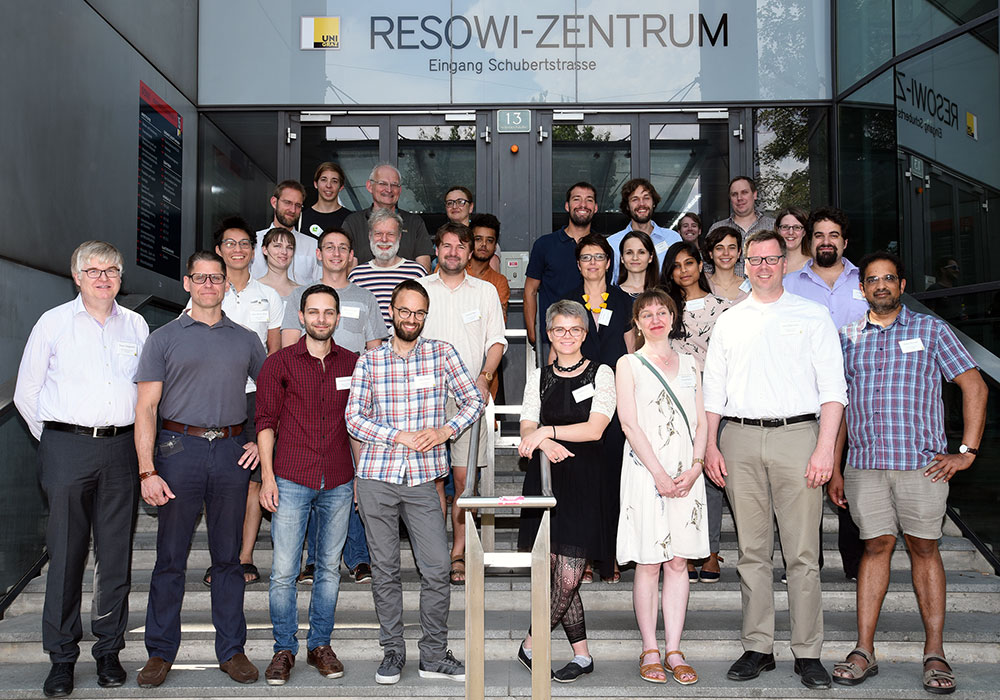
TeilnehmerInnen der Tagung "Responding to an Uncertain Future". Foto: Uni Graz/Pichler

TeilnehmerInnen der Tagung "Responding to an Uncertain Future". Foto: Uni Graz/Pichler

Tagung von Philosophie und Doktoratskolleg Klimawandel widmete sich den Themen Risiko und Unsicherheit

Ob in Bezug auf den Klimawandel, Terroranschläge und neue Technologien oder Alltäglicheres wie Gesundheit, Unfälle und Finanzen: Risiko und Unsicherheit spielen sowohl in individuellen Entscheidungen als auch in politischen Prozessen eine große Rolle. Aus diesem Grund sind sie in der Philosophie viel beachtete Themen. Die Arbeitsbereiche Politische Philosophie und Praktische Philosophie sowie das Doktoratskolleg Klimawandel der Uni Graz luden von 20. bis 23. Juni 2017 zur internationalen Fachtagung „Responding to an Uncertain Future“, bei der renommierte WissenschafterInnen aus der Philosophie und angrenzenden Disziplinen neue Forschungsergebnisse präsentierten.

Eröffnet wurde die Tagung mit einem Vortrag von Sven Ove Hansson, Professor am Institut für Philosophie und Geschichte des Royal Institute of Technology in Stockholm über „Uncertainty at the Science-Policy Interface“. Die Beiträge der Konferenz befassten sich mit der Definition, Abschätzung, moralischen Bewertung und dem Management von Risiko und Unsicherheit und stammten aus einem breiten Spektrum normativer Theorien, beispielsweise aus der Ethik, der politischen Philosophie, der politischen Theorie und den Rechtswissenschaften.

Aber auch benachbarte Public-Policy-Felder, also Bereiche staatlichen Handelns, fanden Beachtung. Eine Frage, die in diesem Zusammenhang vor allem diskutiert wurde, war, welche Strategien zur Anpassung an den Klimawandel, zu dessen Abschwächung sowie Climate-Engineering-Strategien Länder umsetzen sollten, angesichts der Risiken, die mit den Umweltveränderungen einhergehen.

Für die Organisation der Tagung zeichneten Univ.-Prof. Dr. Lukas Meyer, Univ.-Prof. Dr. Harald Stelzer, Dr. Thomas Pölzler, Eike Düvel, MA, und Mag. Kanita Kovacevic verantwortlich.

created by Gudrun Pichler

Related news

AI in schools: Maria Bertel drafts legal guidelines for teachers

The legal expert and her team analysed the legal situation regarding the use of artificial intelligence in education as part of an EU project and answered open questions from practice.

Cosmetics in the environment: University of Graz proves danger to ants

Titanium dioxide, which is found in cosmetics, for example, is increasingly entering the environment in the form of nanoparticles. This could also put insects at risk. If ants ingest the substance in combination with the pesticide glyphosate, it disturbs the development of their offspring. Scientists at the University of Graz are drawing attention to the negative consequences of this toxic cocktail.

Varied and healthy: studies move

Exercise is the ideal way to balance out everyday stress, prevent illness and keep fit. Why this is the case, how to do it properly and what role human bodily functions and psychology play can be studied at the University of Graz.

Religious scholar Theresia Heimerl: Fasting as a spiritual boost

Fasting is not just a strategy for losing weight – it is a ritual dating back thousands of years with spiritual and evolutionary roots that has positive effects on the body. At the University of Graz, religious scholar Theresia Heimerl is investigating why fasting is a "spiritual boost".

Begin of page section:
Additional information:

University of Graz
Universitaetsplatz 3
8010 Graz
Austria
  • Contact
  • Web Editors
  • Moodle
  • UNIGRAZonline
  • Imprint
  • Data Protection Declaration
  • Accessibility Declaration
Weatherstation
Uni Graz

End of this page section. Go to overview of page sections

End of this page section. Go to overview of page sections

Begin of page section:

End of this page section. Go to overview of page sections