Begin of page section:
Page sections:

  • Go to contents (Accesskey 1)
  • Go to position marker (Accesskey 2)
  • Go to main navigation (Accesskey 3)
  • Go to sub navigation (Accesskey 4)
  • Go to additional information (Accesskey 5)
  • Go to page settings (user/language) (Accesskey 8)
  • Go to search (Accesskey 9)

End of this page section. Go to overview of page sections

Begin of page section:
Page settings:

English en
Deutsch de
Search
Login

End of this page section. Go to overview of page sections

Begin of page section:
Search:

Search for details about Uni Graz
Close

End of this page section. Go to overview of page sections


Search

Begin of page section:
Main navigation:

Page navigation:

  • University

    University
    • About the University
    • Organisation
    • Faculties
    • Library
    • Working at University of Graz
    • Campus
    Developing solutions for the world of tomorrow - that is our mission. Our students and our researchers take on the great challenges of society and carry the knowledge out.
  • Research Profile

    Research Profile
    • Our Expertise
    • Research Questions
    • Research Portal
    • Promoting Research
    • Research Transfer
    • Ethics in Research
    Scientific excellence and the courage to break new ground. Research at the University of Graz creates the foundations for making the future worth living.
  • Studies

    Studies
    • Prospective Students
    • Students
  • Community

    Community
    • International
    • Location
    • Research and Business
    • Alumni
    The University of Graz is a hub for international research and brings together scientists and business experts. Moreover, it fosters the exchange and cooperation in study and teaching.
  • Spotlight
Topics
  • Our digital Advent calendar
  • Sustainable University
  • Researchers answer
  • Work for us
Close menu

End of this page section. Go to overview of page sections

Begin of page section:
You are here:

University of Graz News Novel Methods of Semiconductor Manufacturing: University of Graz is partner in EU project

End of this page section. Go to overview of page sections

Monday, 09 December 2024

Novel Methods of Semiconductor Manufacturing: University of Graz is partner in EU project

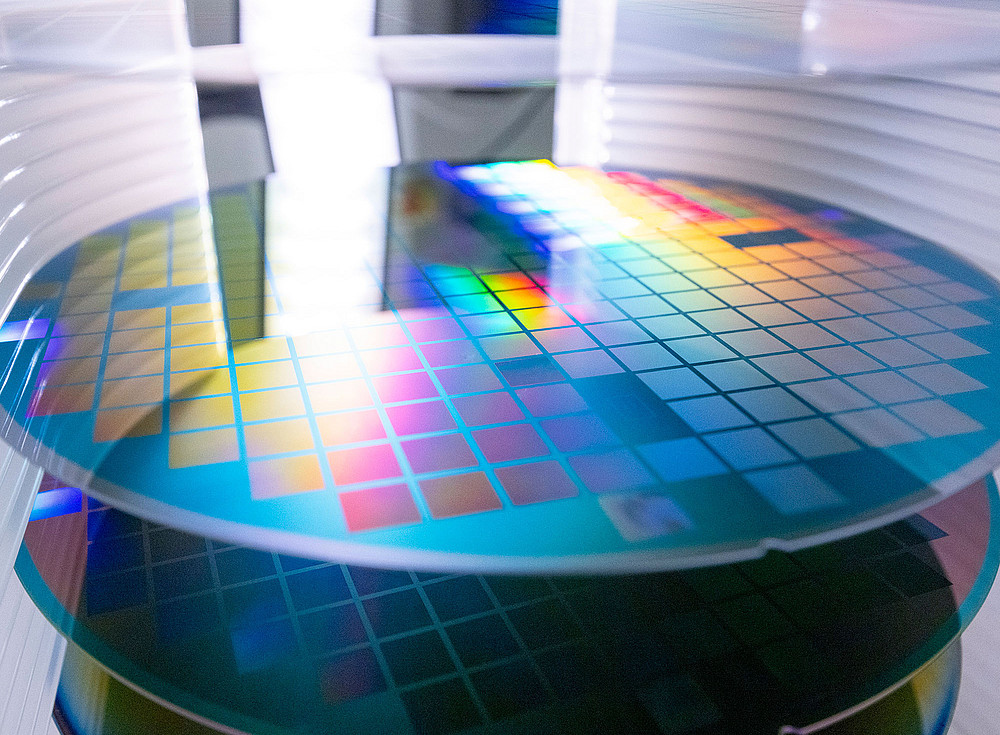
A close-up image of a semiconductor wafer with etched grids during the fabrication process ©TU Chemnitz Press Office

During the fabrication of semiconductors, grids are etched into the wafers. Photo: TU Chemnitz Press Office

How can technological innovations be aligned with principles of sustainability and circularity? This is a challenge being tackled by researchers at the Department of Environmental Systems Sciences at the University of Graz. As a partner in a new EU project, the team, led by Rupert Baumgartner, is contributing its expertise in sustainability assessment for the semiconductor manufacturing process. The focus of the research project “HaloFreeEtch” is on developing innovative, environmentally friendly etching methods for semiconductors.

Semiconductors are the backbones of all electronic devices, as they possess the property of conducting and inducting electricity. They are prominently used for the production of integrated circuit chips. In the industrial production process of integrated circuits, plasma etching is widely used. This process involves patterning the semiconductor wafer material through a chemical reaction using halogens such as sulfur hexafluoride (SF₆), tetrafluoromethane (CF₄), trifluoromethane (CHF₃), or octafluorocyclobutane (C₄F₈). However, this method poses significant environmental and health risks. The goal of the “HaloFreeEtch” project is to replace halogens in etching processes for silicon and silicon dioxide with more sustainable alternatives.

“At the Department of Environmental Systems Sciences at the University of Graz, we develop tools that support environmental and social sustainability decisions during the early stages of process and product design,” explains Rupert Baumgartner, head of the Christian Doppler Laboratory for Sustainable Product Management in a Circular Economy. For environmentally friendly semiconductor manufacturing, such decisions concern, among other things, the selection of suitable chemicals and the development of effective etching methods. “These are evaluated and identified using comprehensive lifecycle data and subsequent environmental impact assessments,” says Saumya Sadhu, who is doing research in the project for her doctoral thesis.

Simulations are used to plan and continuously improve industrial etching processes. However, environmental aspects have not been taken into account so far. This is set to change. “We will develop optimisation tools that our partners in the “HaloFreeEtch” project can then integrate into their process simulations,” explains Baumgartner. With this project, his research group will further strengthen its profile in sustainability assessments and sustainable process design. “HaloFreeEtch” complements ongoing projects in high-tech applications, such as batteries for electric vehicles, including new recycling technologies and electrochemical production processes.

“HaloFreeEtch” is a four-year project involving renowned European research and industry partners. The project is coordinated by Jörg Schuster from TU Chemnitz. Rupert Baumgartner is leading the team at the University of Graz. “HaloFreeEtch” is funded with € 3.9 million as part of the Horizon Europe research programme. The University of Graz’s share is € 476,750.


created by Gudrun Pichler

Related news

Chemical Christmas show at the University of Graz: An explosive evening at the Schauspielh

At the beginning of December, the University of Graz transformed the theater into a laboratory: as part of “Chemical Life,” teacher training students staged a chemical Christmas show for Styrian school classes—complete with ethanol rockets, nitrogen snow, and glowing effects. An evening designed to inspire interest in studying chemistry.

Train by train: Koralm railway accelerates exchange between the Universities

Lectures at the University of Klagenfurt in the morning, seminars at the University of Graz in the afternoon: Austria's longest tunnel and a journey time of around 45 minutes make it easy. The Koralm railway increases the speed of networking between the two university locations. The collaboration builds on existing cooperation - for example in the areas of teacher training, Slavic studies and as employers, the universities are well coordinated.

On the trail of the Big Bang: University of Graz receives 1.5 million euros for doctoral programmes

The Austrian Science Fund FWF has selected the Doctoral Programme in Theoretical Particle Physics at the University of Graz for funding from the Doc.funds. Six young scientists will be funded for 3.5 years. They will gain fundamentally new insights into the origins of the world.

From trans women and knee prostheses: sports science prizes awarded

Walking better with a prosthesis, successfully getting rid of excess weight, training more effectively, more fairness for trans people in sport: these were the topics addressed by the students at the University of Graz who were awarded the sports science prizes for their Master's theses on 3 December 2025.

Begin of page section:
Additional information:

University of Graz
Universitaetsplatz 3
8010 Graz
Austria
  • Contact
  • Web Editors
  • Moodle
  • UNIGRAZonline
  • Imprint
  • Data Protection Declaration
  • Accessibility Declaration
Weatherstation
Uni Graz

End of this page section. Go to overview of page sections

End of this page section. Go to overview of page sections

Begin of page section:

End of this page section. Go to overview of page sections