Begin of page section:
Page sections:

  • Go to contents (Accesskey 1)
  • Go to position marker (Accesskey 2)
  • Go to main navigation (Accesskey 3)
  • Go to sub navigation (Accesskey 4)
  • Go to additional information (Accesskey 5)
  • Go to page settings (user/language) (Accesskey 8)
  • Go to search (Accesskey 9)

End of this page section. Go to overview of page sections

Begin of page section:
Page settings:

English en
Deutsch de
Search
Login

End of this page section. Go to overview of page sections

Begin of page section:
Search:

Search for details about Uni Graz
Close

End of this page section. Go to overview of page sections


Search

Begin of page section:
Main navigation:

Page navigation:

  • University

    University
    • About the University
    • Organisation
    • Faculties
    • Library
    • Working at University of Graz
    • Campus
    Developing solutions for the world of tomorrow - that is our mission. Our students and our researchers take on the great challenges of society and carry the knowledge out.
  • Research Profile

    Research Profile
    • Our Expertise
    • Research Questions
    • Research Portal
    • Promoting Research
    • Research Transfer
    • Ethics in Research
    Scientific excellence and the courage to break new ground. Research at the University of Graz creates the foundations for making the future worth living.
  • Studies

    Studies
    • Prospective Students
    • Students
  • Community

    Community
    • International
    • Location
    • Research and Business
    • Alumni
    The University of Graz is a hub for international research and brings together scientists and business experts. Moreover, it fosters the exchange and cooperation in study and teaching.
  • Spotlight
Topics
  • Our digital Advent calendar
  • Sustainable University
  • Researchers answer
  • Work for us
Close menu

End of this page section. Go to overview of page sections

Begin of page section:
You are here:

University of Graz News How does the brain solve new tasks?

End of this page section. Go to overview of page sections

Tuesday, 02 April 2019

How does the brain solve new tasks?

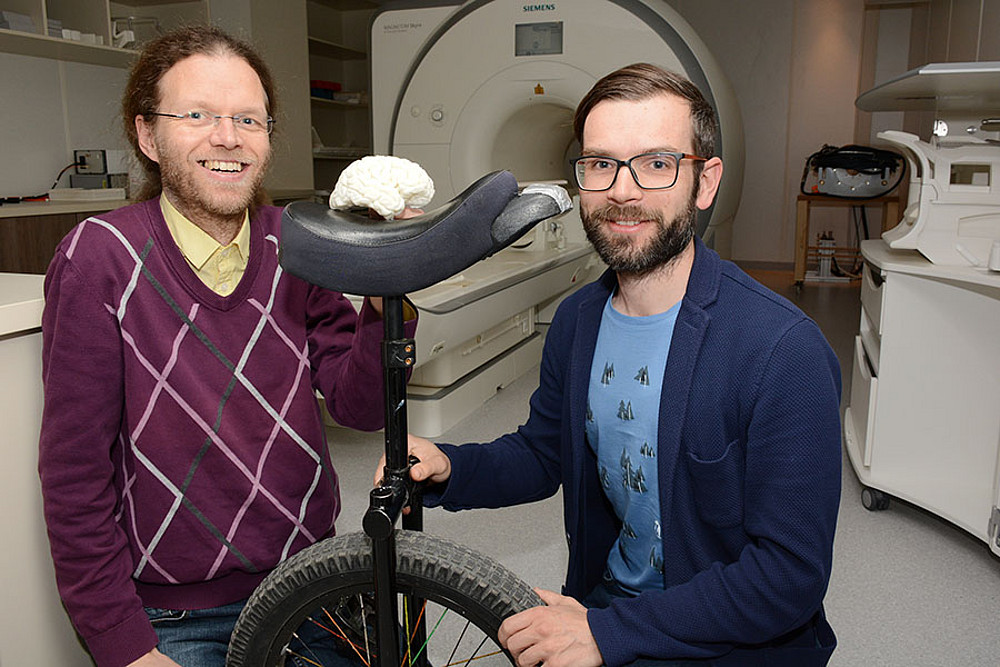
Bernhard Weber (l.) and Karl Koschutnig. Photo: Uni Graz/Pichler ©CP-PICTURES

Bernhard Weber (l.) and Karl Koschutnig. Photo: Uni Graz/Pichler

Neuropsychologists establish link between riding a unicycle, learning aptitude and efficiency enhancement

“You can’t teach an old dog new tricks”, goes the saying. “Wrong”, say neuropsychologists Bernhard Weber and Karl Koschutnig from the University of Graz. In a study published recently in the scholarly journal “Scientific Reports”, the researchers were able to prove that even adult brains can adjust to new challenges. Scientists call this capacity “neuroplasticity”. Weber and Koschutnig performed research on people between 18 and 51 years old to see what happened in their brains when they learned how to ride a unicycle.

“Things really start rolling when you learn to ride a unicycle – in your brain as well”, says Bernhard Weber. Riding a unicycle is probably one of the greatest possible challenges to our sense of balance. Children can learn how to do it in about a week. Doctoral student Bernhard Weber and Senior Scientist Karl Koschutnig were surprised that the adult participants in the study were able to learn it just as fast. Something remarkable happened in the brains of these 23 people. The psychologists found significant changes in the grey and white matter, and in the thickness of the cerebral cortex.
The research subjects, who had never sat on a unicycle before, learned and practiced how to ride a unicycle for three weeks; each week, they received four hours of professional instruction. Throughout the study, the researchers used magnetic resonance imaging (MRI) at three points in time to take structural and functional images of the brain: before training began, after the conclusion of the programme, and then again five weeks later.
“These images showed changes in areas of the brain and in motor control networks, visuospatial attention and sensory information processing”, says Koschutnig. “We were particularly surprised that there was one area in which there was a massive reduction in grey matter during the training. Five weeks after the end of the programme, the volume at that position had re-increased again”, says Weber, proffering a possible interpretation: “The reduction in grey matter could be interpreted as an increase in neuronal efficiency. The brain has learned something and therefore uses less resources. The automatised coordination and balance monitoring are mastered better and more efficiently”. This interpretation is supported by the fact that the better a person had mastered the unicycle riding, the greater the reduction in grey matter.
Results from research on learning how to slackline will provide further insights into the plasticity of the brain. Because the brain is so capable of learning, we can surmise that even acquired deficits could be partially reversible, with the right training.


Publication
Learning Unicycling Evokes Manifold Changes in Gray and White Matter Networks Related to Motor and Cognitive Functions
Bernhard Weber, Karl Koschutnig, Andreas Schwerdtfeger, Christian Rominger, Ilona Papousek, Elisabeth M. Weiss, Markus Tilp & Andreas Fink
Scientific Reports 9, Article number: 4324 (2019)

created by Gudrun Pichler

Related news

Semester abroad without barriers: University of Graz wins award for promoting inclusion

The University of Graz has been awarded the Internationalization Award for its new inclusion initiative. Students with fewer opportunities now also receive financial support for their semester abroad outside Europe.

Fair distribution: Researchers determine just greenhouse gas budgets for all EU regions

Ten years ago, on 12 December 2015, the Paris Climate Agreement was signed at the UN Climate Conference. In order to limit global warming to well below two degrees, only a certain amount of CO2 may be emitted worldwide. While the focus was originally on national emission targets, more than 200 subnational regions and almost 300 cities have now adopted their own targets. But how many emissions are they fairly entitled to? Researchers at the University of Graz have now developed transparent criteria for fair distribution at the subnational level for the first time and determined corresponding greenhouse gas budgets for all European regions. The paper was published today in the scientific journal Nature Communications.

Chemical Christmas show at the University of Graz: An explosive evening at the Schauspielh

At the beginning of December, the University of Graz transformed the theater into a laboratory: as part of “Chemical Life,” teacher training students staged a chemical Christmas show for Styrian school classes—complete with ethanol rockets, nitrogen snow, and glowing effects. An evening designed to inspire interest in studying chemistry.

Train by train: Koralm railway accelerates exchange between the Universities

Lectures at the University of Klagenfurt in the morning, seminars at the University of Graz in the afternoon: Austria's longest tunnel and a journey time of around 45 minutes make it easy. The Koralm railway increases the speed of networking between the two university locations. The collaboration builds on existing cooperation - for example in the areas of teacher training, Slavic studies and as employers, the universities are well coordinated.

Begin of page section:
Additional information:

University of Graz
Universitaetsplatz 3
8010 Graz
Austria
  • Contact
  • Web Editors
  • Moodle
  • UNIGRAZonline
  • Imprint
  • Data Protection Declaration
  • Accessibility Declaration
Weatherstation
Uni Graz

End of this page section. Go to overview of page sections

End of this page section. Go to overview of page sections

Begin of page section:

End of this page section. Go to overview of page sections