Begin of page section:
Page sections:

  • Go to contents (Accesskey 1)
  • Go to position marker (Accesskey 2)
  • Go to main navigation (Accesskey 3)
  • Go to sub navigation (Accesskey 4)
  • Go to additional information (Accesskey 5)
  • Go to page settings (user/language) (Accesskey 8)
  • Go to search (Accesskey 9)

End of this page section. Go to overview of page sections

Begin of page section:
Page settings:

English en
Deutsch de
Search
Login

End of this page section. Go to overview of page sections

Begin of page section:
Search:

Search for details about Uni Graz
Close

End of this page section. Go to overview of page sections


Search

Begin of page section:
Main navigation:

Page navigation:

  • University

    University
    • About the University
    • Organisation
    • Faculties
    • Library
    • Working at University of Graz
    • Campus
    Developing solutions for the world of tomorrow - that is our mission. Our students and our researchers take on the great challenges of society and carry the knowledge out.
  • Research Profile

    Research Profile
    • Our Expertise
    • Research Questions
    • Research Portal
    • Promoting Research
    • Research Transfer
    • Ethics in Research
    Scientific excellence and the courage to break new ground. Research at the University of Graz creates the foundations for making the future worth living.
  • Studies

    Studies
    • Prospective Students
    • Students
  • Community

    Community
    • International
    • Location
    • Research and Business
    • Alumni
    The University of Graz is a hub for international research and brings together scientists and business experts. Moreover, it fosters the exchange and cooperation in study and teaching.
  • Spotlight
Topics
  • Our digital Advent calendar
  • Sustainable University
  • Researchers answer
  • Work for us
Close menu

End of this page section. Go to overview of page sections

Begin of page section:
You are here:

University of Graz News Fighting Tumors

End of this page section. Go to overview of page sections

Wednesday, 19 June 2019

Fighting Tumors

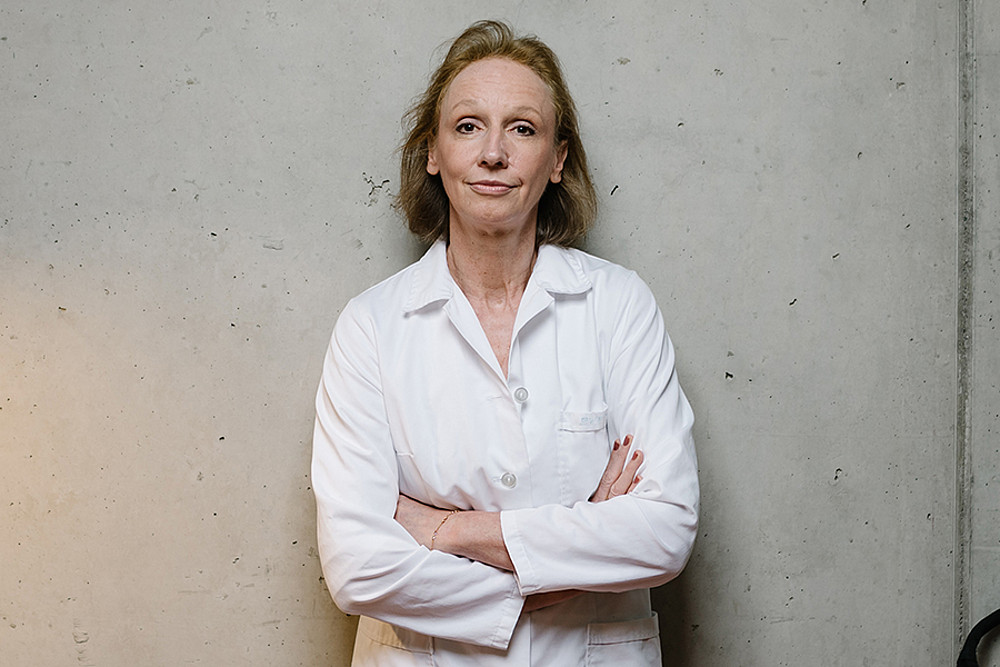
Dagmar Zweytick does not at all find herself with her back to the wall. She has discovered a substance that may heal cancer. Foto: Uni Graz/Kernasenko

Dagmar Zweytick does not at all find herself with her back to the wall. She has discovered a substance that may heal cancer. Foto: Uni Graz/Kernasenko

Dagmar Zweytick has discovered a molecule that occurs naturally within the body which consistently kills cancer cells, in laboratory tests. She and her team are now working to develop efficient and more tolerable therapies to fight tumorous diseases.

The distinctive characteristic of malignant cells is that they multiply quickly and infinitely, and cannot die. For this reason, treatment has for a long time been based on growth-inhibiting substances. “The side effects on similarly fast-growing cells in the bone marrow, mucous membranes and blood must therefore also be factored in,” explains Dagmar Zweytick, from the Institute of Molecular Biosciences. Newer, less aggressive approaches take advantage of very specific differences between the surface of tumorous cells and healthy cells – and this is also the approach used by the research group at the University of Graz. Cancer cells have a specific negatively charged fat molecule on their outer surface. Our innate immune system produces peptides – short protein molecules – that can identify foreign cells by these negative charges and destroy them. In their naturally occurring form they are too weak to cure serious diseases. However, through targeted adaptation, derivatives of these molecules can be produced that could be used as a cancer treatment. In laboratory tests, and in vivo tests in mice, these substances, derived from the breast milk protein lactoferrin have already been successfully used to destroy tumours.

Sneaking in the therapy
What makes cancer life-threatening is firstly resilient cells that simply eject medications, or even prevent them from penetrating at all. Secondly, it is thought that chemo-resistant tumour stem-cells survive, remain for a long time in the body, and then suddenly begin to grow again or to form metastases. This is particularly problematic if they are located in the head, as the blood-brain barrier presents an insurmountable obstacle for most drug therapies.
However, lactoferrin derivatives are able to penetrate this barrier and to kill metastases. They are even effective against resistant types of cancer. The researchers are now working to improve the practical application of these substances. “Logically, the peptide should be delivered through the blood circulation system, so that it destroys all the cancer cells in the body. But to do that it needs to overcome certain obstacles and avoid being broken down itself,” explains Zweytick. So the next step is to “disguise” the substance so that it can reach the malignant cells intact. Once they find a way to do this the researchers hope to be able to develop a new medication. Despite this exciting prospect, Dagmar Zweytick is keen to emphasise: “The most important factors in fighting the disease remain early recognition and a healthy lifestyle.”

Read more about her research in the latest issue of UNIZEIT.


created by Dagmar Eklaude

Related news

Semester abroad without barriers: University of Graz wins award for promoting inclusion

The University of Graz has been awarded the Internationalization Award for its new inclusion initiative. Students with fewer opportunities now also receive financial support for their semester abroad outside Europe.

Fair distribution: Researchers determine just greenhouse gas budgets for all EU regions

Ten years ago, on 12 December 2015, the Paris Climate Agreement was signed at the UN Climate Conference. In order to limit global warming to well below two degrees, only a certain amount of CO2 may be emitted worldwide. While the focus was originally on national emission targets, more than 200 subnational regions and almost 300 cities have now adopted their own targets. But how many emissions are they fairly entitled to? Researchers at the University of Graz have now developed transparent criteria for fair distribution at the subnational level for the first time and determined corresponding greenhouse gas budgets for all European regions. The paper was published today in the scientific journal Nature Communications.

Chemical Christmas show at the University of Graz: An explosive evening at the Schauspielh

At the beginning of December, the University of Graz transformed the theater into a laboratory: as part of “Chemical Life,” teacher training students staged a chemical Christmas show for Styrian school classes—complete with ethanol rockets, nitrogen snow, and glowing effects. An evening designed to inspire interest in studying chemistry.

Train by train: Koralm railway accelerates exchange between the Universities

Lectures at the University of Klagenfurt in the morning, seminars at the University of Graz in the afternoon: Austria's longest tunnel and a journey time of around 45 minutes make it easy. The Koralm railway increases the speed of networking between the two university locations. The collaboration builds on existing cooperation - for example in the areas of teacher training, Slavic studies and as employers, the universities are well coordinated.

Begin of page section:
Additional information:

University of Graz
Universitaetsplatz 3
8010 Graz
Austria
  • Contact
  • Web Editors
  • Moodle
  • UNIGRAZonline
  • Imprint
  • Data Protection Declaration
  • Accessibility Declaration
Weatherstation
Uni Graz

End of this page section. Go to overview of page sections

End of this page section. Go to overview of page sections

Begin of page section:

End of this page section. Go to overview of page sections