Begin of page section:
Page sections:

  • Go to contents (Accesskey 1)
  • Go to position marker (Accesskey 2)
  • Go to main navigation (Accesskey 3)
  • Go to sub navigation (Accesskey 4)
  • Go to additional information (Accesskey 5)
  • Go to page settings (user/language) (Accesskey 8)
  • Go to search (Accesskey 9)

End of this page section. Go to overview of page sections

Begin of page section:
Page settings:

English en
Deutsch de
Search
Login

End of this page section. Go to overview of page sections

Begin of page section:
Search:

Search for details about Uni Graz
Close

End of this page section. Go to overview of page sections


Search

Begin of page section:
Main navigation:

Page navigation:

  • University

    University
    • About the University
    • Organisation
    • Faculties
    • Library
    • Working at University of Graz
    • Campus
    Developing solutions for the world of tomorrow - that is our mission. Our students and our researchers take on the great challenges of society and carry the knowledge out.
  • Research Profile

    Research Profile
    • Our Expertise
    • Research Questions
    • Research Portal
    • Promoting Research
    • Research Transfer
    • Ethics in Research
    Scientific excellence and the courage to break new ground. Research at the University of Graz creates the foundations for making the future worth living.
  • Studies

    Studies
    • Prospective Students
    • Students
  • Community

    Community
    • International
    • Location
    • Research and Business
    • Alumni
    The University of Graz is a hub for international research and brings together scientists and business experts. Moreover, it fosters the exchange and cooperation in study and teaching.
  • Spotlight
Topics
  • Our digital Advent calendar
  • Sustainable University
  • Researchers answer
  • Work for us
Close menu

End of this page section. Go to overview of page sections

Begin of page section:
You are here:

University of Graz News Round about

End of this page section. Go to overview of page sections

Wednesday, 04 December 2019

Round about

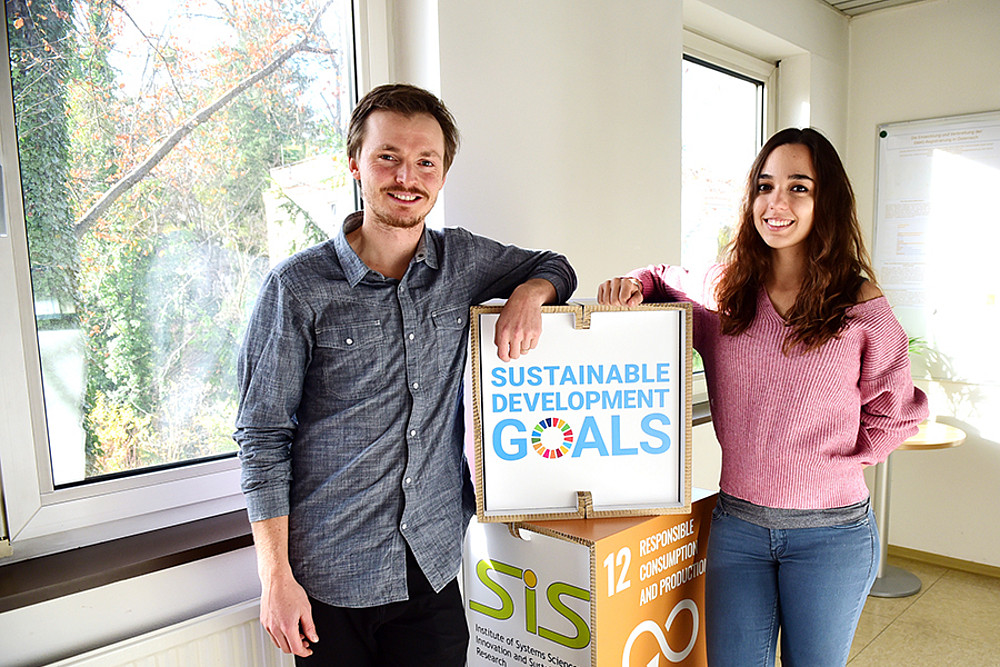
Tomas Santa Maria Gonzalez und Anna Diaz Tena research at the University of Graz, as holders of a scholarship of the international PhD network “Circular Economy: Sustainability implications and guiding progress (CRESTING)”. Photo: Uni Graz/Pichler

Tomas Santa Maria Gonzalez und Anna Diaz Tena research at the University of Graz, as holders of a scholarship of the international PhD network “Circular Economy: Sustainability implications and guiding progress (CRESTING)”. Photo: Uni Graz/Pichler

Research on the Circular Economy is making the University of Graz internationally attractive

Anna is Spanish, Tomas is from Chile. Both are researching for their doctoral thesis at the University of Graz on issues related to the concept of the Circular Economy. This is of great interest if we want to reduce greenhouse gas emissions. Their goal: to find ways to use resources as efficiently as possible and minimise waste. As scholarship holders of the EU-funded international PhD network “Circular Economy: Sustainability implications and guiding progress (CRESTING)” Anna Diaz Tena and Tomas Santa Maria Gonzalez have chosen the University of Graz because of its excellent research environment.

Helping to make decisions about sustainable product design
Reuse, repair, recycle – there are different strategies to save resources. Which should a company choose when designing its products? Should they be designed to last as long as possible or should they be easy to recycle? At present, companies have no way to assess up front which of their strategies would have the most beneficial environmental and social impact. Anna Diaz Tena wants to use her research to lay the foundations to develop such an evaluation tool that could serve as a decision-making aid for companies.
Conventional analysis tools such as the “Life Cycle Assessment” seem unsuitable for this purpose. “One problem is that they require a large amount of data that is not available before the development process begins,” Anna explains. For her doctoral thesis she interviewed product designers from the automotive, aerospace and electronics industries to identify problems in the process of developing sustainable products. These could be, for example, the emissions and raw materials associated with production, or aspects such as fair wages and child labour.

Support in the innovation process
Every company that wants to be part of the Circular Economy must be innovative in how it develops its business model. Along the way, they face challenges that all companies must deal with. These challenges are what Tomas is examining as part of his doctoral thesis. His research results should contribute to a better understanding of the innovation process and lead to the development of guidelines that help companies in this process.
There are many ways to implement the principles of the circular economy. For example, IKEA takes back old furniture, renovates it and sells it again at a lower price. Philips, on the other hand, relies on a product-service system. The company supplies the Amsterdam Schiphol airport with lighting. The airport pays for a service. To get the most out of the business, Philips uses durable, energy-saving components.
Tomas Santa Maria Gonzalez has used companies in the textile, furniture, electronics and recycling sectors for his case studies and has collected detailed information on the innovation process and its economic, social and environmental consequences. “There is a lot of literature on innovative business models that follow the principles of the circular economy. However, what path they need to take to get there has hardly been investigated yet”, Tomas points to a gap in the research and at the same time to the importance of his work. He is putting his knowledge to practice during an internship at Saubermacher, where he is supporting the refinement of an innovative Circular Business Model the company is about to lunch into the market.

Anna and Tomas are being supported in their research by Rupert Baumgartner at the Institute of Systems Sciences, Innovation and Sustainability Research. He is head of the Christian Doppler Laboratory for Sustainable Product Management enabling a Circular Economy, which offers them great research synergy opportunities.

>> more information about the PhD network CRESTING

created by Gudrun Pichler

Related news

Semester abroad without barriers: University of Graz wins award for promoting inclusion

The University of Graz has been awarded the Internationalization Award for its new inclusion initiative. Students with fewer opportunities now also receive financial support for their semester abroad outside Europe.

Fair distribution: Researchers determine just greenhouse gas budgets for all EU regions

Ten years ago, on 12 December 2015, the Paris Climate Agreement was signed at the UN Climate Conference. In order to limit global warming to well below two degrees, only a certain amount of CO2 may be emitted worldwide. While the focus was originally on national emission targets, more than 200 subnational regions and almost 300 cities have now adopted their own targets. But how many emissions are they fairly entitled to? Researchers at the University of Graz have now developed transparent criteria for fair distribution at the subnational level for the first time and determined corresponding greenhouse gas budgets for all European regions. The paper was published today in the scientific journal Nature Communications.

Chemical Christmas show at the University of Graz: An explosive evening at the Schauspielh

At the beginning of December, the University of Graz transformed the theater into a laboratory: as part of “Chemical Life,” teacher training students staged a chemical Christmas show for Styrian school classes—complete with ethanol rockets, nitrogen snow, and glowing effects. An evening designed to inspire interest in studying chemistry.

Train by train: Koralm railway accelerates exchange between the Universities

Lectures at the University of Klagenfurt in the morning, seminars at the University of Graz in the afternoon: Austria's longest tunnel and a journey time of around 45 minutes make it easy. The Koralm railway increases the speed of networking between the two university locations. The collaboration builds on existing cooperation - for example in the areas of teacher training, Slavic studies and as employers, the universities are well coordinated.

Begin of page section:
Additional information:

University of Graz
Universitaetsplatz 3
8010 Graz
Austria
  • Contact
  • Web Editors
  • Moodle
  • UNIGRAZonline
  • Imprint
  • Data Protection Declaration
  • Accessibility Declaration
Weatherstation
Uni Graz

End of this page section. Go to overview of page sections

End of this page section. Go to overview of page sections

Begin of page section:

End of this page section. Go to overview of page sections