Begin of page section:
Page sections:

  • Go to contents (Accesskey 1)
  • Go to position marker (Accesskey 2)
  • Go to main navigation (Accesskey 3)
  • Go to sub navigation (Accesskey 4)
  • Go to additional information (Accesskey 5)
  • Go to page settings (user/language) (Accesskey 8)
  • Go to search (Accesskey 9)

End of this page section. Go to overview of page sections

Begin of page section:
Page settings:

English en
Deutsch de
Search
Login

End of this page section. Go to overview of page sections

Begin of page section:
Search:

Search for details about Uni Graz
Close

End of this page section. Go to overview of page sections


Search

Begin of page section:
Main navigation:

Page navigation:

  • University

    University
    • About the University
    • Organisation
    • Faculties
    • Library
    • Working at University of Graz
    • Campus
    Developing solutions for the world of tomorrow - that is our mission. Our students and our researchers take on the great challenges of society and carry the knowledge out.
  • Research Profile

    Research Profile
    • Our Expertise
    • Research Questions
    • Research Portal
    • Promoting Research
    • Research Transfer
    • Ethics in Research
    Scientific excellence and the courage to break new ground. Research at the University of Graz creates the foundations for making the future worth living.
  • Studies

    Studies
    • Prospective Students
    • Students
  • Community

    Community
    • International
    • Location
    • Research and Business
    • Alumni
    The University of Graz is a hub for international research and brings together scientists and business experts. Moreover, it fosters the exchange and cooperation in study and teaching.
  • Spotlight
Topics
  • Our digital Advent calendar
  • Sustainable University
  • Researchers answer
  • Work for us
Close menu

End of this page section. Go to overview of page sections

Begin of page section:
You are here:

University of Graz News Teilchen für Teilchen

End of this page section. Go to overview of page sections

Friday, 03 March 2017

Teilchen für Teilchen

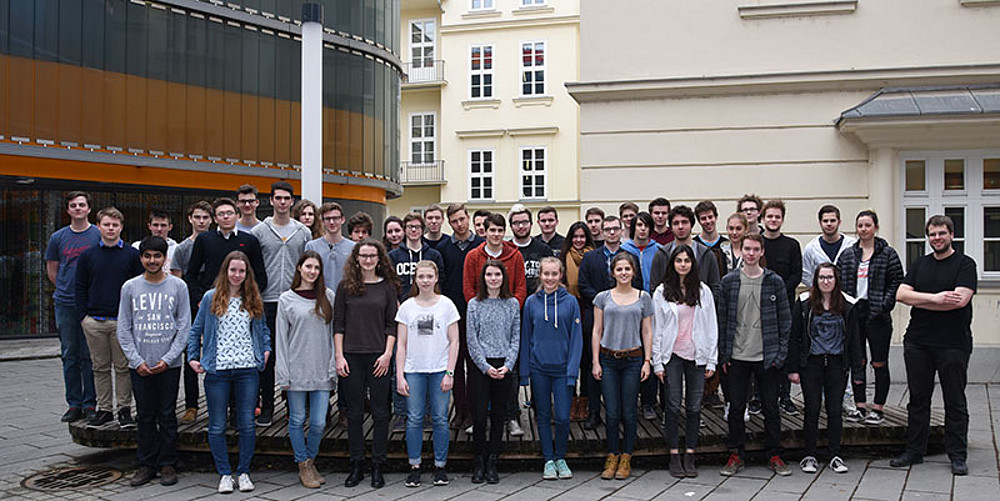
An der International Masterclass, die an der Uni Graz stattfand, nahmen 40 SchülerInnen aus der Steiermark und aus Salzburg teil. Fotos: Uni Graz/Kastrun.

An der International Masterclass, die an der Uni Graz stattfand, nahmen 40 SchülerInnen aus der Steiermark und aus Salzburg teil. Fotos: Uni Graz/Kastrun.

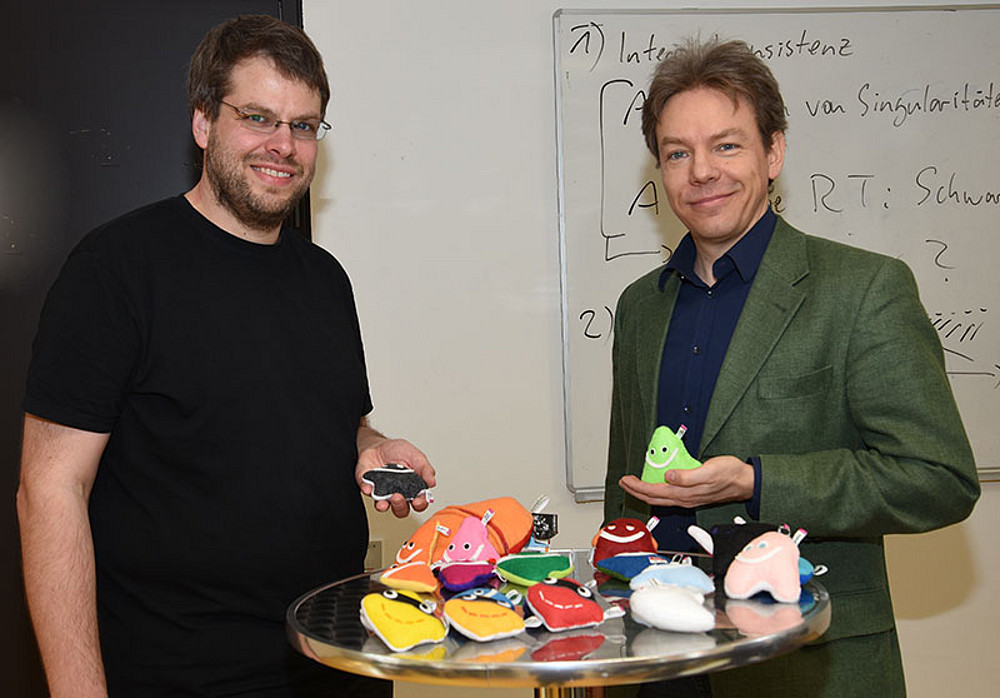
Axel Maas (l.) und Andreas Kassnigg demonstrierten anhand von flauschigen "Elementarteilchen" die Physik dahinter.

Axel Maas (l.) und Andreas Kassnigg demonstrierten anhand von flauschigen "Elementarteilchen" die Physik dahinter.

Uni Graz nahm am an weltweitem Physik-Programm für SchülerInnen teil

Jugendlichen Einblicke in moderne Forschungsmethoden geben und sie für Physik begeistern: Das ist das Ziel der International Masterclasses, die einmal jährlich auf der ganzen Welt stattfinden. Heuer öffnen 210 Universitäten und Forschungseinrichtungen in 52 Ländern vom 1. März bis zum 11. April 2017 ihre Türen. Die SchülerInnen können gemeinsam mit ForscherInnen Experimente durchführen und Daten analysieren, die vom Teilchenbeschleuniger „Large Hadron Collider“ (LHC) am CERN in Genf stammen. Das Institut für Physik der Karl-Franzens-Universität Graz war am Mittwoch, 1. März 2017, mit von der Partie und konnte 40 SchülerInnen aus der Steiermark und aus Salzburg begrüßen.

Seit der Entdeckung des Higgs-Bosons am CERN im Sommer 2012 ist das Interesse an der Teilchenphysik sehr groß. Daher liegt auch der Fokus des internationalen Programms, das sich an OberstufenschülerInnen richtet, auf diesem Thema. Im Rahmen der Vorträge gab Univ.-Prof. Dr. Axel Maas eine Einführung in die Teilchenphysik, Priv.-Doz. Dr. Andreas Krassnigg referierte zu Beschleunigern und Detektoren und Ao.Univ.-Prof. Dr. Wolfgang Schweiger widmet sich der Vorbereitung auf die praktische Arbeit. Die Hauptaufgabe der SchülerInnen war es, verschiedene Elementarteilchen, wie etwa das Z-Boson, oder das Higgs-Teilchen, in den vom ATLAS-Detektor stammenden Datensätzen aufzuspüren und deren Masse zu bestimmen. Dazu stand ihnen die für Lernzwecke adaptierte Originalsoftware zur Verfügung.

Abschließend tauschten sich die TeilnehmerInnen mittels Videokonferenz mit Gruppen aus London, Mailand, Kielce und Innsbruck sowie mit ForscherInnen am CERN aus und diskutieren ihre Messergebnisse. Die neu gewonnenen Kenntnisse konnte man abschließend in einem Quiz testen.

created by Wolfgang Schweiger & Gerhild Kastrun

Related news

Setback: Austria's greenhouse gas emissions rise in 2025

Climate protection is currently facing an uphill battle. The United Nations have recently been unable to agree on a roadmap for phasing out fossil fuels, even though global warming continues to accelerate. Also Austria still does not have a national climate law with a clear target path for reducing emissions. This is evidently taking its toll: Austria’s greenhouse gas emissions rose again in 2025 for the first time in years, by around two and a half percent, according to calculations by researchers at the University of Graz. In addition to overly cautious climate action measures, this is due to somewhat colder winter months compared to 2024, which are driving up natural gas consumption.

Profound: Geoscientist Marko Bermanec deciphers processes of the Earth's plates

What happens deep down is very important to us above ground. Especially when hidden chemical processes between tectonic plates have serious consequences. Earth scientist Marko Bermanec investigates these processes in depth.

Kink in the curve: Eleonore Faber researches the "fuzzy" parts of algebra

How can the movements of robotic arms be described using maths? And what does a computer need to understand in order to function? The magic word to answer these questions is algebra. Eleonore Faber has been a professor of this branch of mathematics at the University of Graz for two years. She is particularly interested in complex phenomena that cannot be fully understood using conventional rules or laws - where algebra becomes "fuzzy".

Jurist Jürgen Pirker erhält den Wissenschaftspreises der Margaretha Lupac-Stiftung

Wie kann der Staat nationale Minderheiten schützen? Wie kann er darauf achten, dass Mitglieder einer bestimmten ethnischen oder religiösen Gruppe nicht gezwungen werden, ihre persönlichen Freiheiten aufgrund dieser Zugehörigkeit aufzugeben? Und wie ging Österreich in den vergangenen 180 Jahren mit dieser Frage um?

Begin of page section:
Additional information:

University of Graz
Universitaetsplatz 3
8010 Graz
Austria
  • Contact
  • Web Editors
  • Moodle
  • UNIGRAZonline
  • Imprint
  • Data Protection Declaration
  • Accessibility Declaration
Weatherstation
Uni Graz

End of this page section. Go to overview of page sections

End of this page section. Go to overview of page sections

Begin of page section:

End of this page section. Go to overview of page sections