Begin of page section:
Page sections:

  • Go to contents (Accesskey 1)
  • Go to position marker (Accesskey 2)
  • Go to main navigation (Accesskey 3)
  • Go to sub navigation (Accesskey 4)
  • Go to additional information (Accesskey 5)
  • Go to page settings (user/language) (Accesskey 8)
  • Go to search (Accesskey 9)

End of this page section. Go to overview of page sections

Begin of page section:
Page settings:

English en
Deutsch de
Search
Login

End of this page section. Go to overview of page sections

Begin of page section:
Search:

Search for details about Uni Graz
Close

End of this page section. Go to overview of page sections


Search

Begin of page section:
Main navigation:

Page navigation:

  • University

    University
    • About the University
    • Organisation
    • Faculties
    • Library
    • Working at University of Graz
    • Campus
    Developing solutions for the world of tomorrow - that is our mission. Our students and our researchers take on the great challenges of society and carry the knowledge out.
  • Research Profile

    Research Profile
    • Our Expertise
    • Research Questions
    • Research Portal
    • Promoting Research
    • Research Transfer
    • Ethics in Research
    Scientific excellence and the courage to break new ground. Research at the University of Graz creates the foundations for making the future worth living.
  • Studies

    Studies
    • Prospective Students
    • Students
    • Welcome Weeks for First Year Students
  • Community

    Community
    • International
    • Location
    • Research and Business
    • Alumni
    The University of Graz is a hub for international research and brings together scientists and business experts. Moreover, it fosters the exchange and cooperation in study and teaching.
  • Spotlight
Topics
  • Sustainable University
  • Researchers answer
  • Work for us
Close menu

End of this page section. Go to overview of page sections

Begin of page section:
You are here:

University of Graz News Strong research impetus: 16 million euros for Circular Bioengineering Excellence Cluster

End of this page section. Go to overview of page sections

Friday, 04 October 2024

Strong research impetus: 16 million euros for Circular Bioengineering Excellence Cluster

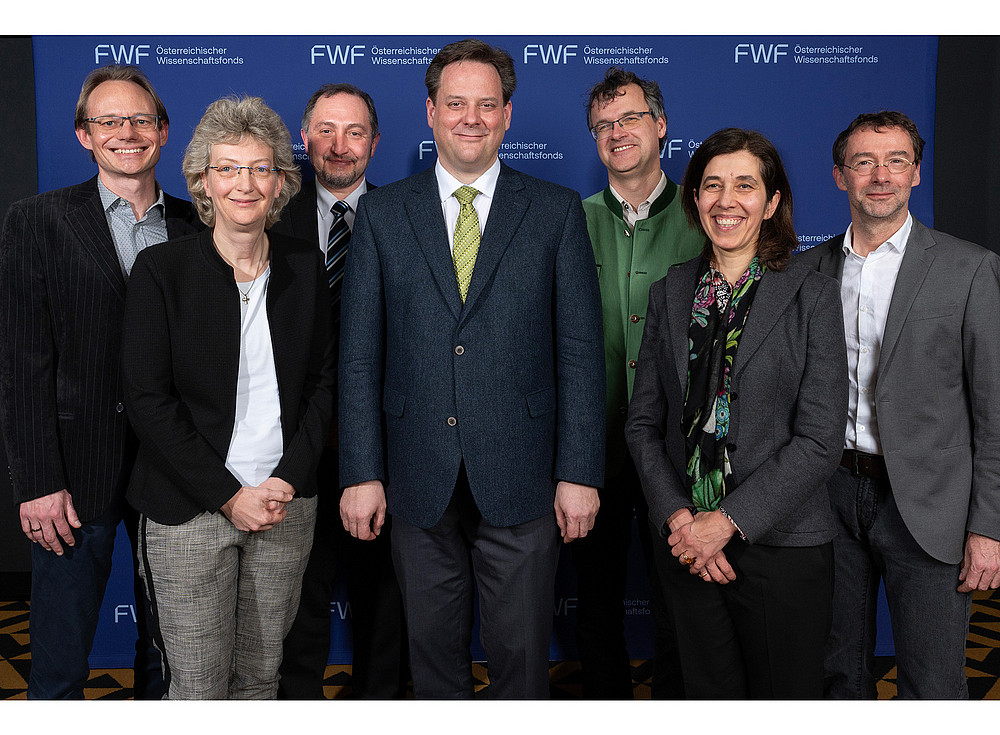
Group photo of the Board of Directors of the Cluster of Excellence Circular Bioengineering, with the FWF logo on the wall in the background ©FWF/Daniel Novotny

The Board of Directors of the Cluster of Excellence Circular Bioengineering (from left): Chris Oostenbrink and Antje Potthast (BOKU), Marko Mihovilovic (TU Vienna), Roland Ludwig (Director of Research, BOKU), Wolfgang Kroutil (University of Graz), Gunda Köllensperger (University of Vienna), Bernd Nidetzky (TU Graz). Photo: FWF/Daniel Novotny

The Cluster of Excellence Circular Bioengineering has today received a grant of 16 million euros from the Austrian Science Fund (FWF). This funding will support research into environmentally friendly bioprocesses and sustainable materials based on renewable raw materials over the next five years. This will provide significant impetus for the transition to a circular bioeconomy. Around 100 researchers from the University of Graz, Graz University of Technology, the University of Vienna and Vienna University of Technology are working together on an interdisciplinary basis under the leadership of BOKU University in the project, which has a total volume of 27 million euros.

"Participation in the Cluster of Excellence Circular Bioengineering is proof of the scientific expertise and excellent networking of our scientists in the international research community. It also encourages us on our path towards becoming a sustainable university in all areas, from teaching and administration to research. In doing so, we are taking responsibility for the future," says Peter Riedler, Rector of the University of Graz.

"The research activities in the field of circular economy at the University of Graz have already brought numerous successes. The Cluster of Excellence Circular Bioengineering now puts us in a position to further expand our research in this area and to inspire a new generation of researchers for the topic," affirms Joachim Reidl, Vice-Rector for Research at the University of Graz.

"We are very pleased about this funding commitment! It enables us to pursue new innovative research paths and further intensify our cooperation with other universities in Austria. Our aim is to develop ways of converting renewable raw materials into specific products or medicines and how substances can be returned to a material cycle after use in an environmentally friendly way," emphasises chemist Wolfgang Kroutil. He will be involved in the Circular Bioengineering Cluster of Excellence together with chemists Katalin Barta Weissert and Mélanie Hall and environmental sociologist Hermine Mitter from the University of Graz. On the Board of Directors, he is responsible for the sub-topic "Biocatalysis and Sustainable Production Pathways".

Further information on the Cluster of Excellence Circular Bioengineering

BOKU University

Information by the FWF

created by Linde Tuscher

Related news

PFAS: Uni-Graz-Studie zeigt, dass Verbote von Ewigkeitschemikalien wirken

Forschende der Universität Graz zeigen: PFAS-Verbote senken die Belastung in der Natur nachweislich. Doch die Industrie weicht auf andere Verbindungen aus, die für Menschen ebenso gefährlich sind.

Neues Kapitel für das Graz Center of Physics: Fachwerkteile angeliefert

Architektonischer Meilenstein für das künftige Grazer Physik-Center: Die ersten Fachwerkteile wurden angeliefert und mit dem Kran auf die richtige Stelle im ersten Obergeschoß platziert. Bis Mai folgen 33 weitere Lkw-Transporte und bringen insgesamt 64 Stück. In Summe werden so 16 große Stahlfachwerke vor Ort zusammengeschraubt. Die acht Meter hohen und teilweise bis zu 30 Meter langen Fachwerke geben dem ganzen Gebäude eine notwendige Stabilität und dienen der Lastabtragung der oberen Geschoße.

New groundbreaking computation method for climate extremes

How much will heat, flooding, drought and storms increase as a result of human-induced climate change? In a groundbreaking study, climate researcher Gottfried Kirchengast and his team at the University of Graz have developed a new method for computing the hazards from extreme events: it can compute all relevant hazard metrics for events such as heat waves, floods and droughts in any region worldwide with unprecedented information content. Using it for Europe, the researchers found that anthropogenic climate change has caused a tenfold increase in extreme heat in recent decades. The study, published in the journal Weather and Climate Extremes, also provides a basis for better quantifying the damage to people, ecosystems and infrastructure.

How Wikipedia and open source are changing the world

From ancient irrigation systems to Wikipedia: common goods have shaped our society for thousands of years. Richard Sturn, professor of economics at the University of Graz, explains why common goods or commons such as open-source software do not work without clear rules and what balance between openness and structure is crucial.

Begin of page section:
Additional information:

University of Graz
Universitaetsplatz 3
8010 Graz
Austria
  • Contact
  • Web Editors
  • Moodle
  • UNIGRAZonline
  • Imprint
  • Data Protection Declaration
  • Accessibility Declaration
Weatherstation
Uni Graz

End of this page section. Go to overview of page sections

End of this page section. Go to overview of page sections

Begin of page section:

End of this page section. Go to overview of page sections