



Begin of page section:
Page sections:

  • Go to contents (Accesskey 1)
  • Go to position marker (Accesskey 2)
  • Go to main navigation (Accesskey 3)
  • Go to sub navigation (Accesskey 4)
  • Go to additional information (Accesskey 5)
  • Go to page settings (user/language) (Accesskey 8)
  • Go to search (Accesskey 9)

End of this page section. Go to overview of page sections

Begin of page section:
Page settings:

English en
Deutsch de
Search
Login

End of this page section. Go to overview of page sections

Begin of page section:
Search:

Search for details about Uni Graz
Close

End of this page section. Go to overview of page sections


Search

Begin of page section:
Main navigation:

Page navigation:

  • University

    University
    • About the University
    • Organisation
    • Faculties
    • Library
    • Working at University of Graz
    • Campus
    Developing solutions for the world of tomorrow - that is our mission. Our students and our researchers take on the great challenges of society and carry the knowledge out.
  • Research Profile

    Research Profile
    • Our Expertise
    • Research Questions
    • Research Portal
    • Promoting Research
    • Research Transfer
    • Ethics in Research
    • Commission for Scientific Integrity
    Scientific excellence and the courage to break new ground. Research at the University of Graz creates the foundations for making the future worth living.
  • Studies

    Studies
    • Prospective Students
    • Students
  • Community

    Community
    • International
    • Location
    • Research and Business
    • Alumni
    The University of Graz is a hub for international research and brings together scientists and business experts. Moreover, it fosters the exchange and cooperation in study and teaching.
  • Spotlight
Topics
  • Sustainable University
  • Researchers answer
  • Work for us
Close menu

End of this page section. Go to overview of page sections

Begin of page section:
You are here:

University of Graz News Study shows: more heavy rain due to global warming

End of this page section. Go to overview of page sections

Tuesday, 11 March 2025

Study shows: more heavy rain due to global warming

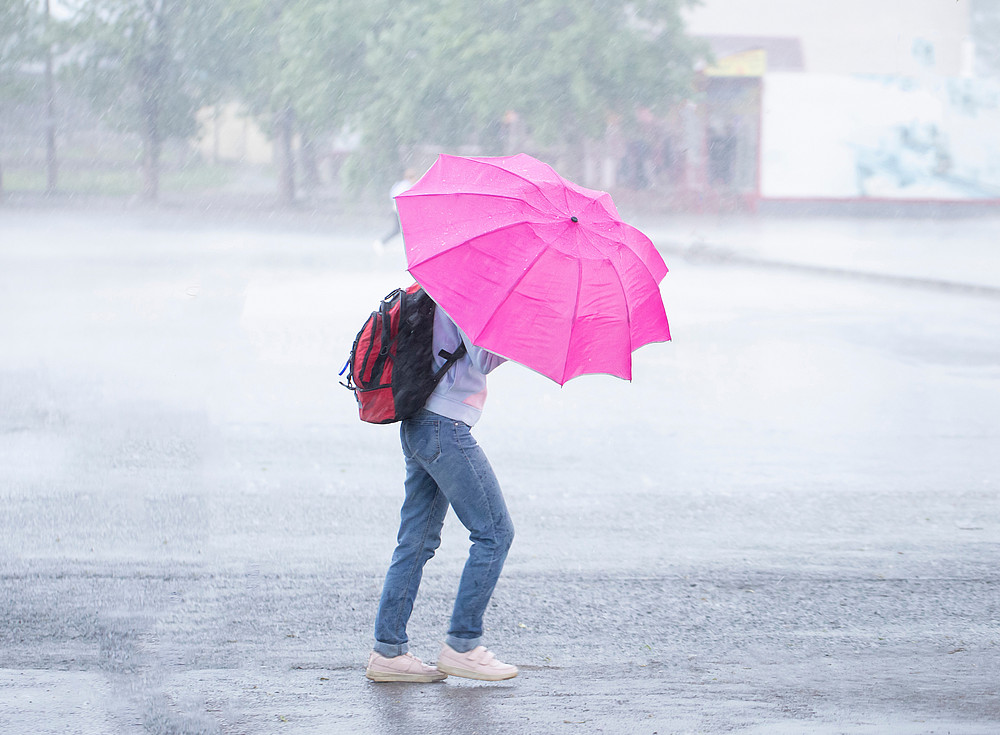
Storm, heavy rain in the city. People in the rain with an umbrella.

There has been a demonstrable increase in heavy rainfall events in Austria. Photo: Adobe Stock, Potashev Alex

A new study has confirmed for the first time that heavy rainfall events in Austria have become more intense. A team of researchers from Geosphere Austria, the University of Graz, the Vienna University of Technology and the Federal Ministry of Agriculture and Forestry was able to prove that the amount of rain falling within one day during extreme events has increased by 8 percent over the last 40 years and that these events bring 15 percent more rain than before.

Many events and studies in recent years have suggested an increase in heavy rainfall and the associated flooding. However, reliable evaluations of extreme amounts of rain within a short period of time, for example hourly rainfall, have been hampered by measurement uncertainties and limitations in data availability. A study by GeoSphere Austria, the Vienna University of Technology, the Federal Ministry of Agriculture, Forestry, Regions and Water Management, and the University of Graz now shows for the first time with robust measurement data that short-term heavy rainfall events have increased significantly in recent decades and that the figures also correspond to the increase in flood events.

In the study published in the journal Nature, data from two independent Austrian monitoring networks (GeoSphere Austria and the Hydrographic Service) with a total of 883 stations were analysed for the period from 1900 to 2023.

Climate change brings more heavy rain

Data from 1950 onwards was used to analyse hourly rainfall, as no usable hourly data is available from before that time. "From 1950 to 1980, the hourly values of heavy rainfall show no trend. In the 40 years from 1980 to the present, heavy rainfall increased by around 15 per cent," says Klaus Haslinger of GeoSphere Austria, lead author of the study. "To put it more precisely: an average heavy rainfall event in the period 2003 to 2023 brought 15 per cent more water than an average heavy rainfall event in the period 1950 to 1970."

The results are similar for all regions of Austria and are consistent with studies from other European countries, as well as India, Australia and the USA. "This shows that global warming is primarily responsible for the increase in hourly heavy rainfall," says climate researcher Haslinger, "according to a physical law defined by the Clausius-Clapeyron equation, for every degree of warming, air can absorb around seven percent more water vapour. Over the last 40 years, Austria has experienced a warming of around two degrees, which thus corresponds almost exactly to the 15 per cent increase in heavy rainfall measured at the stations."

North-south differences in rainy days

The very different development of heavy precipitation over the course of a day between the north and south of Austria is striking. A significantly greater long-term fluctuation (over decades) in the north compared to the south very clearly indicates different weather conditions that cause these extreme events. This is consistent with the experiences in the south of Austria, where low-pressure weather systems from the Adriatic region are particularly relevant for precipitation and westerly weather systems often only reach northern Styria.

“The smaller fluctuation of the percentage changes in southern Austria and thus also in Styria should not obscure the fact that in the south, the absolute values of heavy precipitation are already very high and thus make this region a hotspot for heavy precipitation and thunderstorms in Austria,” says climate researcher Wolfgang Schöner from the University of Graz. The study's surprising finding is that, on an hourly basis and at a small-scale level, heavy precipitation is developing very uniformly throughout Austria and is driven by temperature change rather than weather conditions.

Floods

Another focus of the study was on changes in flood events. This area was mainly worked on by the team from the Vienna University of Technology. In summary, it can be said that the changes in daily amounts of heavy rain correlate well with changes in flood events with large catchment areas. The increase in hourly amounts of heavy rain correlates with the increase in small-scale flood events (+24 per cent in the last 40 years).

The data and results of the study are also being incorporated directly into the recently launched research project "Water in a Changing Climate – Our Water Management 2050+", a collaboration between the TU Vienna, the Federal Ministry of Agriculture, Regions and Water Management (BML), GeoSphere Austria and the University of Graz.

Publication details

Increasing hourly heavy rainfall in Austria reflected in flood changes. Klaus Haslinger, Korbinian Breinl, Lovrenc Pavlin, Georg Pistotnik, Miriam Bertola, Marc Olefs, Marion Greilinger, Wolfgang Schöner & Günter Blöschl Nature 12.05.2025

Note

If you want to learn how the actions of our society affect nature, climate and our livelihoods, you can study Environmental Systems Science at the University of Graz.

Related news

Long Night of Research: How many languages are there in the world?

From a linguistic perspective, there are worlds of difference between Bern, Berlin and Vienna. A dialect impersonator will demonstrate live just how varied German can sound. How many languages are there in the world? What are their distinctive features? Which of these are spoken in Austria? These and other questions will be answered during the Long Night of Research at the University of Graz: on Friday, 24 April 2025, from 5 pm to 11 pm, in the University Library. Visitors can immerse themselves in the diversity of languages without travelling far by taking part in a quiz at the station.

Dual role: Researchers show that platelets can worsen disease

Platelets are best known as rapid responders in the event of injury. They stop bleeding and are indispensable for wound healing. “However, thrombocytes can also aggravate diseases, especially when inflammatory processes are involved,” explains Marion Mußbacher, a pharmacist at the University of Graz. She investigated the “dual role” of platelets in relation to fatty liver disease, a condition closely linked to obesity and type 2 diabetes.

Forscher:innen entdecken natürlichen Wirkstoff zum Schutz vor Lebererkrankungen

Die Leber leidet still. „Fetteinlagerungen, strukturelle Zerstörung des Gewebes oder mutierende Tumorzellen – all das fliegt eine Weile unter dem Radar. Begleitet werden diese Veränderungen oft von leichten, jedoch chronischen Entzündungen“, erklärt Andreas Koeberle, Pharmazeut an der Universität Graz. Er hat mit seinem Team und Kolleg:innen der Universität Innsbruck den Wirkstoff Mitrephoron B untersucht, der neue Behandlungsansätze ermöglicht. Die Ergebnisse der Studie wurden kürzlich in der Open-Access-Fachzeitschrift „Theranostics“ veröffentlicht.

Climate at the cliffs: Researchers unravel the evolution of the Greenland ice margin

Vertical ice walls, up to 40 metres high: in "Game of Thrones" they were dramatised as fortifications; during the Cold War, they were studied with great interest. How these imposing walls along Greenland’s 80,000-kilometre-long ice margin formed, how they are evolving, and what impact they have on the climate is not yet fully understood. Researchers from the Universities of Graz and Innsbruck have come one step closer to solving the mystery. The results of their latest study have been published in the journal The Cryosphere.

Begin of page section:
Additional information:

University of Graz
Universitaetsplatz 3
8010 Graz
Austria
  • Contact
  • Web Editors
  • Moodle
  • UNIGRAZonline
  • Imprint
  • Data Protection Declaration
  • Accessibility Declaration
Weatherstation
Uni Graz

End of this page section. Go to overview of page sections

End of this page section. Go to overview of page sections

Begin of page section:

End of this page section. Go to overview of page sections