Begin of page section:
Page sections:

  • Go to contents (Accesskey 1)
  • Go to position marker (Accesskey 2)
  • Go to main navigation (Accesskey 3)
  • Go to sub navigation (Accesskey 4)
  • Go to additional information (Accesskey 5)
  • Go to page settings (user/language) (Accesskey 8)
  • Go to search (Accesskey 9)

End of this page section. Go to overview of page sections

Begin of page section:
Page settings:

English en
Deutsch de
Search
Login

End of this page section. Go to overview of page sections

Begin of page section:
Search:

Search for details about Uni Graz
Close

End of this page section. Go to overview of page sections


Search

Begin of page section:
Main navigation:

Page navigation:

  • University

    University
    • About the University
    • Organisation
    • Faculties
    • Library
    • Working at University of Graz
    • Campus
    Developing solutions for the world of tomorrow - that is our mission. Our students and our researchers take on the great challenges of society and carry the knowledge out.
  • Research Profile

    Research Profile
    • Our Expertise
    • Research Questions
    • Research Portal
    • Promoting Research
    • Research Transfer
    • Ethics in Research
    Scientific excellence and the courage to break new ground. Research at the University of Graz creates the foundations for making the future worth living.
  • Studies

    Studies
    • Prospective Students
    • Students
  • Community

    Community
    • International
    • Location
    • Research and Business
    • Alumni
    The University of Graz is a hub for international research and brings together scientists and business experts. Moreover, it fosters the exchange and cooperation in study and teaching.
  • Spotlight
Topics
  • Our digital Advent calendar
  • Sustainable University
  • Researchers answer
  • Work for us
Close menu

End of this page section. Go to overview of page sections

Begin of page section:
You are here:

University of Graz News Lernen intensiv

End of this page section. Go to overview of page sections

Monday, 16 April 2018

Lernen intensiv

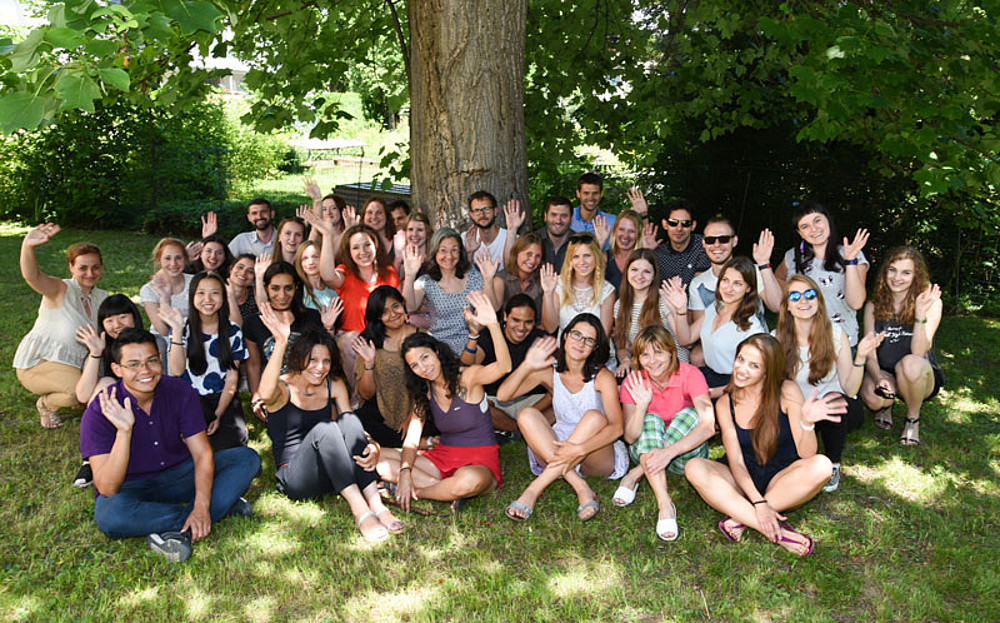
Der Sommerkurs Sprache-Kultur-Literatur ist ein Highlight im Unisommer. Im vergangenen Jahr feierte er zehn Jahre. Foto: Uni Graz/Tzivanopoulos ©Uni Graz/Tzivanopoulos

Der Sommerkurs Sprache-Kultur-Literatur ist ein Highlight im Unisommer. Im vergangenen Jahr feierte er zehn Jahre. Foto: Uni Graz/Tzivanopoulos

Sommerintensivkurs Deutsche Sprache-Kultur-Literatur vom 8. bis 28. Juli 2018. Bewerbung noch bis 4. Mai

Der Sommerintensivkurs „Deutsche Sprache-Kultur-Literatur“ führt jedes Jahr junge Studierende aus Süd-Ost-Europa in die Steiermark. In diesem Jahr geht er in die elfte Runde. In drei Modulen lernen die TeilnehmerInnen viel Wertvolles über Österreich, über Sprachvermittlung, Landes- und Kulturkunde sowie über die Österreichische Literatur nach 1945. Außerdem gibt es wieder ein abwechslungsreiches Rahmenprogramm; die TeilnehmerInnen lernen das ORF-Funkhaus näher kennen oder bereisen die Bundeshauptstadt Wien.

Heuer findet der dreiwöchige Intensivkurs von 8. bis 28. Juli statt, Veranstalter ist treffpunkt sprachen in Kooperation mit dem Bundesministerium für Wissenschaft, Forschung und Wirtschaft.

Bewerbungen - Formular, Lebenslauf und Motivationsschreiben - müssen bis spätestens 4. Mai 2018 eingereicht werden. Alle Informationen dazu unter https://treffpunktsprachen.uni-graz.at/de/lehre/deutsch-als-fremdsprache/sprache-kultur-literatur/

„Mit dem Ziel, durch die Vermittlung der Sprache und der Bearbeitung landeskundlicher und literaturwissenschaftlicher Themen einen Beitrag zur Völkerverständigung zu leisten, ist der dreiwöchige Sommerintensivkurs eine ausgezeichnete Möglichkeit, persönliche Begegnungen zu schaffen und den kulturellen Austausch zu fördern“, sagt Dr. Daniela Unger-Ullmann, Leiterin von treffpunkt sprachen. Neben den Modulen, die von den Studierenden verpflichtend zu absolvieren sind und mit einem Zertifikat abgeschlossen werden, werden zusätzliche Veranstaltungen, wie zum Beispiel Lesungen, Festivals oder Theatervorstellungen, gemeinsam mit dem Organisations- und Lehrendenteam besucht, um den TeilnehmerInnen die österreichische Kultur näher zu bringen. „Diese Vorgehensweise hat eine zweifache Wirksamkeit“, so Unger-Ullmann. „Zum einen fühlen sich Studierende der Gastuniversität stärker verbunden, zum anderen berichten sie, sobald sie an ihre Heimatuniversität zurückgekehrt sind, über ihre guten Erfahrungen und fungieren im Idealfall als weltweite BotschafterInnen der Universität Graz.“

created by Konstantinos Tzivanopoulos

Related news

Rector Peter Riedler: Starting the year with confidence

In 2026, we will continue to work consistently on positioning the University of Graz as a relevant player in Europe, while at the same time focusing on a modern, sustainable and climate-friendly university campus. When new digital applications are rolled out in January, we will not only create a stable and secure IT environment, but also modern working and studying conditions for future generations. Peter Rielder, Rector of the University of Graz

Uni Vibes 2026: the campus festival that transcends borders again

On 29 May 2026, it's that time again: the University of Graz celebrates, dances and vibrates. The campus will become a stage for art, science and music.

Setback: Austria's greenhouse gas emissions rise in 2025

Climate protection is currently facing an uphill battle. The United Nations have recently been unable to agree on a roadmap for phasing out fossil fuels, even though global warming continues to accelerate. Also Austria still does not have a national climate law with a clear target path for reducing emissions. This is evidently taking its toll: Austria’s greenhouse gas emissions rose again in 2025 for the first time in years, by around two and a half percent, according to calculations by researchers at the University of Graz. In addition to overly cautious climate action measures, this is due to somewhat colder winter months compared to 2024, which are driving up natural gas consumption.

Profound: Geoscientist Marko Bermanec deciphers processes of the Earth's plates

What happens deep down is very important to us above ground. Especially when hidden chemical processes between tectonic plates have serious consequences. Earth scientist Marko Bermanec investigates these processes in depth.

Begin of page section:
Additional information:

University of Graz
Universitaetsplatz 3
8010 Graz
Austria
  • Contact
  • Web Editors
  • Moodle
  • UNIGRAZonline
  • Imprint
  • Data Protection Declaration
  • Accessibility Declaration
Weatherstation
Uni Graz

End of this page section. Go to overview of page sections

End of this page section. Go to overview of page sections

Begin of page section:

End of this page section. Go to overview of page sections