Begin of page section:
Page sections:

  • Go to contents (Accesskey 1)
  • Go to position marker (Accesskey 2)
  • Go to main navigation (Accesskey 3)
  • Go to sub navigation (Accesskey 4)
  • Go to additional information (Accesskey 5)
  • Go to page settings (user/language) (Accesskey 8)
  • Go to search (Accesskey 9)

End of this page section. Go to overview of page sections

Begin of page section:
Page settings:

English en
Deutsch de
Search
Login

End of this page section. Go to overview of page sections

Begin of page section:
Search:

Search for details about Uni Graz
Close

End of this page section. Go to overview of page sections


Search

Begin of page section:
Main navigation:

Page navigation:

  • University

    University
    • About the University
    • Organisation
    • Faculties
    • Library
    • Working at University of Graz
    • Campus
    Developing solutions for the world of tomorrow - that is our mission. Our students and our researchers take on the great challenges of society and carry the knowledge out.
  • Research Profile

    Research Profile
    • Our Expertise
    • Research Questions
    • Research Portal
    • Promoting Research
    • Research Transfer
    • Ethics in Research
    Scientific excellence and the courage to break new ground. Research at the University of Graz creates the foundations for making the future worth living.
  • Studies

    Studies
    • Prospective Students
    • Students
  • Community

    Community
    • International
    • Location
    • Research and Business
    • Alumni
    The University of Graz is a hub for international research and brings together scientists and business experts. Moreover, it fosters the exchange and cooperation in study and teaching.
  • Spotlight
Topics
  • Our digital Advent calendar
  • Sustainable University
  • Researchers answer
  • Work for us
Close menu

End of this page section. Go to overview of page sections

Begin of page section:
You are here:

University of Graz News Sonnenflecken

End of this page section. Go to overview of page sections

Monday, 29 January 2018

Sonnenflecken

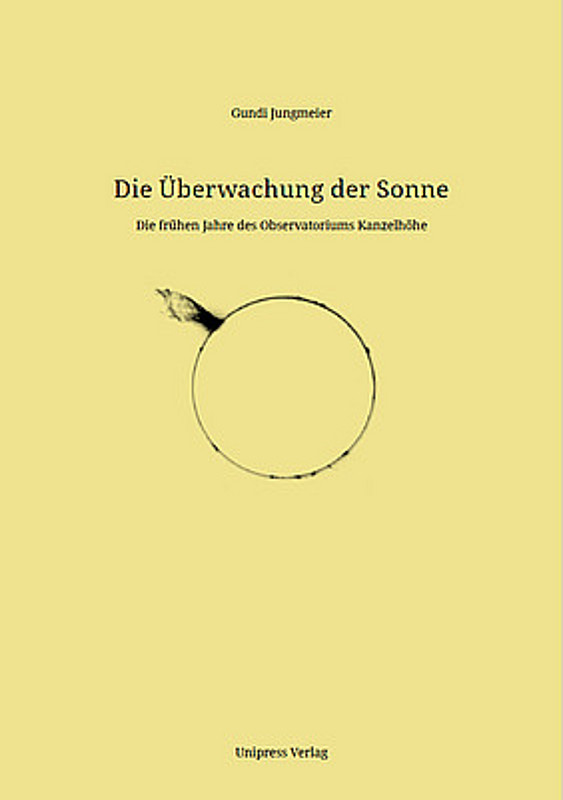
Neu erschienen: Die Sonnenflecken. Foto: Universitätsverlag

Neu erschienen: Die Sonnenflecken. Foto: Universitätsverlag

Neues Buch über die frühen Jahre des Observatoriums Kanzelhöhe im Univerlag erschienen

Kürzlich wurde an der Universität Graz das Buch „Die Überwachung der Sonne“ präsentiert, das Aufschluss über die Anfänge der Sonnenbeobachtung auf der Kanzelhöhe gibt. Die Autorin Gundi Jungmeier und die Leiterin des Observatoriums Astrid Veronigg (Institut für Physik) boten in ihren Vorträgen Einblick in die bewegte Geschichte dieser Forschungseinrichtung und ihre heutige Bedeutung.

Das Observatorium Kanzelhöhe für Sonnen- und Umweltforschung bei Villach wurde 1946 der Universität Graz angegliedert und zählt heute zu den weltweit wichtigsten Einrichtungen zur Erforschung und Dokumentation von Sonnenaktivitäten und des Weltraumwetters. In Betrieb genommen wurde es allerdings schon während des Zweiten Weltkriegs mit dem Ziel, für die deutsche Luftwaffe zuverlässige Vorhersagen der idealen Frequenzbänder für den Militärfunk zu erstellen, nachdem in den 1930er-Jahren festgestellt worden war, dass die Sonnenaktivität den Kurzwellenfunk beeinträchtigt.

Den Anstoß zur Erforschung der Gründungsgeschichte des Observatoriums gab das 70-Jahr-Jubiläum seiner Inbetriebnahme 2013. Das nun im Unipress Verlag erschienene Buch präsentiert in kompakter und gut lesbarer Form die Ergebnisse eines von Land Kärnten, Land Steiermark und der Universität Graz geförderten Forschungsprojekts.


Gundi Jungmeier: Die Überwachung der Sonne

Die frühen Jahre des Observatoriums Kanzelhöhe

Unipress Verlag, 2017

150 Seiten, broschiert

€ 21,90

ISBN: 978-3-902666-48-2


Nähere Infos unter: https://www.unipress-graz.com/ und https://universitaetsverlag.uni-gra.z.at


created by Christian Kaier & Konstantinos Tzivanopoulos

Related news

Chemical Christmas show at the University of Graz: An explosive evening at the Schauspielh

At the beginning of December, the University of Graz transformed the theater into a laboratory: as part of “Chemical Life,” teacher training students staged a chemical Christmas show for Styrian school classes—complete with ethanol rockets, nitrogen snow, and glowing effects. An evening designed to inspire interest in studying chemistry.

Train by train: Koralm railway accelerates exchange between the Universities

Lectures at the University of Klagenfurt in the morning, seminars at the University of Graz in the afternoon: Austria's longest tunnel and a journey time of around 45 minutes make it easy. The Koralm railway increases the speed of networking between the two university locations. The collaboration builds on existing cooperation - for example in the areas of teacher training, Slavic studies and as employers, the universities are well coordinated.

On the trail of the Big Bang: University of Graz receives 1.5 million euros for doctoral programmes

The Austrian Science Fund FWF has selected the Doctoral Programme in Theoretical Particle Physics at the University of Graz for funding from the Doc.funds. Six young scientists will be funded for 3.5 years. They will gain fundamentally new insights into the origins of the world.

From trans women and knee prostheses: sports science prizes awarded

Walking better with a prosthesis, successfully getting rid of excess weight, training more effectively, more fairness for trans people in sport: these were the topics addressed by the students at the University of Graz who were awarded the sports science prizes for their Master's theses on 3 December 2025.

Begin of page section:
Additional information:

University of Graz
Universitaetsplatz 3
8010 Graz
Austria
  • Contact
  • Web Editors
  • Moodle
  • UNIGRAZonline
  • Imprint
  • Data Protection Declaration
  • Accessibility Declaration
Weatherstation
Uni Graz

End of this page section. Go to overview of page sections

End of this page section. Go to overview of page sections

Begin of page section:

End of this page section. Go to overview of page sections